Warehouse-driven shrink wrapper specification in 2026 hinges on three controllable numbers: accepted packages per minute under the actual SKU mix, tunnel residence time at the chosen film gauge, and pallet-output stability downstream of the sealer [S2]. A continuous-motion side sealer with POF film is the default for high-volume frozen, cosmetic, and pharmaceutical lines, while a sleeve wrapper with PE film is the lower-cost fit for beverage multipacks and heavy corrugated bundles [S3][S1].
Buyers should anchor the requirement to net scheduled production time (shift duration minus breaks, planned changeovers, warm-up, and planned checks) rather than to a mechanical cycle figure, then size every stage to the lowest stable accepted rate in the constraint map [S2]. For most regional distribution centres, that means a side sealer rated 30-60 cycles/min mechanically, but commissioned to a sustainable 18-35 accepted packs/min after rejects, normal stops, and SKU-mix changeovers are included [S2].
Film Selection by Temperature and Product Class
Polyolefin (POF) film is the FDA-approved industry standard for direct-food-contact shrink packaging and retains physical integrity down to typical freezer storage temperatures, whereas PVC becomes brittle and cracks at sub-zero conditions and is therefore not recommended for frozen-food lines [S1]. Polyethylene (PE) shrink film is the heavier-gauge option typically specified for beverage multipacks, large corrugated trays, and pallet-style bundles where puncture resistance and higher shrink force matter more than retail clarity [S3].
For warehouse automation, the film decision also drives the heat profile: POF shrinks efficiently at 130-160 °C tunnel setpoints with short residence, while PE typically demands 160-200 °C and longer dwell to reach the same conformity, which in turn enlarges the tunnel footprint and the electrical load on the shrink wrapper [S1][S3]. Specifiers should match the shrink wrapping machine tunnel length to the longest pack dimension plus required airflow gap, and confirm the supplier's approved film-and-temperature matrix before committing to a configuration.
Machine Type Comparison Against Four Decision Criteria
Three machine formats dominate warehouse-bound shrink packaging: the L-bar sealer (manual or semi-automatic), the automatic side sealer (intermittent or continuous motion), and the sleeve wrapper paired with a separate shrink tunnel [S3][S4]. The four criteria that separate them in practice are sustainable accepted rate, film compatibility, labour intensity, and footprint per accepted pack.
An L-bar sealer typically delivers 4-8 accepted packs/min with a single operator and handles POF or low-gauge PE, suiting e-commerce dispatch, kit assembly, and low-SKU warehouses [S3]. A continuous-motion side sealer reaches 30-80 cycles/min mechanically and is the workhorse of food, cosmetic, and pharmaceutical lines, accepting POF and PE across a wide gauge range [S1][S3]. A sleeve wrapper sits in between for uniform rectangular products such as boxes, books, and printed goods, where it can match side-sealer throughput with lower film waste per pack [S3][S4].
Throughput Engineering: From Cycle Rate to Accepted Output
Sustainable throughput is measured as accepted packs over an elapsed run window that includes defined micro-stops, and is the only figure that should drive a warehouse line capacity decision [S2]. The mechanical cycle rate (cycles in a short, uninterrupted run) and the instantaneous package rate (observed while running) are useful for mechanism comparison and short-condition checks, but neither predicts shift output once changeovers, film splices, and reject clearing are counted [S2].
Operators should record, at the same product and run conditions, the stable accepted rate of each stage: product supply, loading or metering, film feed, sealing, tunnel, cooling and inspection, and downstream acceptance [S2]. The lowest demonstrated stable rate is the current line constraint, and adding capacity to a faster stage will not raise output until the limiting stage is also changed. Tunnel occupancy must be validated at the proposed pitch against airflow and product gap, because raising belt speed changes residence time and reducing the gap changes loading and air access, and neither effect is captured by a sealer cycle figure alone [S2].
Integration With Adjacent Warehouse Equipment
Modern warehouse automation treats the shrink wrapper as one node in a line that also includes case erectors, case sealers, strapping machines, and pallet wrappers, and the matching of physical and control interfaces across these nodes is what determines whether the line holds its rated accepted rate [S5]. The sealer, the wrapping machine downstream, and the palletizer must share a common conveyor height, a common pitch discipline, and a single reject-handling protocol, otherwise a faster sealer simply queues work into a starved palletizer.
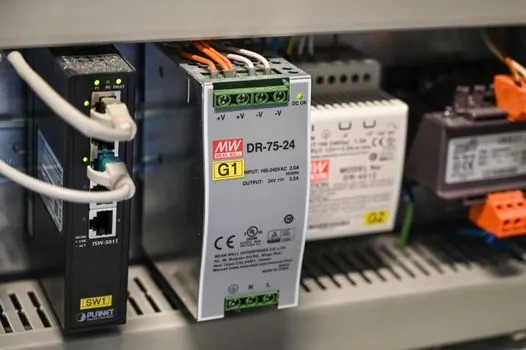
Where the line is controlled by a PLC or packaged electrical automation panel, the shrink wrapper's I/O map must expose sealer status, tunnel temperature, film-low, and reject signal to the upstream metering conveyor and the downstream case packer, so a micro-stop at the tunnel halts infeed before a queue builds and product is crushed. For ambient warehouse distribution, this integration is straightforward; for cold-chain or washdown environments, the panel specification (NEMA 4X or IP65 minimum) and cable jacket rating should be set before the sealer is ordered, not after.
Selection Gates and Failure Modes for Warehouse Specifiers
Five gates reliably filter the shortlist: (1) film-and-temperature compatibility with the actual SKU, validated at the supplier's test cell; (2) accepted-rate evidence at a representative product, not at a brochure product; (3) tunnel length and airflow matched to the longest pack plus gap; (4) control integration exposed and tested against the real upstream and downstream nodes; and (5) service footprint within the warehouse region, because mean-time-to-repair dominates total cost of ownership over a 10-year horizon [S1][S2][S5].
The most common buying mistakes are specifying a continuous-motion side sealer for a low-SKU warehouse that will run it at 20% utilisation, and specifying an L-bar sealer for a high-SKU frozen line where changeover and operator variability will crush accepted output [S1][S3]. Another recurring failure mode is pairing POF-rated tunnel setpoints with PE film to save film cost, which produces dog-ear seals, poor conformity, and excessive reject rates; the film, tunnel setpoint, and sealer profile must be specified as one locked combination [S1][S2]. For a deeper dive into cold-chain film and tunnel gates, see the related spec map on cold-chain shrink wrapper selection, which extends the temperature envelope discussed here to full sub-zero distribution.
Use-Case Mapping by Warehouse Profile
For a regional dry-goods distribution centre shipping 5,000-15,000 accepted packs per shift across mixed SKUs, an automatic side sealer with POF film and a single shrink tunnel is the default fit, and the line is typically anchored by a sleeve-wrapper branch for uniform boxes [S3][S4]. For a frozen-food 3PL running 20,000+ accepted packs per shift, a continuous-motion side sealer with POF, USDA-approved configuration, and CE compliance is the baseline, and a secondary bundling sealer is often added for club-pack multipacks [S1].
For an e-commerce fulfilment centre where pack dimensions vary widely and order volume is bursty, a semi-automatic L-bar sealer with POF film is the most cost-defensible choice, and the same coding machine and inspection stack can be shared across multiple sealer cells. For an automotive parts warehouse, the shrink wrapper is usually replaced or supplemented by a stretch wrapper at the palletizer, and the specifier should be explicit about which node owns unit-pack containment versus which owns pallet-load stability [S3].
Track the next two signals: published accepted-rate data (not cycle data) for continuous-motion side sealers on POF at sub-freezer temperatures, and revised NEMA/IP panel guidance for shrink-wrapper integration in washdown and cold-store warehouses. Either would materially change the warehouse spec map discussed here.