
A sight glass only stays leak-tight when the linear thermal expansion coefficient (CTE) of its disc, gaskets, and mating flanges is matched to the connected piping over the full operating range — a 10× difference in CTE between soda-lime glass (~9×10⁻⁶/°C) and borosilicate (~3.3×10⁻⁶/°C) is enough to shear a gasket or crack the disc across a single 200 °C heat-up [S3].
This article maps the interface layers that decide fit — disc material CTE, gasket compression recovery, flange-to-pipe alignment, and external expansion joint or expansion anchor placement — for process engineers specifying sight glasses on heated or cryogenic lines, with the comparison values drawn from low-expansion glass-ceramic research and current OEM mounting guidance.
CTE mismatch is the dominant failure driver on heated lines
Linear CTE values for common sight-disc glasses span roughly 3.3×10⁻⁶/°C for borosilicate to about 9×10⁻⁶/°C for soda-lime — a ~2.7× spread that produces millimetres of differential growth on a 100 mm bore across a 200 °C swing [S3]. Synthetic plagioclase-like glasses measured by Arndt & Häberle show CTE falling from 7.4×10⁻⁶/°C for albite glass to 4.9×10⁻⁶/°C near anorthite composition, confirming that composition alone can shift CTE by ~35% inside the silicate family [S3]. For a fixed sight glass mounted between carbon-steel pipe flanges (CTE ≈ 11.6×10⁻⁶/°C), the bore will always grow more slowly than the pipe — the disc ends up in compression, which is the desired direction for a sealed joint, but the steel flange must carry the entire differential strain without distorting the sealing face.
Low-thermal-expansion glass-ceramics such as the Schott zero-expansion and ultra-low-expansion families documented in the Bach (ed.) series for Schott Glaswerke push CTE close to 0×10⁻⁶/°C in the crystalline phase, at the cost of reduced optical transmission and higher density per unit volume, and they are specified precisely where the line-side temperature excursion exceeds the elastic limit of a borosilicate disc [S2]. Glass-ceramic discs are the default for steam drums, reformer headers, and boiler water-column applications where a single thermal cycle can push wall temperature through the borosilicate annealing range and then back down on shutdown.
Disc material vs operating temperature band
Three disc material families cover the bulk of industrial sight-glass service, and each is bounded by a combination of CTE, thermal-shock resistance, and maximum service temperature rather than by a single number. Soda-lime sight discs remain the cheapest option but are limited to roughly −20 °C to +150 °C continuous service with limited thermal cycling; borosilicate discs (e.g. DIN 7080 / 8902 patterns) extend the working range to about +280 °C continuous and thermal-shock differentials near 120 K, with CTE around 3.3×10⁻⁶/°C; fused quartz and low-expansion glass-ceramics cover the 300 °C to >500 °C band but at higher unit cost and with reduced impact resistance [S2]. Schott's low-thermal-expansion glass-ceramic development program, published in the 1995 Bach volume, is the technical basis for the disc materials still used in high-temperature sight assemblies today [S2].
Engineers should match disc selection to the worst-case wall temperature, not the bulk fluid temperature — wall temperature on a steam header can sit 30–80 K above line temperature during ramp-up, and that wall value is what the disc sees. Where the line is insulated, the disc housing also acts as a heat sink and the differential CTE strain on the gasket is concentrated at the inner rim; on uninsulated outdoor lines, the entire disc-to-flange stack follows ambient swings and the gasket must recover over a wider compression band.
Flange alignment, gasket stack, and expansion anchor placement
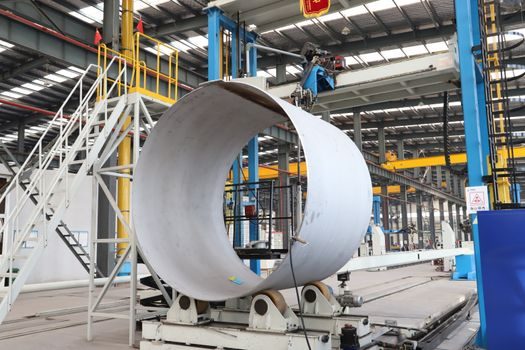
Mechanical fit of a sight glass to its mating pipe flange is governed by four interface layers: flange face finish (RA and flatness), bolt-load distribution, gasket type and compression recovery, and the position of the first pipe expansion anchor or guide relative to the glass body. Misalignment greater than 0.2 mm across the flange diameter on a 100 mm nominal sight glass will lift one side of the gasket into a point-load condition, and the resulting uneven compression is the most common cause of leak paths that reappear with every thermal cycle even when the static cold test holds pressure. [S4]
Gasket choice is a thermal-mechanical decision, not a chemical one. Compressed non-asbestos fibre gaskets tolerate temperatures to roughly 200 °C and recover well under cyclic load but creep under sustained bolt stress; graphite gaskets extend the service ceiling above 400 °C but have a lower recovery rate and demand higher bolt loads to maintain seal force. PTFE envelopes over compressed fibre give a wide chemical envelope but the PTFE softens near 200 °C and the underlying fibre takes the full mechanical load, which shortens cycle life on a heated line. Where the sight glass sits inside a pipe that grows more than ~25 mm between ambient and operating temperature, an expansion joint must be installed on one or both sides of the glass, and the first pipe guide must be placed within 1–2 pipe diameters of the glass body to keep bending moments off the sealing face.
Comparison of disc materials on the four decision criteria
For spec sheets and procurement, the four criteria that drive disc selection are: CTE (10⁻⁶/°C), continuous service temperature (°C), thermal-shock tolerance (K), and relative cost per disc. Soda-lime sits at ~9 CTE, ~150 °C continuous, ~50 K shock tolerance, lowest cost; borosilicate sits at ~3.3 CTE, ~280 °C continuous, ~120 K shock tolerance, mid cost; fused quartz drops CTE to ~0.5 with shock tolerance above 200 K but loses cost competitiveness; low-thermal-expansion glass-ceramic holds CTE near 0 and pushes continuous service above 500 °C at the highest cost per disc [S2][S3].
For a sight disc on a heated line, borosilicate is the default because the combination of low CTE, optical clarity, and shock tolerance covers most process service, with the trade-off that borosilite anneals near 560 °C and disc failure follows if the disc is ever flame-cleaned or impinged by hot gas above that point. Glass-ceramic discs are the correct choice where temperature is the binding constraint, and soda-lime stays in scope only on cooled, low-pressure, or sight-flow-indicator bodies where cost dominates.
Installation pitfalls that pass a datasheet check but fail on site
Three integration pitfalls catch out sight-glass installs even when the disc, gasket, and flange class are individually correct. First, mixed-material bolting — stainless studs on a carbon-steel flange — introduces a CTE-driven bolt-load change on the order of 5–8% across a 200 K swing, which is enough to drive a graphite gasket below its minimum seating stress on cooldown. Second, gasket re-use after a thermal cycle: graphite and non-asbestos gaskets that have been through a hot commissioning cycle and cooled to ambient do not recover their original thickness and will not re-seat to the same bolt torque; replace rather than re-torque. Third, pipe guide spacing around the sight glass: most sight-glass bodies are not designed to carry pipeline bending moments, and a guide placed more than 3–4 pipe diameters away converts axial pipe growth into a side load on the glass body that cracks the disc on the first heat-up. [S2]
For engineers comparing sight-glass assemblies on heated lines, the spec map for vibration meter selection follows similar trade-off logic: transducer body CTE, mounting surface prep, and cable routing each contribute to whether the instrument holds calibration across a thermal cycle. The same logic applies to infrared line level layout on outdoor tanks, where housing CTE and stand-off distance decide whether the optical path stays aligned through winter and summer — a useful parallel for non-contact sight-glass alternatives using optical glass windows and cameras.
Standards, sourcing, and what to verify on the data sheet
Sight-glass discs for pressure-vessel service are commonly supplied to DIN 7080 (borosilicate for high-temperature service), DIN 8902 (for low-temperature and chemical service), and ASME B16.5 / B16.34 flange classes for the body; the disc material is specified separately from the flange class, which is where most procurement errors originate. Request the disc material certificate, the batch CTE value (not just a generic material name), the annealing point, and the maximum recommended thermal-shock differential from the disc maker, and confirm with the gasket maker that the chosen gasket has been tested for the full operating temperature band, not just the design pressure. [S2]
Two trackable signals to watch over the next specification cycle: vendor publication of disc-specific CTE test values (rather than generic material CTE) on each shipping certificate, and gasket makers publishing compression-recovery curves for cyclic thermal service rather than only static pressure-temperature envelopes. Either signal would let a process engineer write a sight-glass specification that survives a real heat-up/cool-down profile, not just a static pressure test.