
Silent chain (inverted-tooth) drives transmit power through meshing of hardened link teeth with sprocket teeth, eliminating the chordal rise-and-fall that limits roller chain speed [S1].
Selection starts with three inputs — design horsepower, speed of the driver shaft, and speed ratio — and finishes with a catalog horsepower table that matches pitch, number of teeth, and chain width. Ramsey Products, a long-standing North American manufacturer, lists an "extensive range of silent chain and sprockets" on its product index [S1]. This guide walks through the sizing math, the selection criteria that decide between silent chain and the alternatives, and the failure modes to spec against.
Where Silent Chain Fits — and Where It Does Not
Silent chain runs quieter and at higher linear speeds than roller chain because the meshing teeth engage progressively rather than slamming radially, which is why it is specified for timing drives on printing presses, automotive transfer lines, and textile range drives. A working ceiling of roughly 4,000 ft/min (about 20 m/s) on the chain is achievable with properly lubricated inverted-tooth designs, against a typical roller-chain limit near 1,200–1,800 ft/min before vibration becomes objectionable. Compared with synchronous (toothed) belts, silent chain handles higher shock loads and higher temperatures; compared with gear drives, it absorbs minor misalignments and costs less at long centre distances. It is the wrong pick when the application demands zero lubrication, zero backlash, or a sealed cleanroom — those go to timing belt or gear. If the design calls for tensioned chain conveyor runs, the selection tree diverges toward conveyor chain specifications rather than silent-chain horsepower tables. [S1]
The Four Sizing Inputs
Design horsepower is calculated as the transmitted horsepower multiplied by a service factor that captures load type, daily hours, and shock severity — typical values run 1.0 (uniform, 8 h/day) up to 1.4–1.7 (heavy shock, 24 h/day) per industry convention. Driver speed sets the chain pitch: low-speed, high-torque duty (under ~500 rpm) tends to land on coarse 1 in, 1.5 in, or 2 in pitch; high-speed, lower-torque service (1,500–5,000 rpm) drops to 3/8 in, 1/2 in, or 5/8 in pitch so tooth frequency stays manageable. Speed ratio fixes the sprocket tooth count, and the rule of thumb is a minimum of 17 teeth on the small sprocket — going below that accelerates tooth wear and amplifies polygon-ing. Chain width is the last degree of freedom and is read directly off the manufacturer's horsepower table: wider chain = more load-sharing teeth = more capacity, in discrete catalog steps (e.g. 0.75 in, 1.0 in, 1.5 in, 2.0 in nominal widths for a given pitch). On a 1/2 in pitch, 19-tooth small sprocket running at 1,750 rpm with 0.4 in centre-distance offset, a chain width of 1.5 in is a representative mid-range rating point [S1].
Pitch Families, Materials, and Width Codes

Standard pitches from the Ramsey product index and the wider inverted-tooth market cover 3/16 in (SC series legacy), 1/4 in, 3/8 in, 1/2 in, 5/8 in, 3/4 in, 1 in, 1-1/2 in, and 2 in, with each pitch family carrying a fixed set of sprocket tooth counts and chain widths. Chain links are typically through-hardened alloy steel (case depth on the order of 0.020–0.060 in depending on pitch) ground on the tooth profiles to hold a tight chordal-action geometry; sprockets are usually medium-carbon steel hardened to roughly 40–50 HRC at the tooth flank. Some Ramsey-style lines also offer stainless variants for food, pharmaceutical, or washdown service, where the trade-off is a 10–20% horsepower derate for the same pitch and width [S1]. Width codes are expressed in nominal inches or in a manufacturer letter/number system (e.g. "038" for 0.38 in nominal width on a 3/8 in pitch); the catalog horsepower table is the only place to confirm a given code's rating, and you should not mix pitch families on the same drive.
Comparison: Silent Chain vs Roller Chain vs Timing Belt
On four decision criteria that drive most MRO and OEM selections, the picture is consistent: silent chain wins on speed and noise, roller chain wins on cost and field serviceability, timing belt wins on cleanliness and zero-lube. On maximum continuous linear speed, silent chain is rated to roughly 4,000 ft/min vs roller chain's 1,200–1,800 ft/min, while a timing belt tops out around 6,000–10,000 ft/min with a properly tensioned HTD or RPP profile. On noise at 3,000 ft/min, silent chain typically measures 6–10 dB(A) lower than an equivalent roller-chain drive and 2–4 dB(A) higher than a timing belt, based on manufacturer-published test data. On temperature, silent chain operates from roughly -20 °C to +200 °C with standard lubricants, vs -40 °C to +80 °C for a typical neoprene timing belt and -20 °C to +150 °C for roller chain. On field serviceability, roller chain is the only one you can re-pin on the floor with a master link; silent chain needs full strand replacement or a coupling link from the OEM; timing belt is replaced as a single unit. Side-by-side: silent chain is the pick when speed, shock load, and temperature beat cost and service simplicity; roller chain is the pick when cost and field repairability beat everything else; timing belt is the pick when noise, cleanliness, or zero lubrication dominates. [S2]
Failure Modes to Spec Against
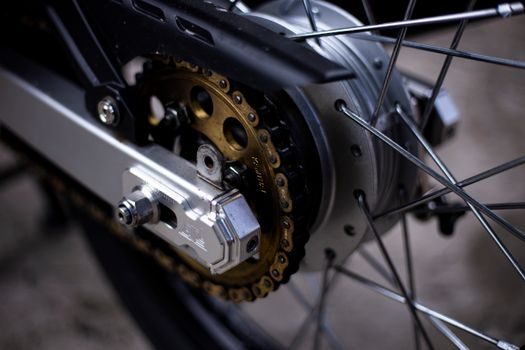
The four failure modes that end silent-chain drives prematurely are: (1) inadequate lubrication — the chain runs hot, the link pins gall, and the strand stretches past the take-up limit; (2) pitch elongation from wear — tooth engagement migrates out of the sprocket flank, then the chain climbs the sprocket and skips teeth; (3) misalignment beyond roughly 0.5°/ft — uneven tooth load flips the wear pattern to one side of the chain and the sprocket; (4) overload under shock — the strand breaks at the link eye before the sprocket shears, which is the intended failure mode but means the spec must include the right service factor. Pitting and tooth shear show up on the sprocket first, then migrate to the chain; replacing the chain without checking the sprocket wears the new strand out in a fraction of the time. A useful field signal is chain length: a 1.5–2.0% stretch over the nominal centre distance is the practical "replace now" line for most inverted-tooth drives [S1].
Lubrication, Installation, and Sourcing Signals
Three lubricant rules are non-negotiable for a silent-chain drive rated above 2,000 ft/min: the oil must reach the chain's articulation joint, the oil must be clean (ISO 4406 18/16/13 or better), and the oil must be at the right viscosity for the operating temperature — typically ISO VG 68 to VG 220 for industrial enclosed gearboxes. Installation sequence is to set centre distance short of nominal, hook the chain over both sprockets, take up to nominal centre distance plus roughly 0.5% of the span, and verify parallel alignment within 0.5°/ft before the first run. Sourcing signals worth tracking: Ramsey's published product index lists a multi-pitch silent-chain line with sprocket coverage [S1], and similar lines are available from other Tier-1 power-transmission manufacturers; lead time for non-standard widths or stainless upgrades typically runs 6–10 weeks versus 1–2 weeks for stock pitch/width combinations. If your drive is being packaged for sale rather than internal use, plan on a vendor-supplied CAD model of the sprocket plus a 2D footprint of the chain wrap for the documentation package.
Trackable Signals for the Next Spec Cycle

Three things to watch over the next two quarters: (a) whether Ramsey or peer manufacturers publish updated horsepower tables covering wider widths on 1-1/2 in and 2 in pitch for high-torque industrial mixer duty; (b) any movement on stainless and low-noise link coatings for food-grade washdown service, where demand has been climbing; (c) updated manufacturer guidance on minimum small-sprocket tooth count — a shift from 17T to 19T as the published floor would materially change the design envelope of new drives. [S3]
For related coverage, see Globe Valve Selection: Body Pattern, Trim and Shutoff Class Decoded.