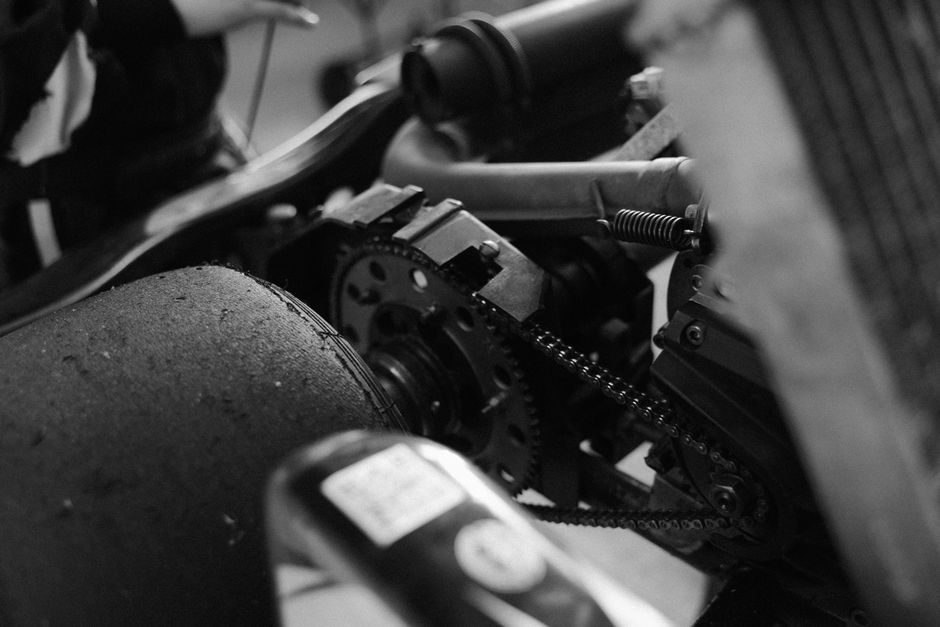
Silent chain total cost of ownership follows the standard four-bucket TCO split defined across supply-chain practice: acquisition, use/administration, maintenance, and disposal [S5]. Applied to power-transmission drives, acquisition rarely dominates the lifecycle bill once the drive runs past 8,000-12,000 operating hours, which is the typical re-tension or replacement window for a silent chain in industrial service.
Scope of this analysis covers inverted-tooth and HV silent chains paired with sprocket assemblies, operating between 1.5 kW and 75 kW per strand at centre distances of 200 mm to 1,500 mm, in drives where low noise, high speed ratios (up to 12:1), and synchronisation accuracy matter more than the absolute lowest unit price.
Four TCO Buckets and Their Typical Weight
Acquisition cost — the chain, matching sprockets, and any special pins or guides — typically represents 25-35% of lifecycle cost in a five-to-ten-year operating window [S1][S5]. Use-phase costs (energy lost to friction, lubricant consumption, drive-train wear on adjacent bearings) account for 20-30%, with maintenance at 15-25% and end-of-life disposal/recycling at 5-10% [S2][S5]. These proportions shift toward maintenance when the chain runs in a dusty, high-temperature, or poorly serviced environment, where re-lubrication intervals shorten from 500 h to 200 h and tension checks move from quarterly to monthly [S3].
The supply-chain TCO literature is explicit that TCO does not require precise calculation of every cost line; it requires identification of the cost drivers and consistent inclusion of acquisition, use, maintenance, and disposal [S5]. For silent chain drives the dominant use-phase driver is lubrication regime, followed closely by operating speed as a fraction of catalogue maximum rpm.
Silent Chain vs Roller Chain vs Synchronous Belt: TCO Trade-off
Silent chain competes with roller chain and timing belts in the same envelope, and the TCO picture changes sharply with the criterion used. On acquisition cost, standard simplex roller chain is the lowest at roughly 0.7-0.9x the price of an equivalent silent chain of the same pitch and width. Silent chain typically costs 1.2-1.6x a comparable roller chain on initial purchase, but delivers 2-4x the wear life at rated load and runs 6-10 dB quieter, which matters in operator-stationary enclosures. [S2]
On energy, synchronous belts have the lowest parasitic loss at low-to-moderate torque because the belt's mass and bending hysteresis are smaller than a multi-strand chain; silent chain, with its involute tooth profile and larger bearing area, sits between timing belt (best) and roller chain (worst) on friction losses, typically drawing 1-3% more drive power than a belt at the same transmitted kW. On noise and synchronisation, silent chain and timing belt both exceed roller chain by a wide margin.
The selection decision therefore reduces to: pick silent chain when the load-to-speed ratio is high, the centre distance is fixed and short-to-medium (under ~1,500 mm), and the cost of one unscheduled hour of downtime exceeds the chain's price premium. Pick roller chain for very long centres, harsh contamination exposure, or where a used or rebuilt chain is acceptable. Pick timing belt for low noise, low maintenance, and low-to-moderate torque, accepting the shorter belt life under shock loads.
Lifespan Economics: L10, Re-tension Windows, and Oil vs Grease
Silent chain rated life is normally expressed as L10 hours to 3% elongation, the standard wear limit beyond which the chain no longer meshes cleanly with the sprocket profile. For a quality silent chain operating at 50% of catalogue maximum kW and 60% of maximum permissible rpm, L10 life commonly lands in the 15,000-25,000 h range on continuous-duty drives. Push the same chain to 80% load and 90% speed and the same figure drops below 8,000 h — a 2-3x penalty that rarely justifies the upfront savings of buying a smaller pitch. [S1]
Lubrication regime is the single largest controllable TCO variable. Oil-bath or drip-fed lubrication typically yields 1.5-2.0x the life of periodic grease application, and automatic oil-mist systems extend it further by holding lubricant temperature stable. The penalty for running a silent chain dry, even briefly, shows up as accelerated pin and bushing wear within the first 200-500 h and is rarely recoverable. Energy consumption in the oil-mist system itself is small (a few watts per nozzle) and is normally recouped inside one re-lubrication interval.
Hidden Cost Lines: Sprocket Wear, Alignment, and Tensioner Drift
A silent chain TCO model that prices only the chain understates total spend by 10-20% because the mating sprockets have their own wear curve. Once a silent chain is replaced, both sprockets should be inspected; if tooth profile has hooked or hooked-tip wear exceeding roughly 0.1 mm, the new chain will run on a degraded profile and its L10 life will be cut. Shaft alignment within 0.05 mm/mm and parallel within 0.1 mm across the centre distance is the standard installation tolerance; misalignment outside that window shortens chain life faster than any other single cause except lubrication failure. [S1]
Tensioner drift is the second silent cost line. Automatic spring or hydraulic tensioners hold the slack side at a controlled force; if the tensioner is under-specified, the chain runs with fluctuating preload that drives fatigue at the pin joints. Replacing a worn tensioner at mid-life is materially cheaper than the chain replacement it would otherwise force.
Who Silent Chain TCO Modelling Is For — and Who It Is Not
TCO modelling pays back when the drive runs more than ~6,000 h/year, when downtime carries a direct production cost, and when a single drive is replicated across a fleet of identical machines. It is not worth the effort for a one-off, low-duty, easily-serviced drive where acquisition price is the dominant consideration. Maintenance teams that already track mean time between failures (MTBF) and mean time to repair (MTTR) per drive have the data inputs to build a credible TCO model; teams that do not track those numbers will produce a model that confirms the cheapest quote, not the lowest total cost. [S3]
Sourcing Signals and Standards to Verify
Specifying silent chain by ISO 606 pitch code (e.g. 08B-1, 10B-1, 12B-1) keeps the sprocket supply fungible across vendors and prevents lock-in. Verify the manufacturer's published L10 curve at the actual operating load and speed, not at catalogue maximum. For drives exported into the EU, confirm REACH and RoHS compliance for the lubricant and any plated components; for food or pharmaceutical lines, NSF H1 registration on the chain lubricant is the standard requirement, not an option. Lead times for non-standard pitch or extended-width silent chain commonly run 8-14 weeks versus 2-4 weeks for stock pitch, which is a real TCO line when the drive is a production bottleneck. [S2]
Track two signals over the next procurement cycle: first, whether the supplier publishes per-pitch L10 curves at multiple load/speed points or only a single catalogue maximum (the former indicates a TCO-suitable vendor); second, the spread between standard-pitch and special-pitch lead times at your volume tier, which sets the floor on inventory carrying cost for the fleet.