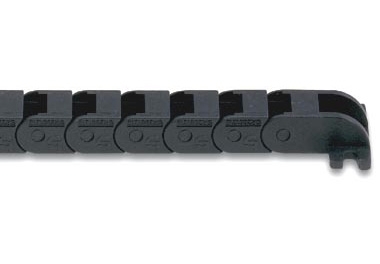
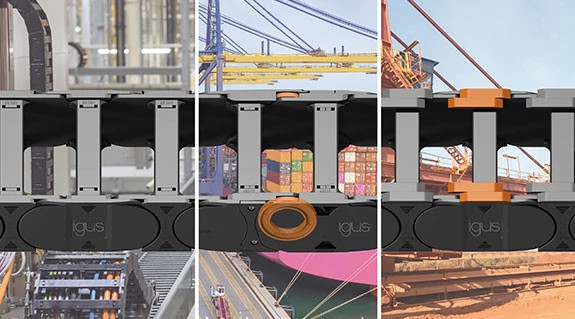
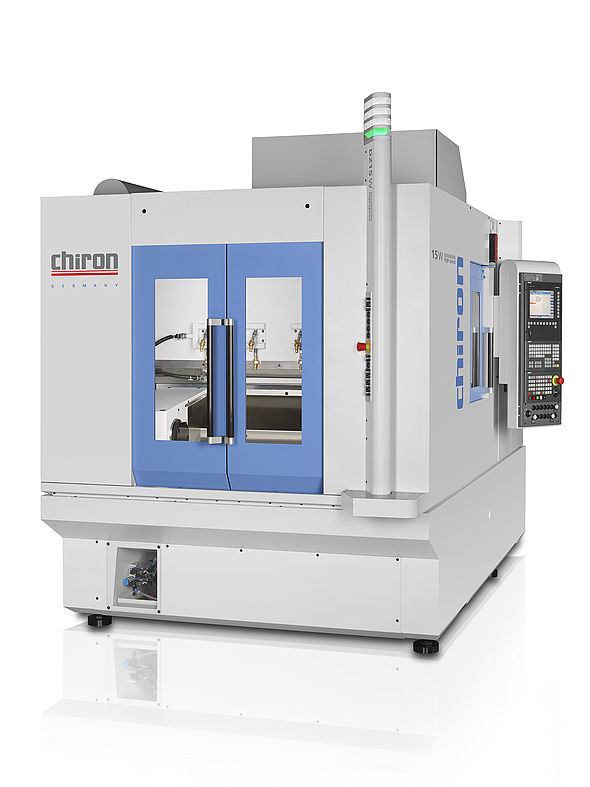
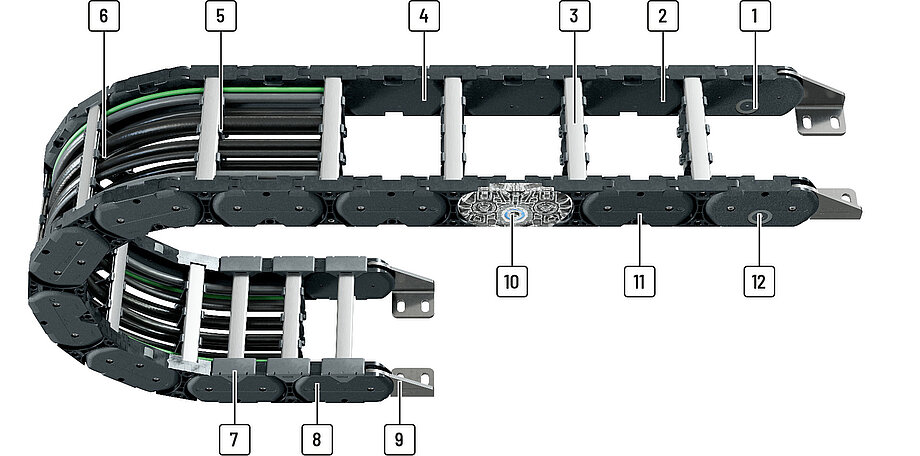
A cable drag chain is an articulated, link-by-link housing that guides, supports, and protects cables, hoses, and hydraulic lines as a machine axis moves back and forth. The same component appears in catalogs under several names: cable carrier, cable track, energy chain, and the igus brand term e-chain are all synonyms. Whatever the label, the job is identical, namely to bend the cable package around a controlled radius at one end of the stroke and return it without kinking, abrasion, or tangle.
This guide treats the drag chain as a mechanical service-life component, not a tidy cable wrap. The parameters that decide whether it survives ten million double strokes are the bend radius, the inner cross section, the fill rule, the installation type (unsupported, gliding, or vertical), and the chain material. Each is covered below with values traceable to manufacturer design data and the NFPA 79 and EN 50525 references that govern the cables inside.
Photo: Matthias Krüger, CC BY 2.5, via Wikimedia Commons
This guide is written for industrial purchasing engineers and design engineers specifying a moving cable package. It runs six chapters: what a drag chain is and where it came from, the carrier types and constructions, plastic versus steel and enclosed tube variants, the fill and bend-radius rules that govern cable life, the key dimensions and ratings you decode from a datasheet, and a step-by-step selection sequence. Performance and design figures reference igus and Tsubaki Kabelschlepp public design data, the NFPA 79 bend-radius rule, and the EN 50525 and DIN VDE 0282 cable standards that apply to the conductors inside the chain.
Chapter 1 / 06
What is a Cable Drag Chain
A cable drag chain is a chain of identical hinged links, each link carrying two sidebands joined by crossbars, that forms a hollow channel for cables and hoses. As a machine slide, gantry, or articulated robot axis travels, one section of the chain stays flat (the lower run), the chain curves through a fixed bend radius at the loop, and the rest of the chain rides above (the upper run) toward the moving connection point. The links can only flex one way, against an internal stop, so the chain holds a constant minimum radius and never folds the cables tighter than the design value. This single mechanical fact, a hard lower limit on bend radius, is the reason the component exists.
Functionally the drag chain replaces the old festoon loop and the bare service loop. A loose service loop on a fast axis whips, abrades against the machine frame, and fatigues the conductors where they leave the fixed clamp. The drag chain converts that uncontrolled flexing into a defined rolling bend at a known radius, keeps the cables separated so they do not saw against one another, and shields them from chips, coolant, and weld spatter. In return the cables inside must themselves be rated for continuous flexing, which is a separate product class covered on the drag-chain cable page.
The terminology is worth settling early because it confuses buyers. The German firm Kabelschlepp, founded in 1954 and now part of the Tsubakimoto Chain group as Tsubaki Kabelschlepp, gave the world the literal word for the product: Kabelschlepp translates as cable drag. The German company igus popularized the term energy chain and trademarked e-chain. North American machine-tool catalogs often say cable track or cable carrier, and many shop floors simply say drag chain. All five terms describe the same articulated carrier, so on a datasheet you should ignore the name and read the dimensions.
Application scale spans a wide range. The smallest stock micro carriers have an inner height around 5 mm and a bend radius near 18 mm, suiting desktop pick-and-place heads and laboratory automation. The largest steel and heavy plastic carriers reach an inner height of about 350 mm and carry fill weights of tens of kilograms per meter, serving gantry cranes, bulk-handling gantries, and steel-mill caster lines. Travel ranges from a few centimeters on a short pneumatic stroke to several hundred meters on a gliding crane runway. No single chain spans that whole envelope; selection is a mapping from the specific travel, speed, and fill onto a series and size.
Four engineering properties govern whether a drag chain reaches its service-life target, typically quoted in millions of double strokes: the bend radius relative to the stiffest cable, the inner cross section relative to the fill, the installation type relative to the travel length, and the material relative to the temperature and contamination. A chain that is correct on three counts and wrong on one will still fail early, which is why the chapters that follow treat each property independently rather than as a single catalog number.
Chapter 2 / 06
Carrier Types and Constructions
Drag chains are classified first by how the cable cavity is opened and closed, and second by how the chain is installed relative to the direction of travel. The opening style decides how fast a technician can fill or service the chain and how well it keeps debris out. The installation type, covered at the end of this chapter, decides how long the chain can span and how fast it can move. The table below summarizes the common opening and crossbar styles.
Construction
How it opens
Debris protection
Typical use
Open frame, fixed crossbar
Crossbars are non-removable
Low
Permanent fills, lowest cost
Snap-open crossbar
Each crossbar lifts individually
Low
Service-friendly, frequent changes
Zipper crossbar
One crossbar opens the run as a strip
Low
Fast filling of long chains
Enclosed tube
Hinged lid or solid cover
High (to IP54)
Chips, dust, weld spatter
Vertical / hanging
Any of the above plus support
Varies
Z-axis, lifts, telescopes
Open frame carriers have the simplest links, with two sidebands and crossbars that are not meant to be removed. They are the cheapest option and suit installations where the cable package is set once and rarely touched. The drawback is filling difficulty: cables must be threaded in from one end, which is slow on a long chain and impossible if a single cable must be added later. They offer no protection from falling chips or coolant spray.
Snap-open crossbar carriers let a technician flip up each crossbar individually to drop cables into the channel from above, then snap it shut. This is the workhorse construction for machine tools and automation because it allows mid-life cable swaps without unthreading the whole run. Zipper carriers go further: the crossbars are linked so that opening one opens the neighbors along the run like a zip, which speeds the initial fill of a very long chain. In zipper-style carriers the crossbars are connected, so opening one also opens the adjacent crossbar.
Enclosed tube carriers replace the open crossbars with a continuous lid or a closed profile, sealing the cable space against the environment. The Tsubaki Kabelschlepp TKA series, for example, is a glass-fiber-reinforced plastic tube carrier developed for environments contaminated with chips and dirt; its closed design prevents ingress of foreign bodies and reaches protection class IP54. Tube carriers cost more and run slightly warmer because the cables cannot shed heat to open air, so the fill rule is applied more conservatively.
The second axis of classification is installation type, which depends almost entirely on travel length. For short travels the chain is run unsupported, also called self-supporting, where the upper run spans the gap in free air. For long travels the upper run is allowed to lie on the lower run in a gliding arrangement inside a guide trough. Other layouts include side-mounted (the chain lying on its side so the bend is horizontal), vertical standing, and hanging (Z-axis), each of which loads the links differently from a flat horizontal run and needs its own design check. The next chapter compares the materials that carry these loads.
Chapter 3 / 06
Plastic, Steel, and Enclosed Tube
The chain material sets the duty class, the noise level, the temperature window, and the corrosion behavior. Three broad families dominate industry: glass-fiber-reinforced plastic (mostly polyamide), metal carriers (steel or aluminum), and hybrid or enclosed designs that combine a plastic body with metal-reinforced links or covers. The table below compares the key engineering properties of the three families; treat the values as typical ranges, because each manufacturer series has its own rated limits.
Family
Continuous temp.
Speed / accel.
Relative weight
Typical applications
Reinforced polyamide
-40 to +130 °C
Up to 5 m/s, 50 m/s²+
Low
Automation, machine tools, robotics
Enclosed tube (plastic)
-40 to +130 °C
Up to 5 m/s, 50 m/s²+
Low-medium
Chip-laden, dusty, washdown areas
Aluminum hybrid
-40 to +130 °C
High span, moderate accel.
Medium
Long gantries, heavy fills
Steel / stainless
Up to +200 °C and higher
Lower (mass limited)
High
Mills, foundries, cranes, oil and gas
Reinforced polyamide is the default for the great majority of axes. Glass-fiber-reinforced PA6 or PA66 gives a high strength-to-weight ratio, inherent corrosion resistance, low sliding noise, and electrical insulation, and igus rates its standard e-chain materials for continuous use across roughly minus 40 to plus 130 degrees Celsius, with short-term peaks to about plus 170 degrees Celsius. The low link mass is what lets plastic chains reach the highest accelerations, because the chain must accelerate its own weight at every stroke. The trade-offs are a ceiling on fill weight and on radiant-heat tolerance.
Enclosed tube plastic carriers share the polyamide base but close the cavity for protection. They are the answer to hot chips, grinding dust, and washdown spray that would otherwise pack an open chain and abrade the cables. The cost is a slightly higher price, a small weight penalty, and reduced convective cooling, which means the cable derating and fill clearance should be checked against the cable manufacturer data for the still-air condition inside the tube.
Steel and aluminum carriers exist for the duties plastic cannot reach. Steel chains, often with stainless or galvanized links, tolerate radiant heat near and above plus 200 degrees Celsius, resist weld spatter and molten splash, and carry the highest fill weights, which is why they dominate steel mills, foundries, heavy cranes, and oil-and-gas drilling. Aluminum hybrids sit between the families, using light metal stays to span long gantries with heavy fills while staying lighter than full steel. The penalties are higher mass (which limits acceleration and increases the support trough loads), higher noise, and the need to manage corrosion on the metal parts. Plastic carriers are more common in industrial automation, robotics, and light-duty equipment, while steel carriers are more prevalent in harsh, heavy-duty environments.
A practical rule for the material decision is to start with plastic and step up only when a specific limit is exceeded: when continuous media temperature passes the plastic rating, when hot chips or spatter will land on the chain, when the fill weight exceeds what a plastic series carries, or when the unsupported span needed is longer than any plastic series can bridge. Each of those is a hard physical limit, not a preference, so the upgrade to metal should be tied to a number on the datasheet rather than a general sense that the duty is heavy.
Chapter 4 / 06
Fill Rules and Bend Radius
Most premature failures of a correctly sized chain trace back to two errors: packing the cavity too tightly and choosing a bend radius below what the stiffest cable needs. Both are governed by manufacturer rules that are conservative for good reason, because the cable inside is the expensive consumable and the chain exists to protect it. This chapter sets out the fill clearance rule, the separator rule, and the bend-radius rule.
The fill clearance rule reserves free space around every cable and hose so it can shift and roll as the chain bends without binding against its neighbors. igus specifies at least 10 percent clearance all round for round electrical cables and roughly 20 percent for hydraulic hoses, with flat cables around 10 percent and pneumatic tubing and media hoses in the 5 to 20 percent band. In practice a 10 mm round cable should sit in a compartment of about 11 mm, not 10 mm. Filling the cavity solid removes the room the cable needs to take up the path-length difference between the inner and outer fibers of the bend, and the result is corkscrewing and jacket abrasion.
The separator rule keeps unlike cables apart and stops similar cables from climbing over one another. Heavy and light cables, and electrical and hydraulic lines, belong in separate compartments formed by vertical dividers, so a heavy hose cannot crush a thin signal cable. For two similar cables side by side, igus advises fitting a separator when their combined diameter is 1.2 times the inner height or less, and limiting the clearance height above loosely laid cables to no more than about 1.5 times the cable diameter, so they cannot cross over and tangle. The table below collects these working numbers.
Fill parameter
Rule of thumb
Why it matters
Round electrical cable clearance
≥ 10% all round
Room to roll on the bend
Hydraulic hose clearance
≥ 20% all round
Hoses swell and stiffen
Pneumatic / media hose clearance
5 to 20%
Type-dependent flexibility
Separator trigger
d1 + d2 ≤ 1.2 × inner height
Prevents side-by-side tangle
Loose stacking height
≤ 1.5 × cable diameter
Prevents cables crossing over
Weight balance
Heavy lines low and centered
Even load across crossbars
The bend-radius rule is the single most important number in drag-chain selection. The carrier bend radius, abbreviated KR or R in catalogs, must be at least as large as the minimum bending radius of the thickest or stiffest cable or hose in the fill, because the chain forces every line to follow the same arc. The widely cited engineering rule, echoed in NFPA 79, is that a continuously flexing cable needs a bending radius of at least 10 times its outer diameter; purpose-built drag-chain cables are often rated lower, from about 7.5 to 12.5 times diameter, so the cable datasheet always overrides the rule of thumb. Manufacturers offer a fixed ladder of radii (igus alone stocks 12), and the correct move is to pick the largest radius the available installation height allows, since a larger radius cuts bending stress and lengthens both cable and chain life.
Two further consequences follow from the bend radius. First, it sets the installation height the machine must provide, because the loop occupies roughly two radii plus the chain height. Second, it sets the camber, the slight upward bow built into the upper run of an unsupported chain so that gravity sag leaves it level under fill weight. Designers who pick a radius purely to save installation height, ignoring the stiffest cable, are the most common cause of early cable jacket cracking in the field.
Chapter 5 / 06
Key Dimensions and Ratings
A drag-chain datasheet lists many figures, but selection turns on a short set: pitch, inner width and inner height, bend radius, unsupported and gliding length limits, fill weight, and travel speed and acceleration. Each is defined below, with the relationship that ties chain length to travel.
Pitch (the link length, symbol t) is the distance between adjacent hinge axes. A small pitch produces a smoother, quieter loop and follows the cable arc more closely, which is why small-pitch series such as the igus E2 family are favored for clean, quiet automation. Pitch also sets the resolution of chain length: the number of links is the chain length divided by the pitch, so chains come in discrete length steps of one pitch.
Inner width and inner height define the usable cavity cross section, often abbreviated Bi and hi. The required inner height comes from the largest single cable plus its clearance, and the required inner width comes from the sum of all cable diameters plus their clearances and separators. igus stocks inner heights from about 5 mm for the tightest spaces up to about 350 mm for high loads, with a correspondingly wide ladder of inner widths, so the cavity is matched to the fill rather than the reverse.
Bend radius (KR or R), defined in the previous chapter, is repeated here as a selectable dimension because it interacts with installation height and chain length. Unsupported length (the free-air span, sometimes written FLG) is the distance the upper run can bridge with negligible sag; the unsupported arrangement allows the longest service life and the highest speed and acceleration, but the span shrinks as fill weight rises. Gliding length is the much longer travel possible when the upper run is allowed to lie on the lower run in a guide trough, reaching hundreds of meters at the cost of restricted speed and added wear.
Travel speed and acceleration are rated together because acceleration usually limits service life before top speed does, by exciting chain vibration in unsupported runs. Plastic energy chains run continuously up to roughly 5 m/s (16.4 ft/s) with accelerations of 50 m/s squared (164 ft/s squared) and higher, the exact ceiling set by series, fill weight, and length. As a reference for the upper envelope, igus has documented short-stroke test peaks near 22 m/s (72 ft/s) and 784 m/s squared (2,572 ft/s squared) for E4 series chains over limited cycles, which are test-rig figures, not continuous ratings. The table below collects the typical envelope.
Parameter
Symbol
Typical envelope
Notes
Pitch
t
10 to 100+ mm
Small pitch is quieter
Inner height
hi
5 to 350 mm
Set by largest cable
Bend radius
KR
18 mm to 0.5 m+
≥ stiffest cable radius
Continuous speed
v
Up to ~5 m/s
16.4 ft/s
Continuous acceleration
a
50 m/s² and higher
164 ft/s²; life-limiting
Gliding travel
S
Up to several hundred m
Speed restricted
The chain length follows a simple relationship for a centered fixed point: the required chain length LK equals half the total horizontal travel plus an add-on for the bend section, written LK = S/2 + K, where S is the total travel and K is taken from each series data table rather than computed by hand. If the fixed point sits off center, the offset dM is added, giving LK = S/2 + dM + K. Centering the fixed end is the most economical layout because it produces the shortest chain, cables, and hoses; moving the fixed point off center lengthens all three. The number of links then follows from dividing LK by the pitch t.
Chapter 6 / 06
Selection Decision Factors
To turn the preceding five chapters into a specific model, follow the sequence below. As with most instrumentation, the costly mistakes come not from a single wrong step but from deciding the cheap parameters before the expensive constraints are fixed, so resolve the cables and the geometry first and let them drive the chain. These eight steps double as a fixed RFQ template.
Cable and hose schedule first: list every line that goes in the chain with its outer diameter, weight per meter, minimum bending radius, and type (power, control, data, hydraulic, pneumatic, media). The stiffest minimum bend radius and the largest diameter drive the whole selection, so this list precedes every other decision.
Travel, speed, and acceleration: fix the total horizontal travel S, the maximum continuous speed, and the peak acceleration. These figures usually come from the axis itself, the linear guide the chain runs alongside and the servo drive that powers the stroke. They decide the installation type: a short fast stroke favors unsupported, a long stroke forces gliding, and acceleration is checked against the series limit because it, not speed, usually caps service life.
Installation type and orientation: choose unsupported, gliding, side-mounted, vertical, or hanging based on travel length and available height, then confirm the series supports that orientation. Gliding needs a guide trough; vertical and hanging need pre-tension or support brackets.
Bend radius: set KR at least equal to the stiffest cable minimum radius from step 1, then choose the largest stocked radius the installation height allows, because more radius means more life. Verify the radius against the cable datasheet, not only the 10-times-diameter rule.
Inner cross section and dividers: size inner height from the largest single cable plus clearance, size inner width from the summed diameters plus clearances and separators, and lay out compartments so heavy and electrical and hydraulic lines are separated per the fill rules in Chapter 4.
Material and protection: default to reinforced polyamide; step up to enclosed tube for chips, dust, or washdown (to IP54), and to steel or aluminum hybrid for high heat, weld spatter, very long spans, or very heavy fills. Tie each upgrade to a number that exceeds the plastic rating.
Mounting, end brackets, and strain relief: specify the fixed and moving end brackets, the strain-relief style (tie plate, C-rail, or comb), and the guide trough if gliding. Strain relief at both ends is what stops the cables being pushed and pulled at the connectors.
Total cost of ownership: weigh chain price against cable price, downtime cost, and service interval. The chain is cheap relative to a rebuilt cable harness and to lost production, so undersizing the radius or the cavity to save chain cost is almost always a false economy over a multi-year run.
One dimension is easy to overlook at the quoting stage but decisive over a 5 to 10 year production life: serviceability. Confirm that the chosen series uses snap-open or zipper crossbars so a single cable can be replaced without unthreading the whole run, that replacement links and end brackets are stocked locally, and that the supplier can provide pre-harnessed and tested chain-plus-cable assemblies if your maintenance crew is small. igus and Tsubaki Kabelschlepp both supply pre-assembled, ready-to-install systems and offer online length and service-life calculators, which shortens both the design loop and the eventual repair.
FAQ
What is the difference between a cable drag chain and a cable carrier?
There is no functional difference; the terms are synonyms for the same component. Cable drag chain, cable carrier, cable track, energy chain, and the igus brand name e-chain all describe an articulated, link-by-link housing that guides, supports, and protects cables and hoses on a moving machine axis. Manufacturers favor different labels: igus uses energy chain and e-chain, Tsubaki Kabelschlepp uses cable carrier, and many machine-tool catalogs say drag chain or cable track. When you read a datasheet, focus on the dimensional terms (pitch, inner width, inner height, bend radius) rather than the marketing name, because those parameters define fit and service life.
How do I choose the bend radius for a cable drag chain?
The carrier bend radius must be at least as large as the minimum bending radius of the thickest or stiffest cable or hose in the fill. A widely used rule, also cited in NFPA 79, is a bending radius of at least 10 times the cable outer diameter for continuously flexing cables; many drag-chain cables are rated for radii from 7.5 to 12.5 times diameter, so always check the cable datasheet. Within the available stock radii (igus alone offers 12 fixed radii), pick the largest radius the installation height allows, because a larger radius lowers bending stress and extends both cable and chain service life.
How many cables can I put in a drag chain, and what is the fill rule?
Follow the manufacturer clearance rule rather than packing the cavity solid. igus specifies at least 10 percent free clearance all round for round electrical cables and roughly 20 percent for hydraulic hoses, so a 10 mm cable needs about 11 mm of compartment space. Keep heavy and light, and electrical and hydraulic lines, in separate compartments using vertical dividers. When two similar cables sit side by side, install a separator if their combined diameter is 1.2 times the inner height or less, and do not stack loose cables more than about 1.5 times their diameter in clearance height, or they will cross over and corkscrew.
What is the difference between unsupported, gliding, and side-mounted installations?
Unsupported (self-supporting) means the upper run spans the travel in free air with negligible sag; it allows the highest speed and acceleration and the longest service life, but the unsupported length is limited and shrinks as fill weight rises. Gliding means the upper run rests on the lower run inside a guide trough for long travels, up to several hundred meters, but speed and acceleration are restricted by friction and wear. Side-mounted (lying on its side) and vertical or hanging arrangements need extra support or pre-tension because gravity acts across the chain links rather than along them.
What travel speed and acceleration can a cable drag chain handle?
For unsupported and gliding arrangements, plastic energy chains run continuously at speeds up to about 5 m/s (16.4 ft/s) and accelerations of 50 m/s squared (164 ft/s squared) and higher, with the exact limit set by chain series, fill weight, and travel length. In specialized short-stroke test rigs, igus has documented peaks near 22 m/s (72 ft/s) and 784 m/s squared (2,572 ft/s squared) for E4 series chains over limited cycles. Acceleration, not top speed, is usually the life-limiting factor in unsupported runs because it excites chain vibration.
How do I calculate the required chain length for a horizontal travel?
For a fixed end in the center of the travel, the required chain length is LK = S/2 + K, where S is the total horizontal travel and K is the add-on for the bend section, taken from each series data table rather than computed by hand. If the fixed point sits off center, add the offset: LK = S/2 + dM + K. The number of links is the chain length divided by the pitch t. Centering the fixed end is the most economical layout because it yields the shortest chain, cables, and hoses; off-center fixed points lengthen all three.
When should I choose a steel cable carrier instead of plastic?
Plastic carriers, typically glass-fiber-reinforced polyamide, suit most automation, robotics, machine-tool, and light-to-medium duty axes; they are light, low-noise, corrosion-free, and run from roughly minus 40 to plus 130 degrees Celsius in continuous use. Choose steel or aluminum carriers for very long unsupported spans, very high fill weights (tens of kilograms per meter), high radiant heat, hot chips and weld spatter, or aggressive media found in steel mills, foundries, cranes, and oil-and-gas rigs. Enclosed tube carriers add a third path: a plastic or hybrid housing that closes around the cables to reach IP54-class protection against chips and dust.
Cable Drag Chain Manufacturers
Source-backed product routes. Open a company dossier for procurement scope and cited evidence.