A silent chain — also called inverted-tooth or "silent transmission chain" in Chinese catalogues — is built from stacked plates with meshing tooth flanks running on sprocket teeth, designed to deliver compact, low-noise power transmission at speeds that an ordinary roller chain would rattle through.
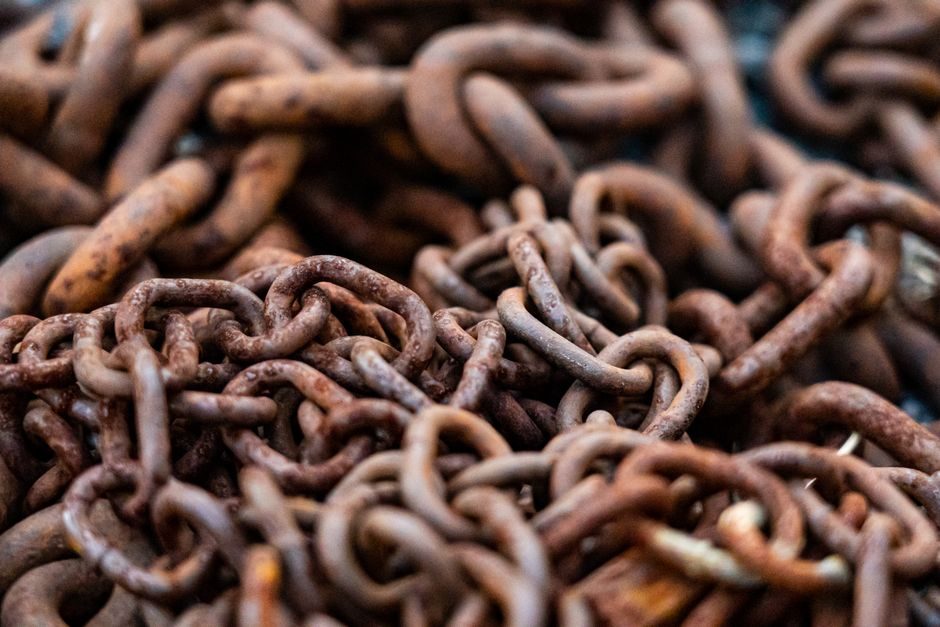
A conveyor chain is the broad family that includes metric FV series, drop-forged, SMS 1698 mill chains, cast link and welded drag styles, all optimised for slow, heavy, often dirty or corrosive duty on bucket elevators, sugar carriers, mining feeders and pallet lines [S1][S2].
Where Each Chain Family Actually Lives on the Speed-Load Map
Silent chain runs as a power-transmission element in timing drives, transfer cases and high-ratio reduction gearboxes; reference implementations quote speed ranges into the tens of metres per second and emphasise low acoustic signature over raw pulling force. Conveyor chain, by contrast, is published against European metric standards DIN 8165 FV, DIN 8167 M and SMS 1698, with welded-mill variants bolted together in flights and used where pitch and flight geometry — not RPM — set the design [S2]. ScanChain's published product map separates these two worlds cleanly: DIN 8165 FV, DIN 8167 M and SMS 1698 on the conveyor side, plus manganese wear rails as the consumable interface [S2].
Standardisation matters because it fixes pitch, pin diameter and breaking load, which then dictate the sprocket cutting and the way the chain articulates around bends. DIN 8167 M-series solid-pin chains are the typical choice for medium-duty elevators; SMS 1698 is the Swedish-mill standard that dominates sugar, cement and bulk-handling conveyors [S2].
Design Intent: Tooth Geometry vs Flight Geometry
The defining difference sits in how the chain transmits force. A silent chain's load path is a row of meshing teeth, similar in concept to a chain conveyor timing element but designed for repeated tooth engagement rather than flight engagement. Plates are stamped, sometimes rocker-jointed (HV/HV-N series) or with crowned teeth for smoother contact, and the chain runs on small-diameter sprockets to push its maximum permissible speed upward. [S1]
Conveyor chain's load path is the pin-and-bushing articulation between links, while the engineering content is in the attachments: K-type or G-type attachments, bent plates, welded flights, bucket-mounting holes, and so on. Suppliers such as Salchain ship "straight or cranked" conveyor and elevator chains manufactured from rolled steel, castings and forgings, with attachments chosen for sugar, mining, fertiliser, food and timber duty [S1]. The Chinese export side reinforces the same point: made-in-china listings group "roller chain, conveyor chain, sprocket, silent chain, saw chain" as four separate product lines from a single manufacturer, confirming that the factory view treats them as distinct products sharing a common pin-bushing core technology [S4].
Selection Criteria: Speed, Load, Environment, Standard
For practical selection, four gates do almost all the work. First, surface speed: if the line is above roughly 5 m/s and noise is a concern, silent chain enters the conversation; if it is below 1 m/s and load is the binding constraint, conveyor chain wins. Second, tensile rating: conveyor chains built to DIN 8165 FV, DIN 8167 M or SMS 1698 are published with breaking loads in the tens to hundreds of kilonewton range, far above what a typical silent chain will see in a transfer case. Third, environment: mining, sugar, fertilizer and timber are explicitly listed as Salchain's heavy-corrosion, heavy-abrasion markets, and that drives the choice toward cast, forged or rolled-steel conveyor chains with surface protection rather than stamped silent-chain plates [S1]. Fourth, available standards: scan the OEM's catalogue for the specific standard it holds — DIN 8165 FV, DIN 8167 M, SMS 1698, ANSI B29.10 drop-forged, or the inverted-tooth HV family — before sizing, because the sprocket, pin and pitch are not interchangeable across families [S2].
Customisation is also a hard requirement in conveyor chains; Jinqiu markets itself as a manufacturer of "conveyor, engineer, and welded chains for diverse industries" with custom runs, and Shinelink similarly positions itself around engineering-class chain with facility upgrades underway in 2026 [S6]. Silent chain is far less commonly offered as a custom geometry; buyers are usually pinned to the catalogue pitch and width of a given HV or HV-N series.
Failure Modes and Misapplication Costs
Silent chains fail in characteristic ways: tooth wear and elongation at high speed, plate fatigue around the guide grooves, and elongation that desynchronises timing. Conveyor chains fail differently: pin and bushing wear, flight attachment cracking, sprocket tooth hooking after elongation, and plate stretch on the load-bearing strand. Using a conveyor chain where a silent chain is specified loses speed, noise and timing precision; using a silent chain where a conveyor chain is specified destroys the plate stack long before the design tensile load is reached because the plates are not built for sustained catenary pull. [S2]
Stainless and plastic options form a third sub-track that is often confused with both: Dongguan Hanjun Plastic Product Co. publishes a conveyor-belt and conveyor-chain line out of an ISO 9001 system, serving food-grade and light-duty lines where neither a steel conveyor chain nor a silent chain is appropriate. A spec writer who lumps these plastic modular chains in with DIN 8165 FV or with HV silent chain is almost certainly misreading the duty.
Sourcing Reality in 2026: Capacity, Standards, Geography
Capacity in the Chinese export market is broad: made-in-china's long-chain supplier index lists 2,000+ manufacturers with 6,000+ products, with response times quoted at ≤3 hours on the leading entries and the cluster centred on Shaoxing, Zhejiang — a hub where roller, conveyor, silent and saw chains are all made under the same roof [S4]. Buyers should anchor on the standard the chain is built to, not the brand label: a 881 flexing chain in the food-beverage export class is a different geometry from a DIN 8167 M chain even though both are sold as "conveyor chain" [S5].
For European and African bulk-handling projects, the supply chain skews toward DIN/SMS rather than ANSI: Salchain (South Africa, Baughan Group) is explicitly a "conveyor and elevator chain" specialist targeting mining, sugar, food, fertilizer and timber, while ScanChain (Denmark) groups its conveyor line by DIN 8165 FV, DIN 8167 M, SMS 1698, drop-forged and welded chains [S1][S2]. For a 2026 power-transmission drive design — say, an EV transfer case, a printing press or a packaging line timing drive — the short list is silent chain from the Hangzhou cluster (Perpetual Machinery & Equipment and similar exporters) plus catalogue HV/HV-N series from global names [S3]. Buyers wrestling with that same spec-vs-supply tension across rotating equipment will recognise the pattern from the transformer supply chain and the electric motor supply chain: the standard family and the lead time are the spec, the brand is downstream.
Final signal: the same Zhejiang cluster offering silent chain alongside roller and conveyor chain is also one of the world's largest single sources of cable drag chain and drag chain cable carriers — so any engineering review that touches more than one chain family in 2026 should treat the supplier short list as a package rather than as a per-line buy. Two trackable signals from the research window: Shinelink's "facility reforming and upgrade" announcement in 2026 (capacity movement inside a Chinese engineering-chain maker) and the commissioning of remaining construction of the Ethiopia Beles-1 sugar factory project, which is a real-world DIN/SMS-style conveyor-chain deployment moving into operation.