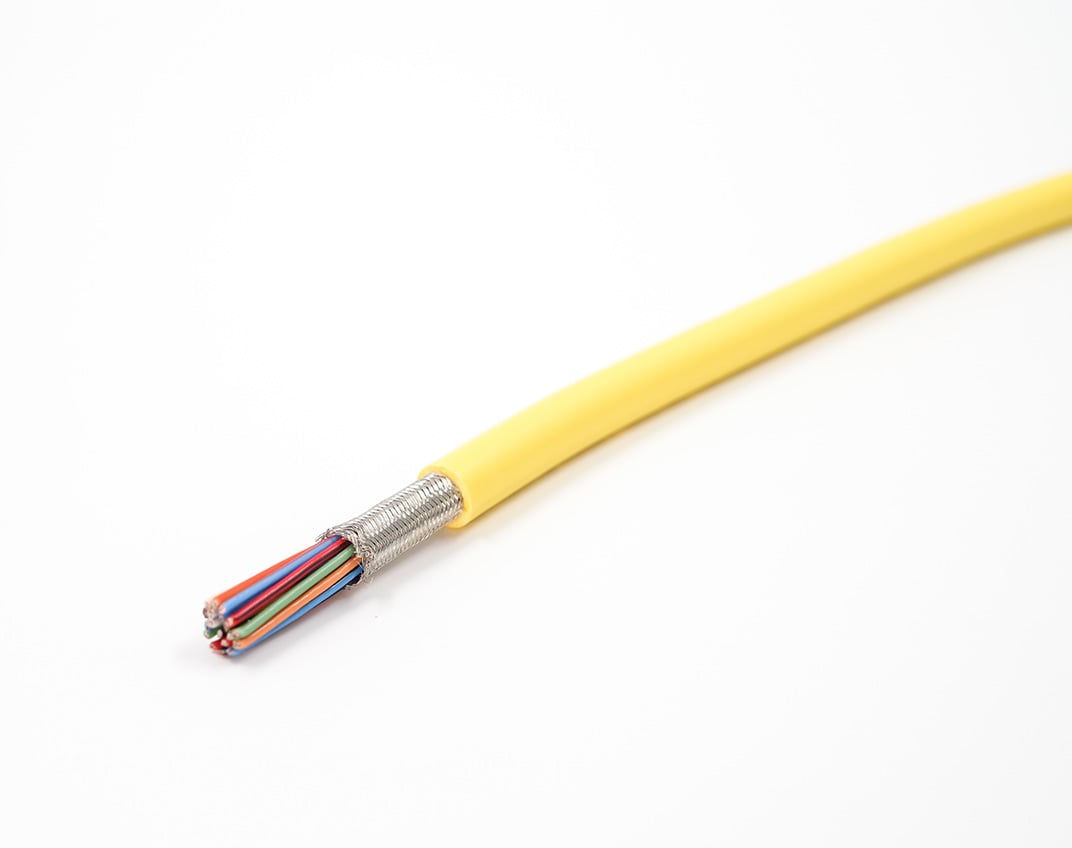
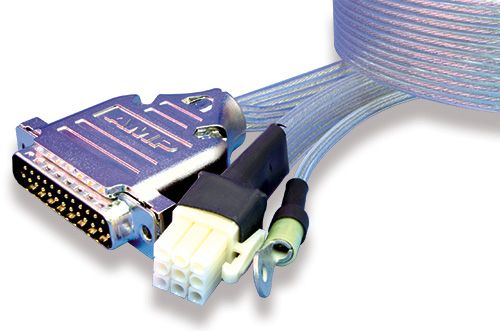
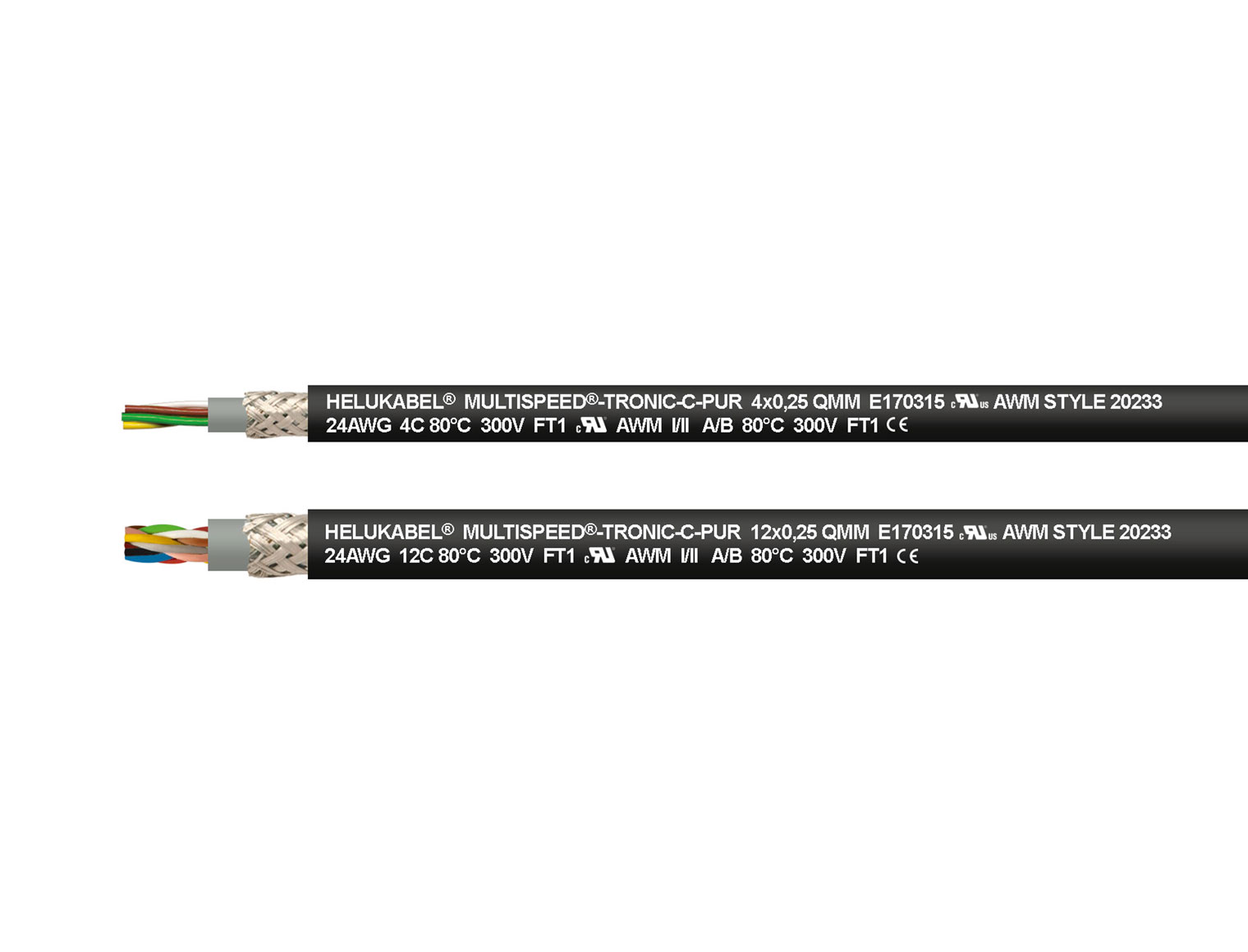
A drag chain cable, also called a continuous-flex cable, energy-chain cable, or e-chain cable, is a power, control, or data cable engineered to survive millions of reciprocating bending cycles inside a moving cable carrier. Unlike an ordinary flexible cable, which is only rated to be routed by hand at installation, a drag chain cable keeps its conductors, shield, and jacket intact through years of back-and-forth travel on gantries, machine tools, automated storage cranes, and pick-and-place robots.
The difference lies almost entirely in construction: fine-wire Class 6 stranding, short bundle twist lay lengths around a central support element, a gliding inner jacket, and an abrasion-resistant PUR or TPE outer sheath. Get the bend radius, jacket material, and conductor class right and the cable outlives the machine; get them wrong and it fails by corkscrewing or core breakage within weeks.
Photo: Matthias Krüger, CC BY 2.5, via Wikimedia Commons
This guide is written for industrial purchasing engineers and machine designers specifying cables for moving applications. It covers six chapters, from what makes a cable continuous-flex capable, through jacket materials, conductor and shield construction, bend-radius and fill rules, spec-sheet decoding, to a step-by-step selection sequence, plus seven selection FAQs and a manufacturer landscape. All parameters reference public standards including DIN VDE 0285-525 / EN 50525, IEC 60228 (conductor classes), and manufacturer engineering data from igus chainflex, LAPP OELFLEX, and Helukabel.
Chapter 1 / 06
What is a Drag Chain Cable
A drag chain cable is a cable specifically constructed to be installed inside a cable carrier (energy chain, e-chain, drag chain, or cable track) and to endure continuous reciprocating motion as the carrier flexes through its bend back and forth. The name comes from the German Schleppkette, the articulated plastic or steel chain that guides and protects the cables as a machine axis travels. The cable is the consumable inside that chain, and its mechanical service life, not its electrical rating, is usually what determines when the whole moving assembly must be serviced.
The defining requirement is fatigue endurance. Every time the carrier reverses direction, the cable bends from straight to its minimum radius and back, a movement counted as one double stroke. Over the life of a packaging line or an automated warehouse crane that adds up to tens of millions of cycles. An ordinary stranded cable, even one labelled flexible, was designed to be bent into position once and then left static. Subjected to continuous flexing it fails in one of two classic ways: individual copper strands fatigue and break until a core goes open circuit, or the cores corkscrew inside an oversized jacket and burst through the sheath. The entire engineering discipline of continuous-flex cable exists to defeat these two failure modes.
Functionally, drag chain cables span the same electrical roles as the rest of the cable world: low-voltage power and motor supply, control and signalling, measurement and instrumentation, bus and Ethernet data, servo and encoder feedback, and increasingly hybrid constructions that combine power and data in one sheath. What unifies them is the mechanical specification layer stacked on top: a rated minimum bend radius expressed as a multiple of cable diameter, a maximum travel speed and acceleration, a temperature window split between fixed and moving installation, and a guaranteed flex-cycle count tied to all of those conditions being respected.
Historically, the energy chain itself was commercialised in the 1950s and 1960s for machine tools, and through the 1970s and 1980s cable makers developed dedicated stranding geometries to match it. The modern continuous-flex cable, with its bundle stranding around a central element and pressure-extruded gliding jacket, took its current form as computer-controlled machine tools, gantry robots, and automated material handling drove travel distances and speeds upward. Today the category is large enough that the leading specialist, igus, runs one of the world's largest e-chain test laboratories, reported at around 5,500 square metres, running hundreds of parallel endurance tests to validate cycle-life claims.
Four engineering metrics dominate drag chain cable quality: the minimum dynamic bend radius (as a factor of outer diameter), the jacket material and its abrasion and media resistance, the conductor stranding class, and the guaranteed flex-cycle life within a defined speed and temperature envelope. These four collectively determine total cost of ownership. A cable that costs less per metre but is under-rated for the carrier radius can shut a production line down for an unplanned cable swap, a cost that dwarfs the original purchase difference.
Chapter 2 / 06
Types and Classification
Drag chain cables are classified two ways at once: by electrical function (what the cable carries) and by motion duty (how hard it flexes). The electrical function decides the core count, cross-section, and whether a shield is required; the motion duty decides the stranding geometry, the jacket compound, and the bend-radius rating. A buyer must specify both axes. The table below maps the main electrical function families and their typical use inside an energy chain.
Motion duty is the second classification axis, and the more decisive one for cable life. Cable makers group their ranges by how the cable moves. The simplest duty is flexible, meaning the cable tolerates being routed by hand and occasional gentle movement, but is not warranted for an energy chain. The core continuous-flex duty is two-dimensional reciprocating travel, the classic linear back-and-forth of a gantry or machine axis inside a carrier. The most demanding duty is torsion, where the cable twists about its own axis, as in the dress pack of a six-axis articulated robot or a faster SCARA robot, which needs a dedicated robot cable rather than a linear e-chain cable.
Within continuous-flex duty there is a further split by travel category. Unsupported (self-supporting) travel describes short to medium horizontal runs where the upper run of the chain bridges the gap without touching the lower run; the cables only have to survive the bend, and bending factors as low as the manufacturer rating apply. Gliding travel describes long horizontal runs where the upper run lies on and slides along the lower run; here jacket abrasion resistance becomes critical and the carrier and cables are specified for the sliding contact. Vertical and side-mounted travel add their own weight-distribution rules. Picking a cable rated only for short unsupported runs and installing it on a 50-metre gliding crane is a frequent and expensive mismatch.
A practical consequence is that the same electrical cable, say a 4G2.5 motor cable, exists in several grades: a basic flexible version, a continuous-flex version rated around 7.5 times diameter, and a high-end version rated to a tighter radius and a higher cycle count at a premium price. The grades look almost identical on a reel. Only the datasheet, with its bend factor, travel speed, and guaranteed cycle figures, distinguishes them, which is why blind cross-referencing by core count and cross-section alone is the most common procurement error in this category.
Chapter 3 / 06
Construction and Jacket Materials
What makes a cable continuous-flex capable is its internal architecture, not its outward appearance. Four construction features distinguish a true drag chain cable from an ordinary stranded cable. First, the conductor uses fine-wire Class 6 stranding per IEC 60228 (EN 60228, VDE 0295): many thin copper strands rather than few thick ones, so the bending strain on each individual wire stays low. Second, the cores are stranded in layers with optimally matched, short lay lengths around a central support element, so that during bending the cores roll against one another instead of stretching and corkscrewing. Third, a fleece wrap or pressure-extruded gliding inner jacket holds the bundle tightly and lets the layers slide. Fourth, an abrasion-resistant outer sheath protects the bundle from the wear of the carrier and the environment.
The outer sheath material is the most visible specification decision, and it trades off cost, abrasion life, oil resistance, and temperature. The three mainstream compounds are PVC, PUR, and TPE. The table below compares them on the properties that matter inside an energy chain.
Jacket
Oil / chemical
Abrasion & notch
Flexible temp range
Relative cost
Best fit
PVC
Limited
Moderate
approx. +5 to +70°C
Low
Dry indoor, low to medium duty
PUR
High (oils, coolants, greases)
High, notch-resistant
-30 to +80°C
Medium
Oil, outdoor, UV, heavy industrial duty
TPE
Moderate
High, very flexible
cold-flex, very wide
Medium-high
Max cycle count, cold, halogen-free
PVC is the lowest-cost compound and is suited to dry indoor service at moderate temperatures, roughly +5 to +70 degrees Celsius, with low to medium mechanical load. Its weakness is limited resistance to industrial oils, coolants, and chemicals, and it stiffens in the cold, so it is generally avoided on machine tools awash in cutting fluid or on outdoor cranes. It remains a sensible choice for clean, light-duty handling equipment where budget dominates.
PUR (polyurethane) is the industrial workhorse. It is highly resistant to oils, coolants, greases, hydraulic fluids, acids, alkalis, and weak seawater, it is notch-resistant and cut-resistant so a nick does not propagate into a tear, it is halogen-free, and it tolerates outdoor and UV exposure. A representative datasheet, the Helukabel MULTIFLEX 512-C-PUR built in alignment with DIN VDE 0285-525-2-21 / EN 50525-2-21, specifies a flexible temperature range of -30 to +80 degrees Celsius and a fixed range of -40 to +80 degrees Celsius, a nominal voltage of 300/500 V, a core-to-core test voltage of 3000 V, and an 85 percent copper braid shield on the screened version. For most machine-tool, automotive, and outdoor automation duty, PUR is the default.
TPE (thermoplastic elastomer) is softer and more elastic than PUR, giving it outstanding behaviour under high cycle counts and excellent cold flexibility, and it is halogen-free. Where the duty is dominated by a very large number of fast cycles, or by cold ambient temperatures, a quality TPE jacket can outlast PUR. Its relative weakness is contact with aggressive crude oils, where PUR generally fares better. In practice, a useful rule is: oil or outdoor exposure favours PUR, maximum cycles and cold favour TPE, and dry budget runs favour PVC.
Shielding is a separate construction layer. EMC-sensitive circuits (servo, encoder, bus, instrumentation) require a braid shield, often combined with an aluminium foil, with typical optical coverage around 85 percent, much as in any stationary shielded cable. The shield is mechanically the weakest element under flexing and torsion, which is why screened cables carry a more conservative bend factor and torsion rating than their unscreened equivalents, and why the shield is usually applied as a short-lay braid rather than a spiral that would open up when bent.
Chapter 4 / 06
Bend Radius, Travel and Fill Rules
The mechanical engineering of a moving cable system is governed by three interlocking rules: the cable minimum bend radius, the carrier travel parameters, and the chain fill rule. Violate any one and the published cycle life no longer applies. These rules are where most field failures originate, and they are the easiest to verify at the design stage.
The minimum bend radius is stated as a factor of the cable outer diameter, written as a multiple such as 7.5xD. Crucially, the moving (flexible) factor is larger than the fixed-installation factor, because a cable can be bent more tightly when it is laid once than when it must survive millions of cycles. The Helukabel PUR datasheet cited above specifies 7.5 times outer diameter when flexing and 4 times outer diameter when fixed. High-end continuous-flex cables push the moving factor lower, with premium chainflex types rated down toward 4xD to 6.8xD for tight installation spaces. The table below shows how the factor translates into a real minimum radius and, therefore, the minimum inner radius the energy chain must provide.
Cable outer dia.
Factor 4xD (fixed)
Factor 7.5xD (flex)
Factor 10xD (flex)
Factor 12.5xD (flex)
8 mm
32 mm
60 mm
80 mm
100 mm
12 mm
48 mm
90 mm
120 mm
150 mm
18 mm
72 mm
135 mm
180 mm
225 mm
25 mm
100 mm
188 mm
250 mm
313 mm
The chosen energy-chain inner bend radius must be equal to or greater than the largest cable moving radius in the bundle. A worked example from igus illustrates the relationship: a 12 mm cable running in a chain with a 100 mm radius gives a bend factor of 100 divided by 12, about 8.3, which sits above the minimum limit of 7 for that cable, so the cycle-life guarantee holds. Drop the same cable into a 60 mm radius chain and the factor falls to 5, below the limit, and the lifetime claim is void.
Travel parameters are the second rule set. A cable rating is conditional on staying within a maximum travel speed, a maximum acceleration, and the moving-installation temperature window. Energy-chain travel commonly runs from short unsupported strokes of a few hundred millimetres up to gliding runs of tens of metres on automated warehouse stacker cranes, with travel speeds and accelerations that the cable datasheet must explicitly cover. Pushing a cable faster or hotter than its rating accelerates strand fatigue and jacket wear, which is why the cycle-life number is always quoted together with these conditions rather than in isolation.
The fill rule is the third and most often neglected. Round electrical cables require at least 10 percent radial clearance all around inside the chain compartment, so the largest cable must be smaller than the usable inner height by that margin. When several similar cables share a compartment, the free clearance height should not exceed about 1.5 times the cable diameter, otherwise the cables stack and corkscrew under motion. Cables of very different diameters should be separated with vertical dividers, weight should be distributed symmetrically across the chain width, and heavier or larger cables should sit toward the outside of the bend. Overfilling, or mixing thin and thick cables loose in one compartment, is a leading cause of premature jacket abrasion and core breakage even when the cable and radius themselves are correctly chosen.
Chapter 5 / 06
Key Specification Parameters
Reading a drag chain cable datasheet means separating the electrical ratings, which it shares with any cable, from the mechanical ratings, which are unique to continuous-flex service. Eight parameters drive the selection decision. Each is explained below, with representative values drawn from the PUR datasheet discussed earlier and from published manufacturer engineering data.
Nominal voltage and test voltage. Continuous-flex control and power cables are commonly rated 300/500 V (U0/U) for control duty and up to 600/1000 V for power and motor duty, with a routine core-to-core test voltage on the order of 3000 V AC for the 300/500 V class. The voltage rating is the floor: it must cover the circuit, but on a moving cable the mechanical ratings usually decide the part number long before the voltage does.
Conductor cross-section and stranding class. Cross-sections run from about 0.14 mm² (encoder pairs) up to 50 mm² or larger (hoist power). The stranding class is the critical mechanical parameter: drag chain cables use IEC 60228 Class 6, the finest-wire flexible class, or a special bundle stranding for torsion duty. Class 5 is acceptable for occasional movement and for static runs in a cable tray, but is generally too coarse for an energy chain. The standard fixes the maximum strand diameter and maximum DC resistance per square millimetre for each class but, for Classes 5 and 6, does not mandate an exact strand count.
Minimum bend radius. Stated as a factor of outer diameter, split into flexible and fixed values, for example 7.5xD flexible and 4xD fixed. This is the single most important mechanical number and must be checked against the energy-chain inner radius, as covered in Chapter 4.
Temperature range. Datasheets give two windows: a wider fixed-installation range and a narrower flexible (moving) range, because cold stiffening and heat softening both reduce flex life. The PUR example specifies -40 to +80 degrees Celsius fixed and -30 to +80 degrees Celsius flexible. Always design to the flexible figure for the moving section.
Jacket and insulation material. Outer sheath PVC, PUR, or TPE per Chapter 3, plus the core insulation compound (special polypropylene, PE, or XLPE) which affects capacitance on data pairs and flexibility at temperature.
Shield type and coverage. Where present, a braid shield (typically around 85 percent optical coverage) or a foil-plus-braid combination, with the shield being the mechanically limiting layer under flex and torsion.
Outer diameter and weight. Listed per part number, these feed directly into the fill calculation and the carrier weight budget. A 7G0.5 control cable, for instance, sits in the single-digit to low-double-digit millimetre range, and copper weight is given separately for cost and carrier loading.
Flex-cycle life and travel ratings. The headline mechanical claim, expressed as a guaranteed number of double strokes at a stated bend factor, travel distance, speed, and temperature. The points below summarise how the leading specialist frames this rating, which is representative of the category:
Guaranteed double strokes: igus chainflex carries a 36-month UL-verified guarantee covering up to ten million double strokes for standard families, up to forty million for high-end types, and about five million for the 800 family, whichever limit is reached first.
Conditional rating: the figure applies only within the rated bend factor, travel speed, acceleration, temperature, torsion, and media exposure; exceeding any of these voids the lifetime.
Test basis: claims are validated on parallel accelerated endurance rigs, with cables run at their specified radius and travel distance rather than estimated from material data alone.
Bend-factor margin: a worked example shows a cable rated to a minimum factor of 7 achieving its full ten-million-stroke life when run at an actual factor of about 8.3, illustrating why designing with headroom above the minimum is good practice.
Chapter 6 / 06
Selection Decision Factors
To convert the knowledge in the previous five chapters into a specific part number, work through the decision sequence below in order. Most selection failures come not from a single wrong number but from deciding electrical details first and discovering the mechanical envelope too late. These eight steps double as a fixed RFQ template.
Motion duty first: classify the application as fixed, flexible (occasional), continuous-flex linear (energy chain), or torsion (robot dress pack). This decides whether you need a true drag chain cable at all, and whether a torsion-rated robot cable is required instead of a linear e-chain type.
Travel category and distance: for continuous-flex duty, distinguish short unsupported runs from long gliding runs, and record the travel distance, because gliding service demands extra jacket abrasion resistance and a carrier rated for the slide.
Electrical function and core layout: power, control, servo, encoder, bus, or instrument; fix core count, cross-section (per ampacity and voltage drop over the run), and whether a shield is mandatory for EMC.
Bend radius check: read the cable flexible bend factor, compute the minimum moving radius, and confirm the chosen energy-chain inner radius meets or exceeds it with headroom above the minimum limit. This is the make-or-break check.
Jacket and temperature: select PVC, PUR, or TPE per media exposure (oil, coolant, outdoor, UV) and confirm the flexible temperature range covers the worst-case moving ambient, not just the fixed range.
Travel speed and acceleration: confirm the datasheet ratings cover the axis maximum speed and acceleration; fast pick-and-place duty needs cables explicitly rated for it.
Approvals and standards: match the regional requirement, DIN VDE 0285-525 / EN 50525 in Europe, UL Type TC-ER, WTTC, or AWM in North America, plus any project-specific flame, halogen-free (IEC 60332), or oil-resistance approvals.
Fill and total cost of ownership: verify the chain fill rule (10 percent clearance, 1.5x rule, weight symmetry), then weigh purchase price against guaranteed cycle life and the downtime cost of an unplanned cable replacement. A cheaper cable that forces a line stop in two years rarely wins on TCO.
One frequently overlooked dimension is serviceability and system match: whether the cable maker also supplies and dimensions the matching energy chain, whether harnessed and connectorised ready-to-install assemblies are available, the documented cycle-life guarantee and its conditions, and local stock for replacement runs. igus pairs chainflex cables with its own e-chains and a guarantee program; LAPP, Helukabel, TKD, Nexans, Prysmian, and Belden offer broad continuous-flex ranges, and carrier specialists such as Kabelschlepp (TSUBAKI) and Brevetti supply the chains. Choosing a cable and carrier from coordinated, well-stocked sources is what keeps a moving axis serviceable five to ten years into production.
FAQ
What is the difference between a drag chain cable and a standard flexible cable?
A standard flexible cable (such as a Class 5 control cable) is rated for occasional movement and for being routed by hand during installation, not for permanent reciprocating travel. A drag chain cable, also called a continuous-flex or energy-chain cable, is engineered for millions of back-and-forth bending cycles inside a cable carrier. It uses finely stranded Class 6 conductors bundled in short twist lay lengths around a central element, a pressure-extruded inner jacket or fleece wrap that lets the cores glide instead of corkscrewing, and an abrasion-resistant PUR or TPE outer sheath. A normal flexible cable dropped into an e-chain typically fails by core breakage or jacket corkscrewing within weeks.
How do I calculate the minimum bend radius for an e-chain cable?
The minimum bend radius is stated as a factor of the cable outer diameter (D). For continuous flexing in a cable carrier, common factors are 7.5xD for PUR control cables, with high-end chainflex types reaching down to 4xD to 6.8xD. For fixed installation the same cable allows a tighter 4xD. So a 12 mm cable rated 7.5xD needs a moving bend radius of at least 90 mm, meaning the energy chain inner radius must equal or exceed that value. Choosing a carrier radius below the cable rating is the single most common cause of premature core failure.
PVC, PUR or TPE jacket: which should I choose?
PVC is the lowest-cost jacket, suited to dry indoor low-to-medium-duty travel at roughly +5 to +70 degrees Celsius, with limited oil and chemical resistance. PUR (polyurethane) is the workhorse for industrial e-chains: highly resistant to oils, coolants, greases and chemicals, notch-resistant, cut-resistant, halogen-free, UV-stable for outdoor use, with a typical flexible range of -30 to +80 degrees Celsius. TPE (thermoplastic elastomer) is softer and excels at very high cycle counts and cold flexibility, is halogen-free, but is generally less oil-resistant than PUR in crude-oil contact. Rule of thumb: oil or outdoor exposure favors PUR, maximum cycles and cold favor TPE, budget dry runs favor PVC.
What conductor stranding class do drag chain cables use?
Drag chain cables use IEC 60228 (EN 60228, VDE 0295) Class 6 fine-wire stranding, the most flexible class, or in some torsion-rated families a special bundle stranding beyond the standard classes. Class 5 conductors are flexible enough for occasional movement and many tray cables, but Class 6 packs more, thinner copper strands per cross-section, which lowers the bending stress on each individual wire and is what enables millions of flex cycles. The standard fixes the maximum strand diameter and the maximum DC resistance per square millimetre for each class, but for Classes 5 and 6 it does not fix an exact strand count, leaving the manufacturer free to optimise.
How many flex cycles can a continuous-flex cable survive?
When operated within its rated bend radius, travel speed, acceleration and temperature window, a quality continuous-flex cable is tested and guaranteed for very high cycle counts. igus chainflex cables, for example, carry a 36-month UL-verified guarantee corresponding to up to ten million double strokes for standard families and up to forty million for high-end types, with the 800 family rated to about five million. These figures come from accelerated test rigs running cables at their specified radius and travel distance. The key point: the rating is conditional. Exceeding the bend factor, speed or temperature voids the lifetime, so the published number only applies inside the full operating envelope.
What is the fill-rule limit for cables inside an energy chain?
Round electrical cables need at least 10 percent radial clearance all around inside the energy-chain compartment, so the largest cable diameter must stay below the usable inner height of the chain with that gap reserved. When several similar cables share a compartment the free clearance height should not exceed roughly 1.5 times the cable diameter, otherwise they pile up and corkscrew. Cables of very different diameters should be separated with vertical dividers, weight should be distributed symmetrically across the chain width, and heavy or large cables belong toward the outside. Overfilling an e-chain is a leading cause of jacket abrasion and core breakage.
Which manufacturers make industrial drag chain cables?
The continuous-flex cable market is led by specialists who pair cables with their own energy chains and test laboratories. igus (chainflex) operates one of the largest e-chain test labs and offers a 36-month guarantee. LAPP (OELFLEX CHAIN, OELFLEX FD, OELFLEX ROBOT), Helukabel (MULTIFLEX series), TKD, Nexans, Prysmian and Belden also offer broad continuous-flex and tray-cable ranges, while igus, Kabelschlepp (TSUBAKI) and Brevetti supply the carriers. Datasheets reference DIN VDE 0285-525 / EN 50525 in Europe and UL Type TC-ER, WTTC or AWM in North America. Match the cable to the carrier radius, the duty cycle and the regional approval required by the project.
Drag Chain Cable Manufacturers
Source-backed product routes. Open a company dossier for procurement scope and cited evidence.