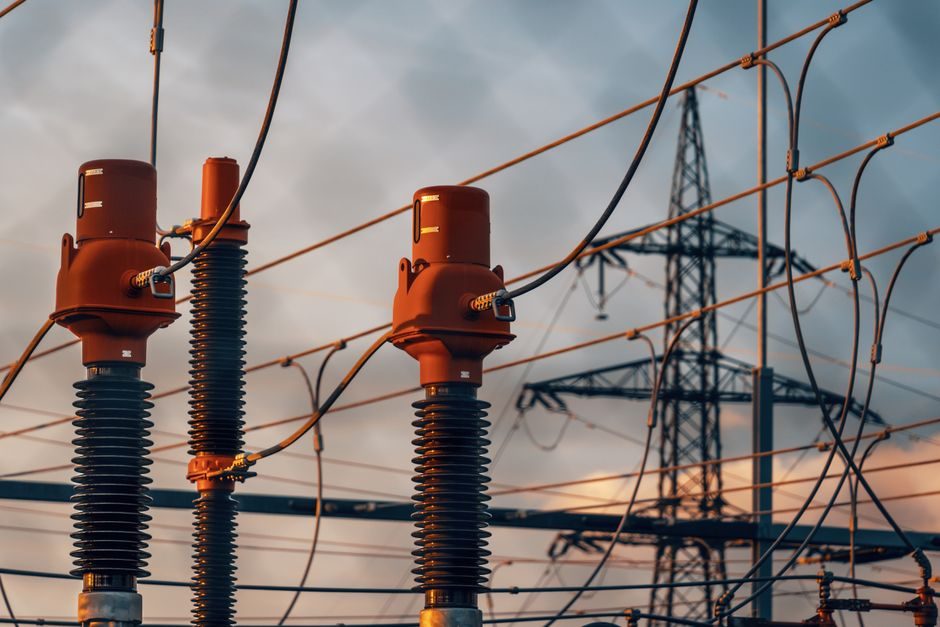
Lead times on large power transformers — units rated 80 MVA and above at 110 kV and higher — remained in the 12–24 month band through the first half of 2026, with the binding constraints sitting in grain-oriented electrical steel (GOES) lamination supply, copper conductor drawing capacity, and dry-type/cast-resin winding shop throughput rather than final assembly bay availability [S2].
Procurement teams in 2026 are no longer treating transformer sourcing as a single PO event: the work has shifted upstream into a multi-tier qualification exercise covering GOES mill allocation, kraft-paper and pressboard insulation capacity, and tap-changer (OLTC) vendor dual-sourcing, with order placement now commonly triggering a 6–9 month spec freeze before fabrication release [S2][S1].
GOES and copper: where the queue actually forms
Grain-oriented electrical steel (M2–M6 grades, typically 0.23–0.30 mm thickness) is the single longest-polarity material on a power-transformer BOM, and 2025–2026 mill allocations from the dominant producers have favored in-domestic utility contracts, leaving export-channel buyers facing 9–15 month call-off queues even for CRGO coils already in the mill production plan [S2].
Copper conductor (typically Cu-ETP / CW004A rectangular sections for HV windings, 1.6–4.0 mm strip for LV) sits as the second binding input; conductor drawing capacity for paper-covered continuously transposed cable (CTC) remains the choke point, with order books at the major European and Korean CTC lines running into 2027 Q1 for new 110 kV+ orders placed in 2026 [S2]. Sourcing teams that historically single-sourced CTC from one mill are now qualifying a second source as standard practice, and a third for any unit above 200 MVA [S1].
The practical lever: locking CRGO grade and thickness in the enquiry stage, and accepting mill-nominated coil widths rather than re-rolling, can shave 8–14 weeks off the material leg of the critical path. This mirrors the wider pattern covered in the power-semiconductor supply-chain 2026 wafer-tier breakdown, where upstream material allocation now drives the delivery date more than fab capacity does.
Dry-type vs oil-immersed vs cast-resin: capacity is not symmetric
Dry-type and cast-resin transformer (CRT) capacity is the third chokepoint and it is asymmetric across technologies. Cast-resin HV units above 36 kV are quoting 10–14 months, driven by epoxy vacuum-pressure impregnation (VPI) chamber availability and the limited number of foundries able to handle 5+ ton coil assemblies; oil-immersed ONAN/ONAF units at the same MVA class are quoting 12–18 months because they also absorb the GOES and copper queues; and conventional ventilated dry-type (VPI) below 36 kV remains the most readily available class at 4–8 months [S2].
Specifiers running mixed-voltage substations should treat the technology split as a capacity hedge: a 10 MVA cast-resin unit for an indoor 33 kV switchroom and an oil-immersed unit for the outdoor 132 kV step-up will not share a delivery date, and treating them as one procurement package tends to slip both. The technology fit is governed by IEC 60076-series for oil-immersed power transformers and IEC 60076-11 for dry-type, with the cast-resin classification sitting inside the dry-type family for the purposes of fire-class and partial-discharge limits.
What is in scope — and what is not

This is a sourcing-and-spec article for utility-scale and industrial power transformers in the 1 MVA to 500 MVA range, covering oil-immersed, dry-type, and cast-resin builds. It is intended for procurement engineers, substation specifiers, EPC electrical leads, and OEM planner-buyers operating in 2026 delivery windows [S1].
It is NOT a buying guide for distribution transformers below 1 MVA, NOT a tutorial on transformer design theory, and NOT a financial-market view on listed transformer OEMs. Readers looking for very small distribution-class units, instrument transformers, or rectifier transformers for electrolyzer service will find different lead-time and bottleneck profiles, and the conclusions below will not transfer cleanly to those product classes.
Selection criteria that actually move the delivery date in 2026
Four specification levers materially change quote-to-dispatch timing in the current market. First, impedance tolerance: tightening from the IEC 60076 default ±10% to ±7.5% forces a re-quote on the winding geometry and typically adds 6–10 weeks. Second, noise spec: a 55 dB(A) guarantee at 1 m on a 100 MVA unit requires tank-wall damping and active mounts that few vendors carry in stock; relaxing to 60 dB(A) opens a wider vendor pool and saves 8–12 weeks. Third, partial discharge: ≤10 pC at 1.5×Um narrows the vendor list to those with VPI or vapor-phase drying expertise; ≤50 pC is the default and unlocks more capacity. Fourth, OLTC vs DETC: a 17-step on-load tap-changer typically adds 14–20 weeks over a de-energized tap-changer, with the OLTC itself a single-source component on most European units [S2].
A practical comparison for specifiers in 2026, against four decision criteria:
• Oil-immersed ONAN/ONAF (≥110 kV): lead time 12–18 months; GOES/copper risk HIGH; fire-class constrained (typically requires bunding, fire walls, or ester fluid substitution); cost per MVA LOW at ≥50 MVA. • Cast-resin HV (≥36 kV): lead time 10–14 months; GOES/copper risk MEDIUM (lower core mass per MVA); fire-class favorable (IEC 60076-11 F1 / E2 / C2 classes commonly met); cost per MVA HIGH above 25 MVA. • Ventilated dry-type VPI (≤36 kV): lead time 4–8 months; GOES/copper risk MEDIUM; fire-class favorable; cost per MVA MID at ≤10 MVA. • Ester-fluid (natural or synthetic) filled: lead time 14–20 months; GOES/copper risk HIGH (same queues as mineral oil); fire-class favorable (higher flash point, lower flammability); cost per MVA MID–HIGH, used where mineral-oil bunding is impractical [S2].
Tier-N visibility: what digitization is actually changing in 2026

Supply-chain digitization in 2026 is delivering measurable value on two specific transformer BOM tiers: tier-2 (CRGO coils, copper CTC, transformer oil) and tier-3 (kraft paper, pressboard, OLTC diverter switches) [S2]. The shift is away from monthly forecast updates and toward weekly call-off confirmation tied to mill production schedules, with tier-2 status now pushed directly to the OEM planner from the material mill's ERP. The result is that the original 12–24 month quote is being replaced by a series of shorter confirmable windows, each with a defined confidence band.
What digitization is NOT yet doing well: tier-4 and below (epoxy resin suppliers, bushing porcelain and composite insulator makers, and the silicon-steel scrap re-melt chain) remain opaque to the OEM planner, and a bushing allocation slip is now a more common cause of late delivery than a core-steel slip. The model is closer to the pattern in OLED capacity planning, where the bottleneck has migrated downstream of the obvious material queue.
Failure modes and constraints buyers should price in
Three failure modes are showing up repeatedly in 2026 factory-acceptance-test (FAT) reports on newly delivered units. First, load-loss overshoot: actual no-load and load losses running 5–12% above the guaranteed figure on units where the GOES coil allocation was a downgraded M-grade; the IEC 60076-1 tolerance band still allows this, but the energy-cost penalty over a 30-year asset life erodes the procurement savings. Second, sound-level exceedance at no-load: tank-wall resonance on 50–80 MVA units where the noise spec was tightened late in the order; the fix is a retrofitted damping panel and a 2–4 week on-site rework. Third, OLTC contact wear outside duty-cycle expectations: usually traceable to a vendor that has been substituted under dual-sourcing pressure, and addressed only by a tighter IEC 60214 acceptance protocol on incoming inspection [S2].
Constraint buyers should price in: marine-shipping volatility for export-channel units (typical 2026 transformer sea-freight transit 28–45 days from EU or KR to US Gulf, with 7–14 day port-dwell variance), and a 6–10 week on-site erection and commissioning window for units above 100 MVA. Total project-critical-path from PO to energized handover for a 132 kV / 80 MVA oil-immersed unit placed in Q1 2026 is realistic at 18–22 months.
Standards, sourcing reference, and what the next 6 months will signal
The governing documents for the spec and acceptance decisions above are IEC 60076-1 (general), IEC 60076-2 (temperature rise), IEC 60076-3 (insulation levels and dielectric tests), IEC 60076-7 (loading guide), IEC 60076-11 (dry-type), and IEC 60214 (tap-changers); energy-efficiency classes for EU placed-in-service units follow the EU 548/2014 implementing measure tier-2 thresholds as the live regulatory floor in 2026 [S2]. Sourcing teams should treat the data points above as the working baseline.
Trackable signals for the next two quarters: (a) whether CRGO mill export allocation reopens after the Q2 2026 maintenance cycle at the major Korean and Japanese producers — a published allocation-letter or a mill-side press release is the cleanest read; (b) whether CTC order books at the second-tier (non-flagship) European mills push into 2027 Q3, which would force a further re-rating of the 1.6–4.0 mm strip sourcing cost; and (c) whether any of the major OEMs publish a dual-sourcing policy for OLTC diverter switches, which would mark the first industry-wide move away from the single-source tap-changer dependency that currently drives much of the late-stage slip risk. The sourcing environment covered here overlaps materially with the broader industrial-supply tightening described in the dynamic compactor 2026 cost and sourcing guide, and the procurement logic for transformer cores, conductors, and tap-changers is converging on the same tier-N visibility pattern discussed across the power-semiconductor supply-chain 2026 sourcing breakdown.
For component-level specifications, see dc power supply, switching power supply, and chain conveyor.