Silicon nitride (Si3N4) and sialon (SiAlON) protection tubes are the dominant immersion-heater sheath material in aluminum holding and casting furnaces, with manufacturers reporting >99% thermal efficiency and tube life of 12-24 months in direct molten-aluminum service [S3][S5].
Silicon carbide (SiC) radiant tubes are typically specified for high-temperature air-service furnace linings at 1200-1450°C with an 8-10 year life, not for direct immersion in aluminum melt, where unprotected SiC reacts with the bath and survives only 4-8 months [S2][S4]. The decision between the two comes down to bath contact, temperature ceiling, and total cost of ownership over a 5-7 year campaign.
Why molten aluminum destroys most ceramic tubes
Molten aluminum is one of the most aggressive melts in commercial foundry practice because the liquid metal wets, then chemically reduces, most oxide ceramics. A protective tube that wets allows aluminum to climb the wall by capillary action, attack the bond phase, and progressively thin the section until it fails. Si3N4 forms a thin, stable oxide skin on its surface that resists wetting, so aluminum does not stick to or chemically attack the tube [S2]. Sialon, a silicon-aluminum oxynitride variant of Si3N4, inherits the same non-wetting surface and adds a tougher grain-boundary phase; Sialon Ceramics has been shipping sialon immersion heaters to foundries since 1986 [S5].
SiC tubes, by contrast, can be wetted and reduced by molten aluminum over time, with documented service life of 4-8 months in direct bath contact compared to 12-24 months for Si3N4 under similar cycling conditions [S2]. The comparison table published by SGJL Fine Ceramic, summarised from casthouse operating data, ranks Si3N4 as "excellent" and SiC as "good" for thermal-shock resistance, and rates Si3N4 "excellent" versus SiC "fair" for corrosion resistance in molten aluminum [S2].
Direct immersion vs gas-fired top heating: efficiency and control
Immersion heaters using Si3N4 or sialon sheaths operate by direct conduction from a submerged ceramic wall into the bath. To hold a 720°C aluminum bath, the heater sheath only needs to run roughly 30°C above setpoint, around 750°C, so thermal efficiency exceeds 99% [S3][S5]. Gas-fired reverberatory furnaces must superheat the furnace atmosphere to 900-1000°C to push heat downward through a reflective aluminum oxide skin, with best-case thermal efficiency of 20-45% and worst case 20-30% in older units [S3][S5].
Temperature precision follows the same gap. Immersion systems with a PID loop and a thermocouple in the melt hold the bath within ±2°C of setpoint, versus ±10-15°C for a gas-fired roof burner that reads an atmosphere lagging the metal by minutes [S3][S5]. That tighter band cuts dross generation, because aluminum oxide growth is exponential with surface temperature, and it removes the burner-jet turbulence that folds oxide skins back into the bulk melt, a real defect source for aerospace and automotive castings [S5].
Decision matrix: Si3N4 vs SiC for an aluminum holding furnace
For a furnace spec, four criteria do most of the work: max continuous tube-surface temperature, direct-melt contact, thermal-shock cycling, and cost per campaign. [S4]
On maximum operating temperature, SiC radiant tubes hold structural integrity in continuous air service up to roughly 1450°C, beating metal alloys rated to 1250-1350°C [S4]. Si3N4 protection tubes are typically operated with sheath temperatures around 750-800°C in aluminum service, well below their material ceiling, so the temperature rating rarely decides an immersion-heater bid [S3][S5].
On direct-melt contact, Si3N4 and sialon win decisively with 12-24 month life versus 4-8 months for SiC in molten aluminum, because the Si3N4 surface oxide resists wetting while SiC is gradually attacked at the grain boundary [S2]. On thermal-shock cycling, Si3N4 has a low thermal-expansion coefficient and high fracture toughness, so it survives the repeated 700-800°C extraction and reinsertion cycles of immersion-heater maintenance; alumina and quartz tubes shatter under the same conditions, with service life dropping to 1-3 months and 1 week respectively [S2].
On cost, metal-alloy radiant tubes have a low purchase price but a 2-3 year life, with reported energy consumption 20-30% higher than SiC; SiC radiant tubes cost 3-4 times the metal baseline up front but run 8-10 years in air service [S4]. For aluminum holding furnaces specifically, the Si3N4 immersion-heater package (element, sheath, flanged mount, control) targets a 7-year operating life per KANTHAL design guidance, with the sheath as the planned wear item [S1]. Cast-house data also shows that switching from gas top heating to direct immersion cuts energy costs 30-50%, mostly from killing flue-gas and refractory losses [S5].
Use cases that pick the material for you
Si3N4 or sialon sheaths are the right call for any application where the tube sits inside the melt: aluminum holding furnaces, melting furnaces, die-casting machine thermocouple protection, degassers, and molten-metal pumps, plus zinc and magnesium alloy baths where the same non-wetting logic applies [S2][S3][S5][S6].
SiC radiant tubes are the right call where the tube is outside the bath, radiating heat across an air gap: heat-treatment furnaces, aluminum billet reheating furnaces with U-type radiant tubes, and any air-atmosphere application running continuously at 1200-1400°C [S4][S7]. Putting a bare SiC tube directly into aluminum is the most common mis-spec; it works for a few months, then fails by grain-boundary attack and wall thinning [S2].
Sizing and specification details that move life expectancy
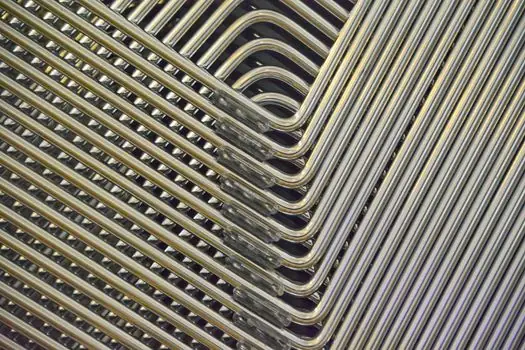
Wall thickness is the main trade-off in Si3N4 sheath design. Thicker walls resist mechanical impact and erosion better but slow thermal response, which matters when the heater is cycled by a PID loop. Most industrial immersion-heater designs land in the 3-6 mm wall range as the practical balance between durability and heat-transfer rate [S2]. Diameter is set by the resistance-heating element core, typically a NiCr wire wound on a ceramic bobbin inside the sheath [S3].
Composition grade matters as well. High-purity, high-density reaction-bonded or sintered Si3N4 is the baseline, but sialon (SiAlON) variants and aluminium-titanate ceramic formulations are used where extra toughness or specific thermal-expansion matching is needed [S2][S5]. Reference background on the base materials is available in the silicon nitride and silicon carbide encyclopedia entries, and on the furnace itself in the holding furnace overview.
On controls, the typical spec is a PID loop with a thermocouple in the melt, a flange-mounted heater boss, and a 12-month warranty on the ceramic sheath and resistance element; Sialon Ceramics, for example, warrants its immersion heaters against both chemical attack and electrical defects for that period [S5]. A related casthouse decision is the shot-sleeve fill ratio in the downstream die-casting cell, where the same ±2°C bath stability directly improves fill consistency.
Failure modes, limits, and what to track on the next campaign
The dominant failure mode for an Si3N4 immersion sheath is thermal-shock cracking during extraction for maintenance or after a power-loss cooldown, not chemical attack; the second is mechanical impact when a frozen-bath recovery attempts to pry the heater out [S1][S2]. For SiC radiant tubes, the dominant failure mode is oxidation and grain growth in continuous high-temperature air service, with the energy penalty building as the oxide scale thickens and emissivity drifts [S4].
Track two numbers across the next 12-18 months: sheath-side temperature in the bath, which should hold at 750°C ± a few degrees for a 720°C setpoint, and dross generation rate per shift, which is the cleanest single indicator of whether the new direct-immersion system is delivering the 30-50% energy and metal-loss reduction the spec claims [S3][S5].