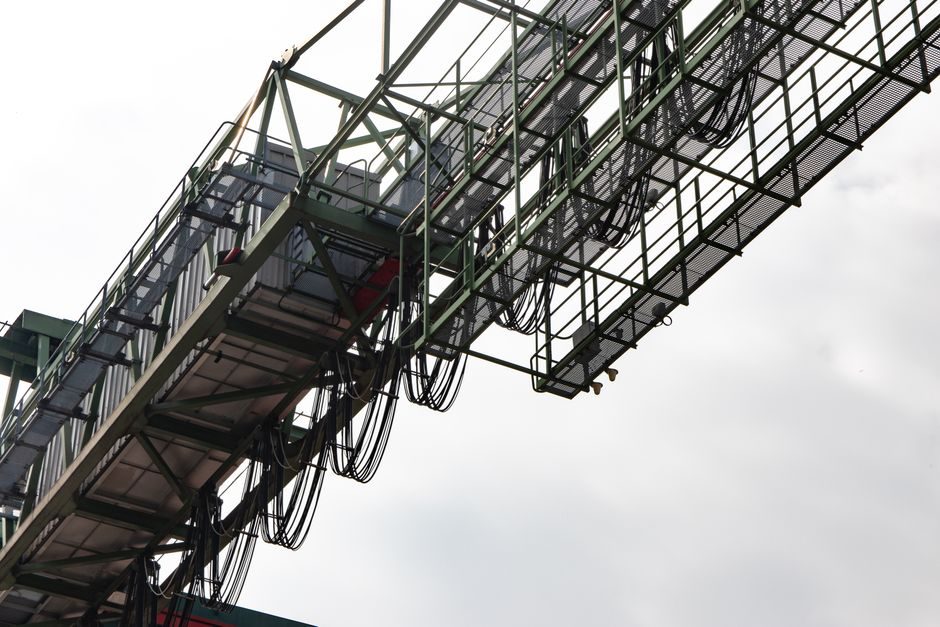
Single girder overhead cranes sold in mid-2026 carry a layered compliance stack: ISO 4301 series for classification, FEM 1.001 / 9.341 for duty grouping, EN 15011 for safety-of-machinery design rules, and CE marking under the EU Machinery Directive 2006/42/EC for any unit placed on the EEA market [S1]. Chinese OEM listings on Okorder cap the LD model single-girder bridge crane at 32 t maximum lifting capacity as of 2026-06-08 [S5].
For a buyer, the spec sheet that actually matters is not "single girder" vs "double girder" — it is the duty class letter (A3–A7 per ISO 4301-1, or FEM 1Bm–5m), the hoist group, the FEM 9.341 cycle hours, and whether the manufacturer publishes a Declaration of Conformity referencing EN 15011:2011+A1:2014. IMMA Global A.S. markets a single-girder unit that explicitly meets ISO and CE norms and is designed per FEM, DIN, VDI and CMMA rules, with a lifting-height envelope from 2 m to 70 m [S1]. TAWI's single-girder suspended crane covers the light end of the spectrum at 125 kg minimum and 1,500 kg maximum payload [S3].
Core Design and Safety Standard Stack for Single Girder Cranes
EN 15011:2011+A1:2014 is the harmonised European standard that gives single girder overhead cranes their CE presumption under the Machinery Directive 2006/42/EC; it covers structural design, welds (referencing EN 1090 execution class EXC2 as a typical minimum), hoisting and traversing mechanisms, and limiting/indicating devices [S1][S4]. ISO 4301-1 classifies cranes by utilisation class U0–U9 and load spectrum Q0–Q5, which combine into the A-series duty label stamped on the nameplate of every compliant unit [S1].
FEM 9.341 (now re-issued as FEM 1.001 in its 9th edition) drives the European duty grouping from 1Bm (light, infrequent) up to 5m (very heavy, continuous), and it pairs the mechanism group (M3–M8) with the structural group (S3–S9) to predict the theoretical service life in full-load cycles and operating hours [S1]. CMMA (Crane Manufacturers Association of America) and the Chinese GB/T 3811 together cover the equivalent duties for North American and PRC-built cranes, which is why IMMA's product page lists FEM, DIN, VDI and CMMA in a single compliance line [S1]. For light-duty suspended applications, a TAWI single-girder crane rated 125–1,500 kg typically falls into FEM 1Bm / 2m territory [S3].
Capacity Bands and Application Fit by Crane Class
The mainstream single-girder product line in 2026 splits into three payload bands that map directly onto standard duty groups: light-duty suspended or workstation cranes from roughly 0.125 t to 2 t (FEM 1Bm–2m, typical ISO A3–A4), mid-range workshop single-girder EOT cranes from 2 t to 16 t (FEM 2m–3m, ISO A4–A5), and heavy-duty single-girder units from 16 t to 32 t built to FEM 4m or 5m (ISO A6–A7) [S3][S5]. Xiecheng's catalog splits the offering into "Single Girder Crane", "Double Girder Crane" and "Suspension Crane" lines, which mirrors how Chinese OEMs separate light from heavy structural framing within the same product family [S4].
Single-girder cranes make sense for indoor workshop cells, machine-tending bays, light assembly lines and storage rooms with predictable load spectra — anywhere the hook height, span and cycle count fit inside a one-girder, under-running or top-running envelope [S3]. They are not the right tool for outdoor shipyards, hot-metal handling above A6, or 24/7 steel-mill coil yards; those applications shift to a double-girder EOT or gantry crane where the higher FEM 4m–5m duty and longer span justify the second girder. For a deeper comparison of selection criteria across lifting categories, the truck crane selection walkthrough is a useful adjacent read because the same FEM/ISO duty logic applies.
Hoist, Drive and Explosion-Proof Sub-Systems

Every single-girder crane is mechanically defined by its hoist: wire-rope electric hoists dominate the mid- and heavy-duty end (DEMAG, STAHL, Verlinde and Chinese equivalents on Okorder listings), while chain hoists and electric chain hoists own the sub-2 t band [S1][S5]. The hoist mechanism's FEM group, the hoist reeving (2/1, 4/1, 4/2, 8/2), and the hoist motor's duty rating (S3, S4 or S5 per IEC 60034-1) all flow into the overall ISO/FEM classification of the assembly [S1].
For hazardous-area plants, IMMA lists an explosion-proof single-girder variant alongside the standard line, and the relevant compliance layer becomes ATEX 2014/34/EU for the hoist motor, brakes, junction boxes and pendant controls, with IEC 60079-0 / IEC 60079-1 governing the motor enclosure and IEC 60079-31 the dust-tight variant [S1]. If the same crane is destined for a North American refinery, the equivalent path is NEC Class I Division 1 or Division 2 groups, with CSA C22.2 No. 33 on the hoist body. Traverse drives on a single-girder crane are typically two-motor end-carriages with skewed-axle or SEW-type geared motors rated for the FEM traverse group, sized so that bridge skew and creep do not exceed EN 15011 limits [S1][S4].
Nameplate, Documentation and CE Marking Workflow
A spec-compliant single-girder crane ships with five non-negotiable documents: the EC Declaration of Conformity (DoC) referencing Machinery Directive 2006/42/EC and EN 15011, the nameplate showing the FEM/ISO class, serial number and SWL, the operating and maintenance manual, the load test certificate (typically 1.25 × SWL static and 1.1 × SWL dynamic per EN 15011 §5.4), and the welding book referencing EN 1090-1 EXC2 as a minimum [S1][S4]. Okorder's "Quality Product, Order Online Tracking" pledge is an indicator that the LD model at 32 t capacity is sold with a load-test certificate issued at the manufacturer's bay [S5].
For CE marking specifically, the manufacturer must compile the technical file, run a risk assessment per EN ISO 12100, and — since 2014 — verify that any safety-related control system reaches at least Performance Level PL c under EN ISO 13849-1, with overspeed, overwind and limit-switch logic hard-wired or safety-bus implemented to that level [S1]. Buyers should reject any quote that cannot produce a DoC, that uses "CE" as a generic quality label rather than a notified-body-issued marking, or that omits the FEM/ISO class on the nameplate — these are the three most common shortcuts seen in 2026 trade-channel listings [S1][S4].
Materials, Welding and Surface Protection
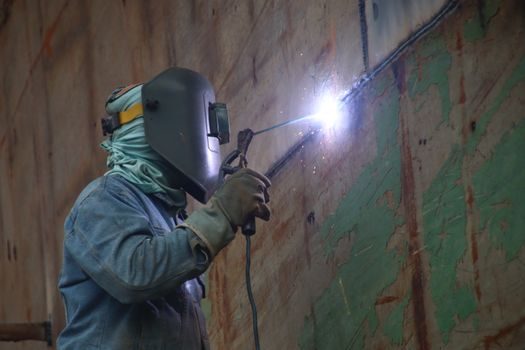
The girder itself is normally rolled-steel section (I-beam or H-beam) up to about 10 t SWL, and welded box-section plate girder above that, fabricated to EN 1090-1 execution class EXC2 as a baseline and EXC3 for any crane above FEM 4m or rated for outdoor service [S1][S4]. End carriages are cast or fabricated steel, with rail wheels forged or cast to ISO 6336 or DIN 15081 and heat-treated to a surface hardness typically in the 350–420 HB band. Hoist rope selection follows ISO 4309 for discard criteria and FEM 9.341 for rope group. Surface protection is normally a sand-blast to Sa 2.5 per ISO 8501-1, primer at 60–80 µm DFT, and a polyurethane topcoat to give the C3/C4 corrosivity category per ISO 12944 — Chinese OEM datasheets typically call out two coats of anti-rust primer plus a finishing enamel as standard [S4][S5].
Common Sourcing Signals and Buyer Red Flags in 2026
On 2026-07-08, Zhejiang Xiecheng Crane Machinery publishes a tri-line product split (Single Girder / Double Girder / Suspension) with direct English-language contact, which is a useful baseline for buyers comparing Chinese OEM datasheets against European EN 15011-stamped units [S4]. Okorder's 2026-06-08 listing pushes the LD single-girder bridge crane to 32 t SWL with a 500 set/month supply capability, but the listing does not display the FEM class or the DoC reference on the public page — a buyer has to request both documents before PO [S5]. IMMA's 2026-06-06 entry explicitly markets an explosion-proof single-girder variant on the same compliance line, with a 2–70 m lifting height envelope that signals it is positioned for petrochemical plant rooms rather than open yards [S1]. The persistent red flag across all three channels is missing EN 15011 / FEM 9.341 stamps on public datasheets — request them in writing before releasing the deposit.
Next trackable signal: monitor EN 15011 amendment cycles and any update to FEM 1.001 (9th edition) that re-classifies mechanism group thresholds — these are the two documents that govern how a single girder crane is actually sold, classified and CE-marked, and the published revision notes are the cleanest leading indicator of spec-sheet changes on the 2026–2027 OEM datasheets. For related fixed-path lifting equipment, the mobile crane and stacker crane encyclopedia entries round out the selection logic when indoor single-girder capacity is exceeded.