
Single girder overhead cranes on the 2026 market cover load ratings from light-duty EUROSYSTEM ST units up to 70 t (77.2 us ton) IMMA Global A.S. units, with spans running 3–35 m and lifting heights 2–70 m per the manufacturer's published data sheet [S1].
These cranes are built to ISO and CE norms, with FEM, DIN, VDI and CMMA duty classifications applied to girder sizing, hoist selection and end-carriage design [S1]. The single girder crane format is the default for workshops, warehouses, and molten-metal handling bays, with explosion-proof and low-headroom derivatives in the same product family [S1].
Duty classification drives the maintenance schedule
FEM/VDI duty group (1Am, 1Bm, 1Cm, 2m, 3m, 4m, 5m) sets the inspection interval: light-duty workshop units (1Am–2m) typically run annual visual + functional checks, while CMMA Class D/E or FEM 4m–5m units serving multiple shifts need quarterly wire-rope, brake and limit-switch inspection [S1].
CMMA 70/74/75 series and FEM 1.001 establish the number of full-load cycles the mechanism must withstand, and that cycle count — not calendar time alone — is what triggers overhaul of hoist brakes at roughly 1 million cycles for FEM 3m duty [S1].
Mechanical calibration points: wheels, rails, bridge alignment
End-carriage wheel diameter tolerance is typically held to ±0.05 mm per wheel set, with parallel misalignment between the two end carriages limited to under 2 mm across the full bridge span — verified with a dial gauge and laser alignment tool during annual survey [S2].
Rail gauge is checked against the installed span; a 35 m bridge running on 30 kg/m or QU80 rail must hold gauge to within ±5 mm of nominal, and the joint gap between rail sections should not exceed 1.5 mm to prevent wheel climb and flange wear [S2]. For a deeper look at the structural side, the steel fiber calibration reference covers bond behaviour and field checks that parallel girder stiffness verification.
Hoist, wire rope and limit-switch calibration
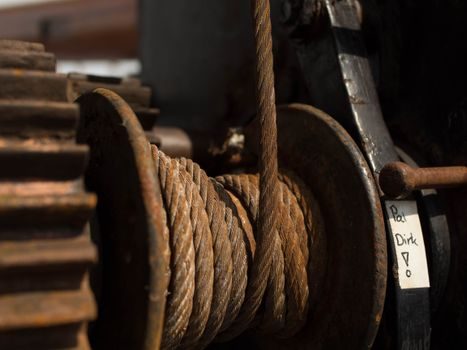
Wire rope (typically 6×36 WS or 6×19 S construction for hoist duty) is retired when outer-strand wear reaches 10% of nominal diameter, when broken wires exceed 12 in one rope lay, or when rope elongation exceeds 1% over a 1 m gauge length [S2].
Hoist over-travel limits are tested under no-load: the upper limit switch must trip with at least 50 mm of hook travel remaining before the top block contacts the drum, and the lower limit must stop the hook before the last 2 wraps of rope leave the drum [S2]. Pendant or radio-control dead-man switches are tested for <100 ms release-time, and emergency-stop circuits are checked for direct-to-coil cut-off, not just contactor drop-out [S2].
Electrical, explosion-proof and motor checks
For hazardous-area units, the explosion-proof enclosure integrity, cable gland sealing, and bonding of all metal parts are verified at each major inspection — a single damaged gland compromises the Zone 1/Zone 2 rating on the hoist motor and junction box [S1]. The explosion-proof electrical buying guide maps zone classification to enclosure specs and cable entry ratings.
Insulation resistance on hoist and travel motors is measured at 500 V DC; readings below 1 MΩ per phase trigger drying-out or rewind. Crane-scale verification on the hoist line is done with calibrated test weights at 25%, 50%, 75% and 100% of nameplate SWL — repeatability should fall within ±0.5% of applied load [S2]. For weighing-instrument methodology, the crane scale reference covers load-cell drift, corner-load testing and the re-calibration window.
Calibration vs maintenance: where the line sits

Calibration is the quantitative side — load-test verification, limit-switch trip-point adjustment, brake-torque measurement, and weigh-system linearity check against known masses, all traceable to a standard [S2].
Maintenance is the mechanical side — lubrication (grease every 400 h for bearings, gearbox oil change at 3 000 h or annually), brake-pad thickness, rope dressing, wheel-flange wear, and electrical contactor tip inspection [S1]. The two run on different cadences: calibration on a defined test cycle (typically annual for SWL, six-monthly for production-critical units), maintenance on runtime hours plus visual cues [S2].
Common failure modes and field fixes
Three recurring defects show up in survey reports: bridge skew beyond 5 mm causing one end-carriage to take full trolley load, brake-lining wear below 3 mm causing hook drift on hold, and pendant cable insulation cracking at the strain-relief boot causing intermittent control [S1][S2].
Trackable signals to watch through 2026: a rising share of EU-made EUROSYSTEM ST light-duty single-girder units at the low end of the range [S3], and continued Chinese-OEM supply from Zhejiang Xiecheng, Zhongyuan Ship Machinery and NUCLEON covering both EN 15011-conformant workshop and shipyard-duty variants [S2][S4][S5]. Watch the truck crane selection guide for the mobile side of the same lifting-duty spec bands. For tracked outdoor lifts on uneven ground, the crawler crane format is the parallel mobile option.