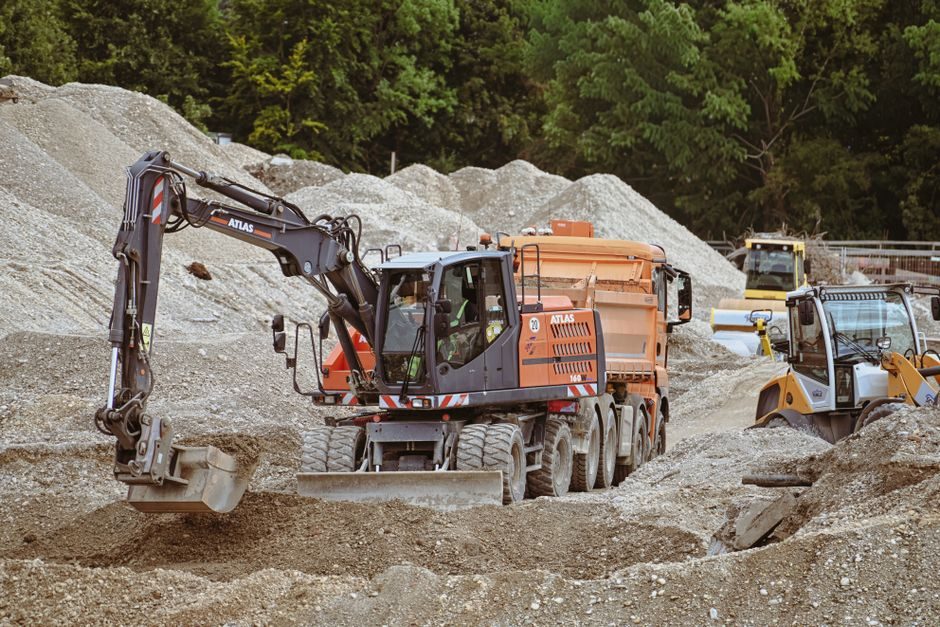
A skid steer loader is a compact, four-wheel machine with independent left/right drive that turns by varying wheel speed, and its working envelope is defined by engine power from 47.5 kW (64.58 hp) on a KATO IMER AS28 [S1] up to 92 hp (68.7 kW) on a Bobcat S770 diesel [S2], with operating weights of 2,925 kg (6,448.5 lb) [S1] and 4,224.8 kg (9,314 lb) [S2] respectively. The platform's defining advantage is attachment density: the KATO IMER AS28 alone accepts buckets, snowplow blade, sweeper, brushing head, hydraulic breaker, crusher bucket, concrete bucket, grippers, pallet forks, bale fork, and trenching head as factory options [S1].
Because the machine pivots on its own axle rather than steering, it is short, narrow, and manoeuvrable in places a backhoe loader or wheel loader cannot enter — but the same geometry that enables 360° on-site rotation also drags the tyres sideways during every turn, which is the root cause of its most-cited drawback.
Compact Footprint and One-Side Loading
Skid steers typically measure under 2 m wide and under 4 m long with bucket, so a single unit can pass through a 1.8 m garden gate, a standard 3 m roller-door bay, or a barn doorway that excludes a backhoe loader on overall width [S1]. Operators routinely load from one curb line on narrow urban streets, then drive straight off without turning radius to plan, which is why rental fleets dominate the landscaping, demolition, and agricultural segments.
The trade-off is chassis rigidity: with no articulated joint, the frame absorbs bucket breakout force as torsional stress, so high-flow auxiliary hydraulics must be derated versus an equivalently powered wheel loader. That is why manufacturers such as KATO IMER publish attachment-specific operating pressures rather than one universal figure [S1].
Power Density and Engine Sizing
Engine power on machines currently listed in the DirectIndustry catalogue clusters between 47.5 kW (64.58 hp) at 2,925 kg on the KATO IMER AS28 [S1] and 92 hp (≈68.7 kW) at 4,224.8 kg on the Bobcat S770 [S2], giving roughly 15–22 kW per tonne across the population. The Bobcat S770 explicitly meets Tier 4 emissions without a diesel particulate filter (DPF) by design, eliminating DPF regeneration downtime and long-term DPF service cost — a maintenance-budget distinction that matters for fleet operators running two-shift schedules [S2].
Disadvantage: the same compact engine bay concentrates heat around the operator, so cab pressurisation, smart cooling, and cold-weather protection packages are priced options rather than standard, and they directly affect uptime. The S770 specification lists battery run-down protection, hose/quick-coupler guarding, and a Smart Cooling system as engineered uptime features rather than cosmetic add-ons [S2].
Attachment Versatility vs. Hydraulic Budget
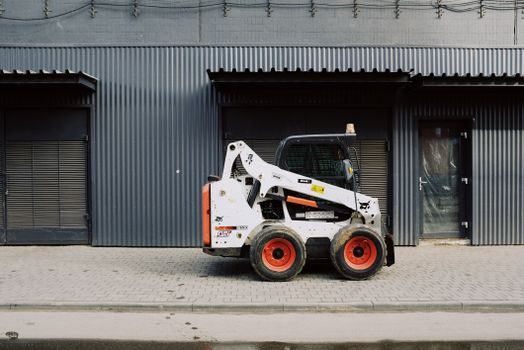
Skid steers are attachment platforms first, earthmovers second: KATO IMER fits the AS28 with more than 11 distinct factory attachment types [S1], Auger Torque markets its Earth Drill 3000–4500 series specifically for skid steers between 50–80 hp [S3], and Caterpillar publishes a dedicated skid steer and compact track loader bucket line [S5]. Chinese OEM Senyue lists the SYZN-S65, T23, and T1000 series with over 20 configurations and more than 100 attachment types from a single supplier catalogue, so the modular claim is verifiable across at least four independent vendors.
The binding constraint is auxiliary hydraulic flow. Auger Torque explicitly sizes its 3000–4500 drive range to the 50–80 hp skid-steer class with output-shaft bearings 50% larger than competitor equivalents — a design choice driven by the high-torque, low-speed duty cycle that hydraulics-only loaders experience when an auger stalls in rocky ground [S3]. Operators who underspec auxiliary flow see slow cycle times and overheated pumps, which is the most common reason a 92 hp machine feels underpowered on a breaker or trencher job.
Operating Cost: Tyre Wear, Ride Comfort, Noise
Tyre wear is the single largest variable maintenance cost on a skid steer because the machine turns by dragging tyres rather than rotating them on a kingpin. Hard-surface yards accelerate shoulder wear; a solid-tyre or foam-fill upgrade typically doubles the wheel budget but removes downtime from punctures. Bobcat's S770 specification calls out a maintenance-free chaincase and reduced routine service intervals to offset this category of cost, but the catalogue description does not quote a tyre-life figure [S2].
Ride comfort is the second structural disadvantage. With a wheelbase roughly half that of a wheel loader, vertical shock on broken ground is transmitted directly to the operator station; cab suspension is an upcharge, and the open-station variants used in agriculture often have no suspension at all. Long-shift operator fatigue on unprepared sites is a documented productivity hit and a vibration-related health exposure (whole-body vibration, ISO 2631 evaluation criteria — applicable to self-propelled work machines).
Lift Capacity, Reach, and Stability
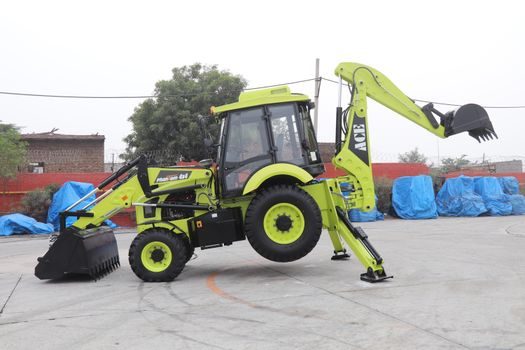
Radial-lift skid steers (the smaller AS28 class at 2,925 kg [S1]) offer good breakout at grade but limited reach at maximum lift height, while vertical-lift models such as the Bobcat S770 trade low-end breakout for parallel lift at full height [S2]. For truck-loading at 2.5–3.0 m hook height, vertical-lift geometry wins on cycle time; for grading or back-dragging at low height, radial-lift wins on pushing force.
Tipping load is the hard limit, and skid steers are intentionally operated without a counterweight. The KATO IMER AS28 catalogue excerpt [S1] does not publish a rated operating capacity, listing only engine power (47.5 kW / 64.58 hp) and operating weight (2,925 kg / 6,448.5 lb), so buyers should request ROC directly from the manufacturer before specifying a hydraulic breaker or auger. Auger Torque's 50–80 hp sizing range [S3] is itself a proxy for the ROC envelope, because an attachment that exceeds machine stability becomes dangerous regardless of hydraulic capacity.
Sourcing, Standards, and Supplier Landscape
Globally available skid steer lines in 2026 include KATO IMER (Italy, AS28 at 47.5 kW [S1]), Bobcat (USA, S770 at 92 hp with non-DPF Tier 4 engine [S2]), XCMG (China, XC740K / XC760K / XC7-SR08 / SR10 / SR12 family at US$5,000–20,000 per unit FOB [S6]), and Senyue (China, T23/T1000/S65 series with 20+ configurations). Attachments come from dedicated specialists such as Auger Torque (UK, Earth Drill 3000–4500 for 50–80 hp hosts [S3]) and from OEM accessory lines such as Cat skid steer buckets [S5].
Buyers comparing machines across borders should weigh three independent criteria before signing a purchase order: rated operating capacity (ISO 14397-1, 50% tipping), engine emissions tier (EPA Tier 4 Final / EU Stage V, with explicit non-DPF design if the S770 specification is the benchmark [S2]), and attachment hydraulics (auxiliary flow in L/min at rated pressure). A 47.5 kW AS28-class machine [S1] is correctly paired with low-flow augers and brooms; a 92 hp S770-class machine [S2] is the minimum envelope for high-flow mulchers and cold planers. Mismatched pairing is the most common cause of premature hydraulic failure in mixed-fleet rental yards, and is the single most actionable decision a spec engineer can lock in writing. For a side-by-side classification of platform variants, see the skid steer loader types and classifications field reference; for comparison points that translate the same trade-off logic to a different compact machine class, the AGV robot advantages and disadvantages field view is a useful cross-check.
For component-level specifications, see skid steer loader.