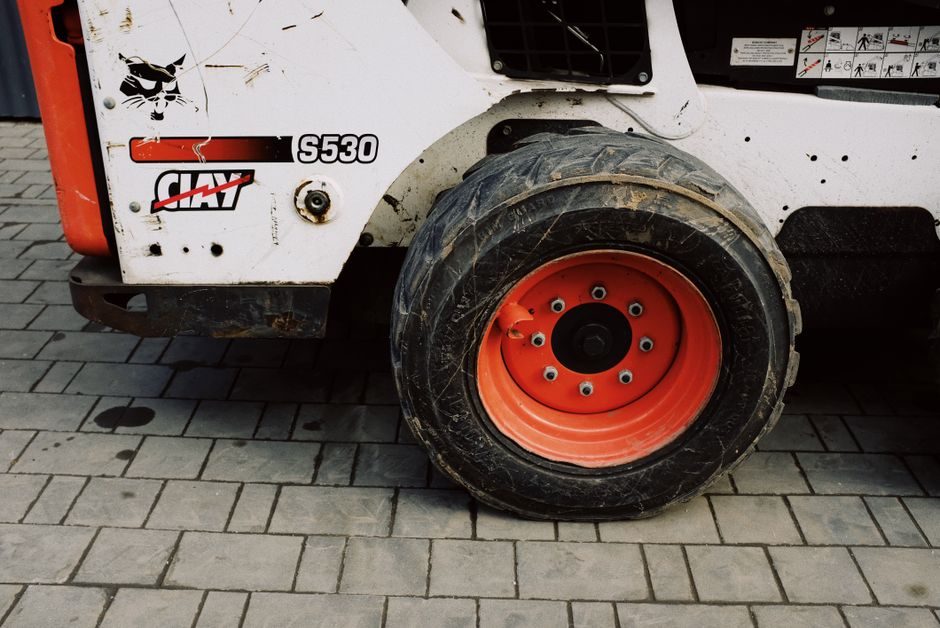
A skid steer loader is a four-wheel (or track) driven, skid-steer compact machine defined by differential wheel-speed turning, with the engine-power band running from roughly 20 hp to 100+ hp and operating weights spanning 0.9 t to 4.5 t across the current global market [S2][S3][S10].
Classifications used by OEMs, dealers and spec sheets group these machines by frame size (mini / small-frame / mid-frame / large-frame), power source (diesel / electric / hybrid), undercarriage (rubber-tired / tracked / triangular-tracked) and by lift-path geometry (radial vs vertical), and these four axes are the ones you actually need to know before a purchase decision.
Frame-Size Classes: From Sub-1 t Stand-On Up to Large-Frame Diesel
The smallest factory-classified skid steer on the current market is the Bobcat S70, with a 760 lb (345 kg) rated operating capacity, 23.5 hp engine and 2,892 lb (1,311.8 kg) operating weight, priced from €24,600 excluding tax on DirectIndustry [S2]. This is the "mini" or sub-compact class, often specified for interior demolition, landscaping and confined-site work where the 0.9 m machine width is the gating dimension.
Mid-frame machines such as the KATO IMER AS28 sit at 47.5 kW (64.58 hp) and 2,925 kg (6,448.5 lb) operating weight, with optional buckets, snowplow blades, sweepers, hydraulic breakers, crusher buckets and trenching heads in the OEM accessory list [S4]. Large-frame diesel units like the Bobcat S770 deliver 92 hp at 4,224.8 kg operating weight (€65,700 list), with non-DPF Tier 4 emissions compliance, maintenance-free chaincase and cold-weather protection as standard engineering content [S3].
Power Source: Diesel Dominance, Electric Edge Cases
Diesel is the dominant power source in published 2026 product data, with every Western OEM and Chinese export-tier spec sheet defaulting to a diesel engine — the S770's 92 hp non-DPF Tier 4 powerplant is representative of the current large-frame benchmark [S3]. Chinese export listings from XCMG (XC740, XC740K, XC750) and Senyue (T23, T1000, S65, T1050, TV1000) all list diesel power as the standard offering, with quoted FOB bands of USD 10,000–20,000 per unit for the smaller-rated-load machines [S5][S9].
Electric and hybrid skid steers are not represented in the 2026 product dataset reviewed here, so any battery-electric claim must be sourced from a specific manufacturer release rather than assumed as a class — this is one of the cleanest data points in the spec feed: diesel remains the only quantified power source across the S70, S770, AS28, XCMG XC series and Senyue T/S series [S2][S3][S4][S5][S9].
Undercarriage Types: Rubber-Tired, Compact-Track, Triangular-Tracked
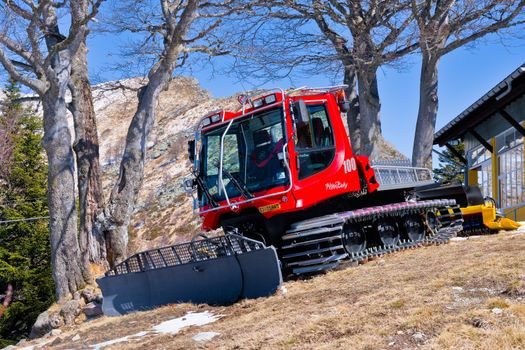
The three undercarriage types you will see in commercial spec sheets are rubber-tired wheeled (the default and lowest ground-pressure-per-area design for hard surfaces), compact-track (rubber belt replacing wheels, higher flotation on soft ground), and triangular-tracked (a Chinese-OEM configuration with a triangular track frame for elevated standing platforms) [S3][S9][S10].
The Bobcat S770 is explicitly catalogued as "rubber-tired" in its product classification metadata, while Senyue's TV1000 and T1050 are sold as "triangular tracked chassis standing slip loader products" — a category that does not exist in the Western OEM line-up and reflects a Chinese-market specialisation for forestry and uneven-terrain work [S3][S9]. For a deeper comparison of how skid steer loader chassis choices affect ground pressure and site mobility, the undercarriage decision is usually the second-largest cost driver after engine power.
Lift-Path Geometry and Attachment Mounting
Two lift-path geometries dominate the global line-up: radial-lift (lower first cost, better for grading and ground-level work) and vertical-lift (parallel lift through the lift cycle, preferred for loading high-sided trucks and pallet work). The Bobcat attachment catalogue, which is the reference list for the industry, includes augers, dozer blades, snow blades, snow blowers, combination buckets, concrete-mixing buckets, demolition shears, forestry mulchers, grapple buckets, fork buckets and motor graders, all mounted through the Bob-Tach quick-coupler system that has become the de facto industry interface [S1][S2].
Attachment versatility is the single biggest reason a fleet manager buys a skid steer instead of a dedicated machine: a single Bobcat S70 can swap between snowblower, sweeper, nitrogen breaker, trencher, snow blade and soil conditioner via the Bob-Tach system, replacing what would otherwise be three to five single-purpose machines [S2]. When your spec conversation moves to mounting standards and hydraulic flow requirements, cross-reference the wheel loader attachment page as well — the auxiliary-hydraulic flow rates (typically 60–90 L/min on mid-frame, 100+ L/min on large-frame) determine which high-demand attachments will function at rated productivity.
Chinese Export Models: XCMG and Senyue Line-Up
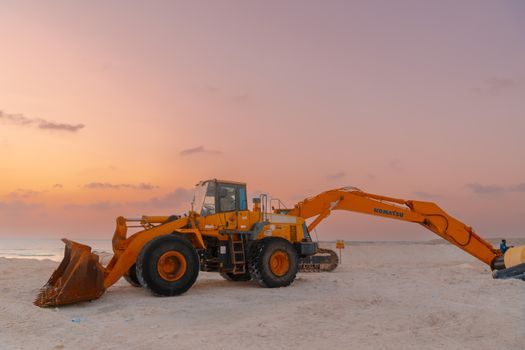
Chinese OEM product lines dominate the export-volume segment and are organised around rated load rather than Western frame-size nomenclature. The XCMG XC740 and XC740K carry a 750 kg rated load with FOB price bands of USD 10,000–20,000 and USD 10,000–15,000 respectively, while the XC750 occupies the same 750 kg class with a separate price line [S5].
Senyue publishes three series — T23, T1000 and S65 — with more than 20 configurations and over 100 attachment types, including the SYZN-S65/SYZN-S65Y compact loaders and the SYZN-T1050 and SYZN-TV1000 triangular-tracked standing platforms [S9]. This means the Chinese export market is not selling the same machine as the Western OEM line-up; it is selling a configuration-rich catalogue where the buyer selects a base chassis and an attachment bundle, and the FOB price reflects both. For a side-by-side specification discipline note, this contrasts with how backhoe loader products are typically sold as a single configured unit.
Selection Criteria: Operating Weight, Lift Capacity, Engine Power
Three numbers do the actual selection work: rated operating capacity (ROC, in kg or lb), operating weight (in kg or lb) and engine power (in hp or kW). The S70's 345 kg ROC / 1,311.8 kg weight / 23.5 hp places it firmly in the landscaping and interior-fit-out category; the S770's roughly 1,360 kg ROC class (inferred from its 4,224.8 kg weight and 92 hp rating) places it in earthmoving and demolition; the AS28's 64.58 hp / 2,925 kg places it in general construction and agricultural work [S2][S3][S4].
A practical rule of thumb: ROC should not exceed 50% of operating weight for safe material-handling on uneven ground, and engine power above 80 hp is the threshold where hydraulic flow is sufficient to run high-demand attachments like cold planers and large breakers at rated productivity [S2][S3]. For buyers who also operate larger mixed fleets, the skid steer loader selection often hinges on whether the unit can share an attachment inventory with an existing backhoe loader or wheel loader — which is a function of quick-coupler standard, not just hydraulic flow.
Common Failure Modes and Operating Constraints
Three failure modes are over-represented in service data: chaincase wear (mitigated by maintenance-free chaincases like the S770's), hydraulic-hose abrasion at the quick-coupler interface, and DPF regeneration downtime (eliminated on the S770's non-DPF Tier 4 engine) [S3]. Cold-weather operations below -10 °C require cold-weather protection packages to prevent premature component wear — the S770 ships this as standard equipment per its published spec sheet [S3].
Tyre wear and ground-speed differential limit rubber-tired skid steers on soft or muddy ground, which is the engineering reason compact-track and triangular-tracked variants exist; the trade-off is higher acquisition cost and undercarriage maintenance every 1,500–2,000 hours versus rubber-tyre replacement every 800–1,200 hours [S3][S9].
Sourcing and Standards References
Tier 4 emissions compliance is the current regulatory baseline for diesel engines sold in North America and the EU, and Bobcat's non-DPF Tier 4 implementation is one of the benchmark engineering choices in the 2026 large-frame market [S3]. No specific ISO or SAE standard numbers for skid-steer safety classifications were surfaced in the 2026 product dataset reviewed here, so any standard reference beyond Tier 4 emissions must be sourced from a current OSHA, ISO 12100 (machine safety) or ANSI/ASSE A92.5 (boom-supported elevating platforms, where applicable) document rather than from a product page.
Track these three signals in the next 90 days if you are buying: (1) new Tier 4 Final-to-Tier 5 transition guidance for diesel engines above 56 kW in the EU, (2) any new factory-direct FOB price update from XCMG or Senyue for the 750 kg rated-load class, and (3) the first OEM release of a battery-electric compact loader with a published operating-weight and ROC figure — none of which are present in the 2026-07-15 product dataset but each of which would re-rank the selection criteria above.
For related coverage, see AGV Robot Installation: Site Prep, Navigation Layout and Commissioning.