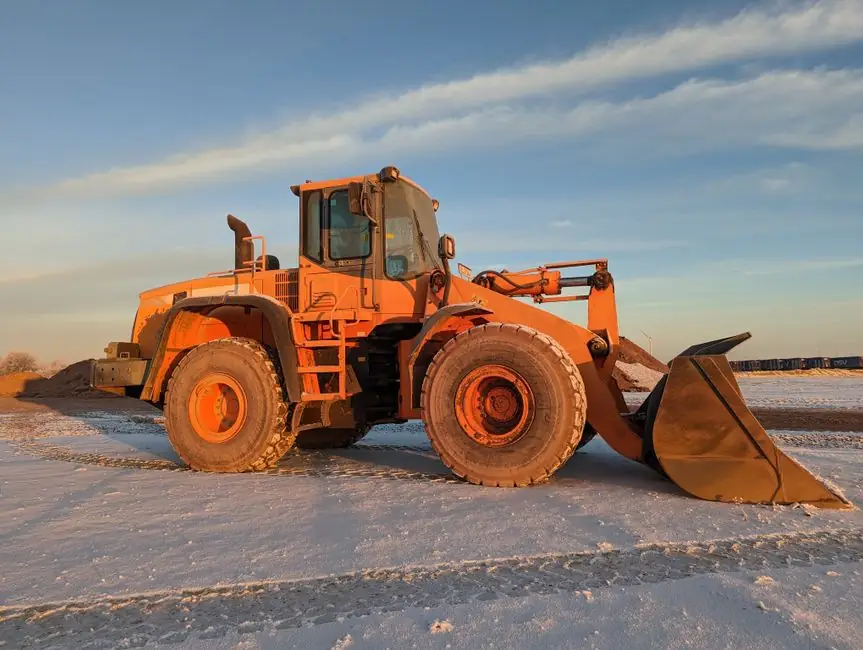
For road-building crews, a skid steer loader in the 60-80 hp, 2,000-3,500 lb rated operating capacity (ROC) band is the workhorse class for sub-base prep, backfilling, and attachment-driven milling work, with published industry specs spanning 15-191 hp net power and 370-4,130 lb ROC across the global model range [S2].
The same skid steer loader category, because of hydrostatic drive and quick-change attachment plates, is routinely cross-deployed between grading, trenching, and compaction-support tasks on road jobs, making spec selection more about matching lift path and tip load than raw horsepower [S1][S5].
Operating envelope: power, weight, and ROC bands road crews actually see
Across 370 cataloged models, net power spans 15-191 hp and operating weight spans 1,750-18,528 lb, so the road-construction decision is rarely about the absolute extremes but about the 50-100 hp / 6,000-9,000 lb cluster where most production machines sit [S2]. Rated operating capacity in that cluster typically lands between 1,300 and 3,500 lb, which is the binding constraint for a wheel loader bucket of aggregate or a plate compactor with ballast [S2][S3].
Published examples such as the ASV RS-75 (74.2 hp, 7,595 lb operating weight, 2,600 lb ROC, 125 in lift height at pin) and ASV VS-75 (74.3 hp equivalent, 8,910 lb, 3,500 lb ROC, 130 in pin height) show how a 1,000 lb ROC delta within one engine platform changes the usable bucket size and the choice between radial and vertical lift [S3]. Lift height at pin matters whenever a crew loads a 4-6 ft side-dump truck or feeds a portable crusher, since bucket-hinge geometry, not raw engine torque, sets the truck-side clearance.
Lift path geometry: radial vs vertical, and why the road differs from the demo yard
Vertical-lift machines keep the bucket arc flatter as the arms rise, which preserves reach at the top of the lift and is preferred for loading high-side dump trucks, placing rebar cages, or stacking pipe on a road right-of-way; radial-lift machines deliver higher breakout force at ground level and are the lower-cost default for grading, backfilling, and planing work [S3][S4].
For road projects that mix sub-grade work (radial-friendly) with truck loading (vertical-friendly), the practical rule is to spec the lift path to the dominant 60% of cycle time, not the most spectacular single task, because retrofitting lift geometry on a production machine is not field-practical [S3]. Where soft subgrade, mud, or freshly placed aggregate threatens wheeled traction, the parallel compact track loader (CTL) variant, originally spun off from Bobcat rubber-track conversions in the late 1960s, gives materially better flotation at the cost of higher ground pressure on finished surfaces and slower roading speed [S4].
Attachment and drive-train integration for road work
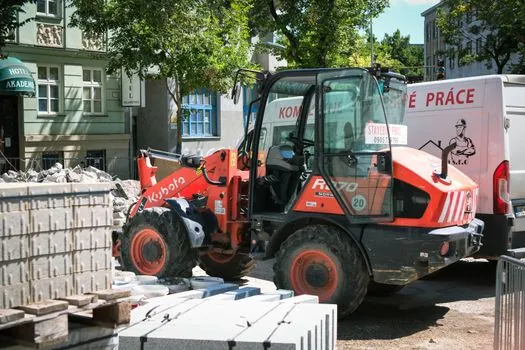
All production skid steers use hydrostatic drive with side-to-side speed differential steering, meaning the machine "skids" rather than articulating, and the smallest air- or water-cooled gas units have given way to 4-cylinder diesel platforms in the typical road-spec unit [S5]. The hydraulic auxiliary circuit, not the engine, sets attachment productivity: high-flow (often 30-40 gpm class) auxiliaries are required to run planers, cold planers, and trenchers at productive shaft speeds, while standard-flow circuits are adequate for buckets, brooms, and pallet forks [S1][S5].
For road crews the attachment family that drives machine choice is: planer/milling wheel, trencher, auger, breaker, compaction wheel, broom, and snow/blade in cold-climate shoulder work; matching machine ROC to the heaviest attachment (a fully loaded breaker or a wet milling drum) plus 10-15% margin is the standard sizing step [S3][S6]. A typical small-frame machine near 1,300 lb ROC is well-matched to 6-9 in trenching and light auger work, while a mid-size 2,500-3,500 lb ROC unit is the minimum credible platform for an 18 in planer or a mid-sized breaker [S3][S8].
Frame size, transport weight, and small-site maneuverability
Industry guides consistently segment skid steers into small, mid-size, and large frames, with the small frame preferred for interior demolition, landscaping, and tight urban work, the mid-size frame as the versatile default, and the large frame reserved for high-ROC material handling and demolition [S8]. Small frames are typically easier to trailer behind a 1-ton pickup, and that transport logistics, not the rated spec, often sets the lower bound on a road contractor's fleet.
Compact dimensions also matter on active road jobs: published widths of 60-72 in on common small/mid-frame models allow lane-closure work in a single traffic lane, and overall length near 146 in with bucket fits a standard 8 ft equipment trailer without permits in most jurisdictions [S3]. For shoulder work, ditching, and culvert cleaning, a small-frame machine with a 4-in-1 bucket is often a better economic fit than a larger radial-lift unit that the same crew cannot efficiently load on a lowboy.
Spec comparison: small, mid-size, and large frame at a glance
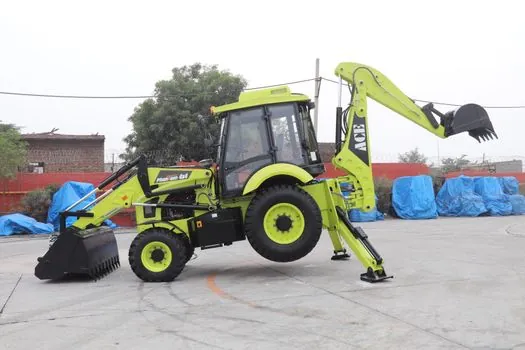
Across the catalog, the practical decision matrix reduces to four criteria: net horsepower, operating weight, rated operating capacity, and lift path, and the table below shows how the three frame classes line up for road work [S2][S3][S8]:
- Small frame (under ~60 hp, under ~6,000 lb, 370-1,500 lb ROC, radial lift typical): best for landscaping edges, sidewalk rehab, and trenching in finished surfaces; limited on truck loading.
- Mid-size frame (60-80 hp, 6,000-9,000 lb, 1,500-3,500 lb ROC, radial or vertical): the default road-construction class, covers backfill, planing, breaker, and truck loading in one machine.
- Large frame (80-191 hp, 9,000-18,528 lb, 3,000-4,130 lb ROC, mostly vertical): demolition, high-side truck loading, and production milling where cycle time dominates labor cost.
Selection gates specific to road construction
Gate 1, lift path: choose vertical if truck loading or high-reach placement is more than 30% of cycle hours; otherwise radial is the lower-cost default [S3]. Gate 2, hydraulics: high-flow auxiliary is required for planers, cold planers, and breakers above mid-size, and the auxiliary circuit spec must be confirmed before, not after, attachment purchase [S1][S5]. Gate 3, traction: on soft subgrade, mud, or reclaimed aggregate, spec the tracked variant and accept the roading-speed penalty, because wheeled machines in those conditions consume operator hours in recovery, not production [S4].
Gate 4, transport: confirm operating weight, width, and height against the contractor's trailer and any local oversize rules; a 9,000 lb machine on a 10,000 lb trailer is workable, but an 11,000 lb machine on the same trailer violates most jurisdictions [S3][S8]. Gate 5, support: published OEM entry pricing for current-generation skid steer loaders begins around $61,101 USD on Bobcat's Pro S6 platform, and fleet planners should compare total cost of ownership (fuel, filters, track/tire wear, and high-flow hydraulic maintenance) rather than acquisition price alone [S7].
Where skid steers stop and other carriers start
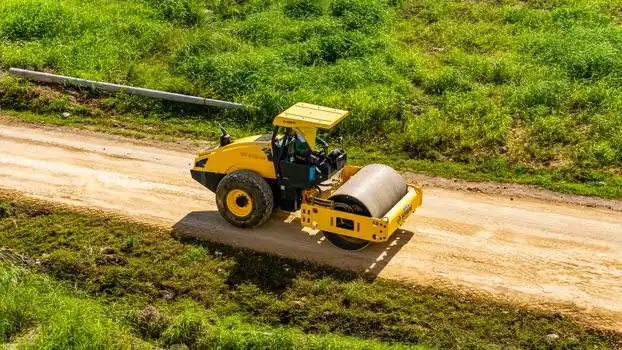
For sustained grade work, fine trimming, or long-haul aggregate cycles, a wheel loader with articulated steering beats a skid steer on cycle time, and for deep utility trenching below 12 ft a backhoe loader with an extendable boom is the more productive carrier. A skid steer is the right tool when the bottleneck is access, attachment changeover, and trailer logistics, not raw cycle productivity on a wide-open site [S1][S6].
On dense urban road rebuilds where the machine shares the lane with a road roller doing the compaction pass, the skid steer's compact footprint and quick-coupler plate let one operator swap from planer to bucket to broom between lifts without leaving the work zone, which is the productivity case that keeps the category in road fleets despite the wheel loader's higher per-cycle output [S1][S4].
Trackable signals and next data nodes
Track the next 90-day OEM price-list updates for high-flow auxiliary availability on mid-size frames, and the next round of compact track loader rubber-track wear-life data, since track replacement cost is the single largest variable maintenance line on tracked skid steer variants. For road-specific application, watch for planer drum width options (18 in vs 24 in) being qualified on the 60-80 hp platform, because a 24 in planer on a 2,500-3,000 lb ROC unit is the productivity threshold that typically pushes a crew from a skid steer to a dedicated compact milling machine. [S3]
Related analysis: LPDC Machine Selection for Automotive Castings.