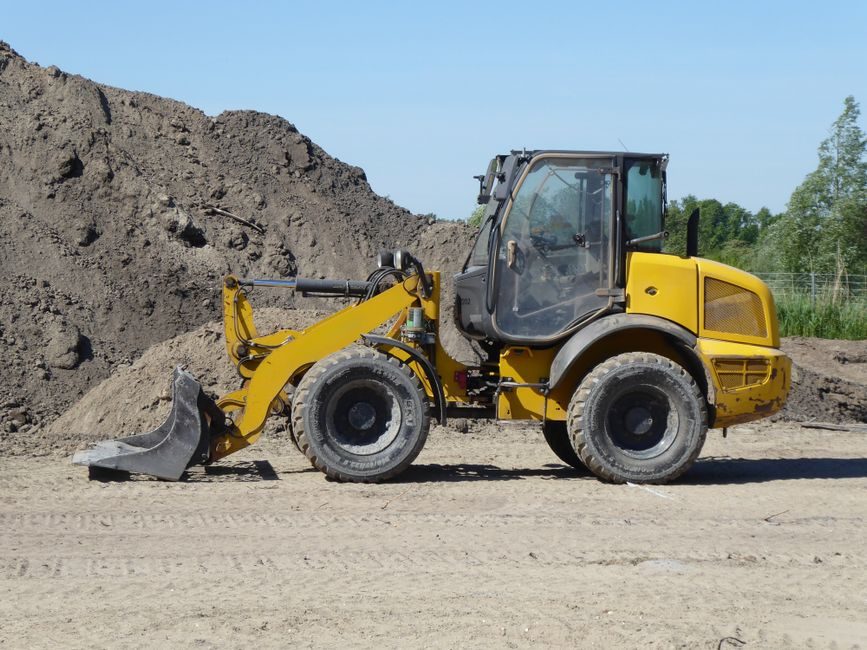
Operating weight and rated operating capacity (ROC) bracket the skid steer market into four practical bands — sub-1 t, 1–2 t, 2–3 t, and 4 t-plus — and every other spec (engine power, hydraulic flow, tyre size, bucket width) scales with that band [S1][S2][S4][S5].
Attachment interface is the first hard cut: Bobcat Bob-Tach and ISO-style quick hitches in the 1,125 × 825 mm class (HT65A) are dominant, and a machine that does not match the fleet hitch is a non-starter regardless of engine output [S2][S10].
Operating-Weight Bands and Where Each One Earns Its Keep
The Bobcat S70 sits at 2,892 lb (1,311.8 kg) with 760 lb (345 kg) ROC and a 23.5 hp Tier 4 engine, sized for access work where a 3 ft wide standard bucket is the constraint, not lift height [S1]. For a site that needs to pass through a standard gate or down a finished floor corridor, the S70-class machine is the realistic floor; anything heavier is a logistics problem before it is a productivity one.
At the other end, the Bobcat S770 ships at 9,314 lb (4,224.8 kg) operating weight with 92 hp diesel and a maintenance-free chaincase, targeting grading, bulk material and high-flow attachment work [S5]. The two-decade-old 92 hp non-DPF Bobcat engine is the headline here — for fleets in markets where diesel particulate filters raise emissions-compliance friction, this is a deliberate choice, not a deficiency.
For the 1–2 t band the Zhejiang Hero Time HT60A at 860 kg (1,896 lb) operating weight with 45 kW (61.18 hp) and a 0.41 m³ bucket targets landscaping, light agriculture and rental fleets, while the HT65A at 940 kg (2,072.3 lb) bumps to 47 kW (63.9 hp) on a Perkins 804D-33 and adds a high-flow pump option [S2][S4]. Between HT60A and HT65A, the choice is engine pedigree (China 498BG vs Perkins 804D-33) and pump class, not raw ROC.
Rated Operating Capacity, Engine Power and Hydraulic Flow — the Real Triangle
Engine kW alone misleads selection: the S70's 23.5 hp is paired to 760 lb ROC for a ~0.5 t work envelope, while the S770's 92 hp lifts 4× that envelope. Hydraulic flow — not horsepower — is the spec that decides whether a loader can drive a high-flow mulcher, snow blower or cold planer at productive shaft speed [S1][S5].
Standard-flow skid steers handle brooms, buckets, pallet forks, augers, dozer blades, grapples and standard snow blowers. High-flow (and in some lines, extreme high-flow / XPS) packages are required for cold planers, large snow blowers, trenchers in hard ground, and forestry mulchers — and that requirement travels with the attachment, not the engine [S10]. Bobcat's published attachment catalogue for skid steers lists 71+ implements on the active North American line, which is the practical proxy for how the OEM expects the ROC/flow envelope to be used [S10].
Steering and control also belongs in this triangle. The HT60A and HT65A both use mechanical steering — fine for rental and intermittent operators, but a documented productivity gap on long shifts versus joystick SJC-class electrohydraulic controls on the Bobcat S70 and upmarket S-line [S1][S2][S4].
Wheelbase, Tyres and Site Constraints That Override Paper Specs
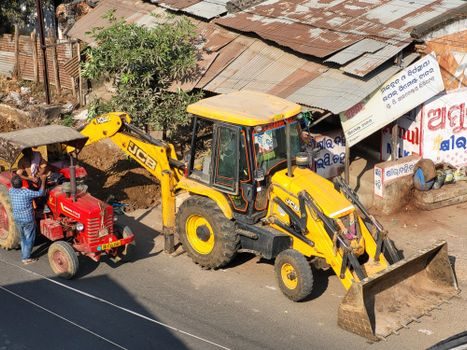
Wheelbase and tyre size set the actual footprint. The HT65A documents a 1,020 mm wheelbase with 10-16.5 tyres and a 2,704 × 1,740 × 2,020 mm envelope, with the 1,125 × 825 mm quick-hitch plate dictating the attachment fleet it can run [S2]. A 10-16.5 tyre is the de-facto standard in this class — it is the spec the bucket, auger, trencher and most third-party attachments are designed around.
For soft ground or finished-surface work, a compact track loader variant trades the rubber-tyred skid steer footprint for lower ground pressure at the cost of ~10–15% higher purchase price and track-wear OPEX. Cat's published skid steer line explicitly positions wheeled skid steers against general construction, landscaping, agriculture and snow removal — the four duty cycles where a wheeled chassis is still the right call [S8].
Bucket width also belongs in the site-constraint check: the S70 at roughly 36 in. clears a 3 ft door; a 72 in. bucket on a 2 t class machine will not. The Bobcat attachments catalogue is searchable by host machine, which is the cleanest way to enforce a bucket-width envelope before quoting [S10].
Attachment Ecosystem: Why the Hitch Class Beats the Engine
Once a fleet commits to a hitch standard, switching cost is high — every bucket, every auger, every attachment plate is captive. The Bob-Tach family and the Chinese-market 1,125 × 825 mm quick hitch are the two ecosystems that dominate the new 2026 skid steer attachment catalogues [S2][S10]. Cat's published bucket and attachment catalogue is organised by skid steer and compact track loader host machines, and the 50+ attachment categories on the Bobcat side (sweepers, snow blades, soil conditioners, breakers, trenchers, snow blowers) show how broadly the ROC envelope is leveraged once the hitch is locked [S7][S10].
For backhoe-style work — drainage, septic, utility trench — the skid steer backhoe attachment on a Bobcat host delivers 1.5–3.5 m maximum digging depth without committing to a dedicated backhoe loader, which is the right tool when trenching is episodic rather than the primary duty cycle [S3].
Selection Criteria Mapped Against Real Models
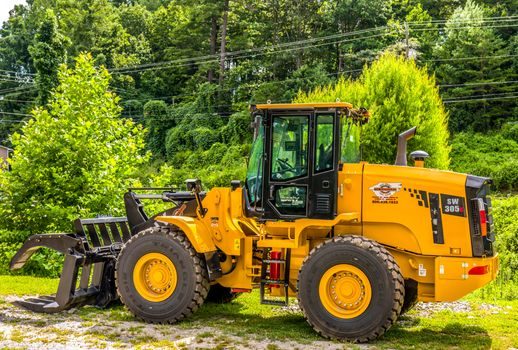
The decision matrix has four axes: ROC, operating weight, engine pedigree (Tier 4 diesel vs Stage V vs non-DPF regional diesel), and hitch/control class. Sub-1.5 t ROCs (HT60A, HT65A, S70) suit landscaping, rental and indoor demo. Mid-ROC 1.5–2.5 t machines suit agriculture, light utility and snow work. Above 2.5 t ROC the S770-class is the entry point for grading, bulk earthmoving and high-flow attachments [S1][S2][S4][S5][S8].
A spec-first buyer who filters by hitch class, ROC envelope, hydraulic flow package and tyre size will converge on two or three candidates per duty cycle; brand, dealer support and parts availability then break ties. The Bobcat, Cat, and the Chinese OEM lines (Hero Time HT-series, plus the broader Mainland OEM family referenced in ECVV supplier listings covering wheel loaders, skid steers, backhoes, forklifts and road rollers) all conform to the same hitch and ROC envelopes — that is the point of the spec map, not an accident [S6][S8].
Who a Skid Steer Is For — and Who It Is Not For
Skid steers are the right call for tight-radius work on prepared surfaces, multi-attachment fleets (more than 3 distinct tool types in regular use), and rental yards that need one chassis to span a 0.5 t to 4 t ROC envelope. They are the wrong call for long-distance roading (no steering beyond differential braking, tyre scrub on asphalt), high-cycle bulk earthmoving (a wheel loader cycles cheaper per cubic yard), or repetitive deep trenching (a dedicated backhoe wins on cycle time and operator comfort). [S1]
Inside the skid steer envelope, sub-1.5 t ROCs are not the right tool for full-time high-flow forestry mulching or large cold-planing work — the hydraulic system is undersized and the chassis stresses stack up. Above 4 t ROC, a compact track loader is the safer pick for soft-ground sites, and a small wheel loader the safer pick for roading between sites [S5][S8].
Standards, Compliance and Sourcing Signals to Watch
For European-bound units, the binding regime is EU Stage V for engines (off-road mobile machinery), which has been the active emissions standard for new machines since the end of the Stage IV transition. US EPA Tier 4 Final remains the parallel US standard, and Bobcat's S70 is explicitly described as a Tier 4 unit — that is the floor for any new diesel skid steer delivered into a regulated market [S1]. China-domestic machines (HT60A, HT65A) may be sold with non-Tier 4 diesels for sale into markets where Stage V / Tier 4 is not enforced; the engine plate is the source of truth, not the marketing line [S2][S4].
Sourcing signals worth tracking over the next two quarters: the Intermat 2027 exhibition (21–24 April 2027, Paris) where Bobcat has a listed presence for new-generation compact loaders [S1], and the Cat skid steer and compact track loader line refresh cadence published on the OEM product pages [S8]. Watch for hitch-standard cross-compatibility statements — every time a major OEM endorses an open hitch, aftermarket attachment pricing loosens and total fleet cost drops.
For deeper cross-equipment comparison, the palletizer machine selection guide covers another spec-driven capital-equipment decision in the same weight class as a mid-ROC skid steer; the MIG welder selection guide addresses a different duty cycle but uses the same spec-first filter logic that pays off on skid steer tenders.