Small-frame skid steer loaders weigh 1,300–1,500 kg with 23–25 hp engines, mid-frame units cluster at 2,900–3,600 kg with 45–65 hp powertrains, and large-frame diesel machines reach 4,200+ kg with 90+ hp — three bands that map cleanly to job-site class [S1][S2][S5].
Selection is driven by rated operating capacity (ROC), tip-hinge geometry, auxiliary hydraulic flow in L/min, and the host attachment mount (Bob-Tach, ISO 23727, or proprietary quick-coupler), with operating weight a secondary envelope check for transport and trailer class [S6][S7][S9].
Three Size Bands and Their Engineering Envelopes
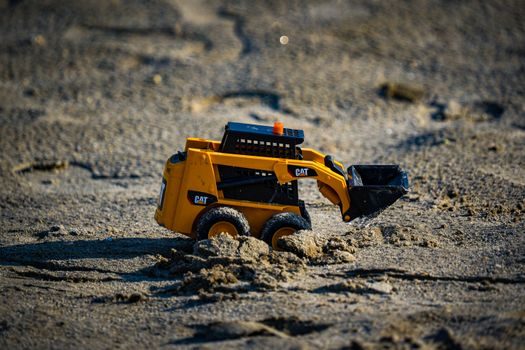
Sub-compact skid steers such as the Bobcat S70 sit at 1,311.8 kg operating weight with 23.5 hp (17.5 kW) output and a 345 kg ROC, suited to landscaping, light trenching and indoor demolition where a 1.5 m gate width is the access constraint [S2]. Compact-frame machines in the 2,900–3,000 kg band — typified by the KATO IMER AS28 at 2,925 kg and 47.5 kW (64.58 hp) — add 0.4–0.6 m³ bucket capacity, snowplow, sweeper, breaker and crusher-bucket compatibility, which is the practical inflection point where a skid steer becomes a multi-tool carrier rather than a one-job machine [S1].
Large-frame diesel units such as the Bobcat S770 at 4,224.8 kg and 92 hp push ROC past 1,360 kg, accept high-flow auxiliary circuits above 100 L/min, and pair with cold-planer, trencher and tree-shear attachments that the smaller frames cannot drive at production rates [S5]. For buyers cross-shopping frame sizes, the sizing decision for a skid steer loader follows ROC first, weight second, and engine power third.
Rated Operating Capacity vs Operating Weight vs Engine Power
Rated operating capacity is the maximum load the machine can lift at the bucket pivot with the load centred, and it is the single number that determines attachment pairing — a 345 kg ROC machine will not safely run a 500 kg concrete mixer at full hang [S2]. The Bobcat S70’s 760 lb (345 kg) ROC against a 1,311.8 kg chassis illustrates a roughly 26% payload-to-weight ratio, while the S770 at 9,314 lb (4,224.8 kg) chassis and 92 hp supports ROC values typically in the 1,360 kg class on a 32% ratio [S2][S5].
Engine power scales sub-linearly with chassis mass: the KATO IMER AS28 posts 47.5 kW at 2,925 kg (16.2 kW/t), and the S770 posts 92 hp (68.6 kW) at 4,224.8 kg (16.2 kW/t) — meaning power density is roughly constant across frames, so buyers should not over-index on horsepower and instead verify hydraulic-flow L/min at rated engine RPM, which is what drives attachment productivity [S1][S5]. The Case 440 mid-frame, with a 274 cu in (4.5 L) turbocharged diesel, 8 ft (2 m) max-lift clearance and 21 in (54 cm) reach at max lift and dump, typifies the geometry envelope a buyer should chart against truck-bed or trailer sidewall height before committing [S7].
Hydraulic Flow, Coupler Standard and Attachment Sourcing
Auxiliary hydraulic flow is the gating spec for any attachment beyond a bucket: 60–80 L/min covers augers, brooms and small breakers, while 100+ L/min is the threshold for cold-planers, mulchers and high-flow snow blowers [S3][S9]. Digga’s Ø 50 mm × 1,500 mm A-series auger is engineered for hydraulic skid steer mounts and ships in single-cut, double-cut and fully-flighted flight configurations, with custom diameters available, illustrating that auger diameter and flight geometry must be matched to host flow in L/min at continuous rating — not peak [S3].
Coupler standard is the second hard gate: Bobcat’s Bob-Tach and the 7-pin electrical harness that signals auxiliary flow, while ISO 23727 governs a growing share of non-Bobcat mounts; mixing the two without an adapter either derates flow or disables electric-over-hydraulic attachment control [S6][S9]. The 71 attachment SKUs catalogued on Bobcat’s skid-steer attachment page as of 2026-07-09 — including sweepers, breakers, augers and grapples — are largely Bob-Tach native, so a buyer standardising on ISO-only mounts loses roughly 60% of the commercial attachment catalogue until adapters are fitted [S9]. For comparison-shoppers already evaluating wheel loader suppliers and capacity bands, the attachment-ecosystem gate is the single biggest reason a skid steer, not a compact wheel loader, is the right tool for intermittent attachment work under 1,500 kg ROC.
Diesel vs Battery, Open Cab vs Enclosed, and Two-Path Lineups
The 2026 Bobcat lineup is split into a Classic path and a Pro path, with the Pro tier adding higher auxiliary flow, two-speed travel, and operator-control refinements, while the Classic path covers sub-compact to mid-frame buyers who prioritise unit price over cycle time [S6]. 0% financing for 36 months on select models was promoted on 2026-07-08 across the Bobcat skid-steer range, which directly compresses the total-cost-of-ownership calculation for fleets replacing 2014–2018 Tier 4 Interim units [S6].
Open-cab machines remain the entry tier for sub-compact and most compact frames; enclosed cabs with HVAC add roughly 8–12% to MSRP and are specified when site silica-dust or noise ordinances apply, not for comfort alone [S2][S5]. Battery-electric skid steers are appearing on 2026 OEM pipelines but are not yet represented in the listed Bobcat or KATO IMER model lines as of the 2026-07-08 product-page snapshot, so diesel remains the only currently shipping powertrain in the 1.3–4.2 t band covered by the cited SKUs [S1][S2][S5][S6].
Selection Criteria, Comparison and Sourcing Levers
Four criteria separate the cited models: operating weight, ROC, engine power, and attachment-coupler family. KATO IMER AS28 weighs 2,925 kg, runs 47.5 kW (64.58 hp), and pairs with a wide bucket-and-breaker accessory list [S1]. Bobcat S70 sits at 1,311.8 kg, 23.5 hp, 345 kg ROC, and accepts the full Bob-Tach attachment catalogue [S2]. Zhejiang Hero Time HT60A posts 860 kg ROC and 45 kW (61.18 hp) on a 1,896 kg chassis with a 0.41 m³ bucket and a Sauer-Danfoss hydraulic system, illustrating the China-OEM pricing leverage buyers get when ROC and engine power parity are prioritised over cab refinement [S4]. Bobcat S770 at 4,224.8 kg and 92 hp closes the large-frame diesel band with non-DPF aftertreatment, which simplifies Tier 4 maintenance intervals for fleet owners [S5].
For buyers comparing this class against how to choose a wheel loader, the rule of thumb is straightforward: skid steers win on footprint, turning radius (the Case 440 rear-machine turning radius is 59 in / 150 cm) and attachment density, while compact wheel loaders win on ride, roading speed and bucket breakout force above 2,500 kg ROC [S7].
Limits, Failure Modes and Standards to Watch
Skid steers fail in three recurring patterns: overloading beyond ROC on slopes (the narrow track and high CG create tip risk above 10° lateral), hydraulic-flow mismatch on augers and planers (stalls the auxiliary motor and burns the drive seal), and coupler cross-compatibility damage (Bob-Tach pin locks deformed when ISO-spec attachments are forced-fit without an adapter) [S1][S3][S9]. A buyer should also check the host machine’s rated hydraulic pressure in bar — typically 200–230 bar on small frames and 230–250 bar on large frames — before specifying any high-pressure attachment [S3][S5].
Trackable signals to watch through 2026 Q3: Bobcat’s 0% / 36-month finance offer on select models was live as of 2026-07-08 [S6]; Bobcat’s 71-SKU attachment catalogue refresh on 2026-07-09 indicates a continued push into sweeper and grapple categories [S9]; and Cat’s skid-steer bucket catalogue on cat.com continues to list compact track loader bucket compatibility, which is a sign of cross-platform attachment convergence buyers should factor into coupler-standard decisions [S8].
For component-level specifications, see linear guide, and crossed roller guide.