A complete skid steer commissioning program stacks four inspection tiers, indexed on engine hours, not calendar dates: a 15-point pre-shift walkaround (8-10 min), 50-hour weekly service (~30 min), 250/500/1000-hour PM, and 2000-hour powertrain service [S2].
Skid steers accumulate hours faster than most jobsite equipment, so a rental unit running 8 hours/day reaches 2,000 hours in roughly a year, while a 25-hour/week jobsite unit takes ~10 weeks to hit the same 250-hour interval [S2]. Hour-meter discipline, not date stamps, is what makes PM programs actually trigger.
Pre-Shift Walkaround: 15 Checkpoints, 8-10 Minutes
Operators must complete the daily walkaround before engine start: engine oil on a cold dipstick, coolant level at the expansion tank sight glass, hydraulic reservoir, fuel system with moisture/sediment drain, radiator for leaks, air-cleaner restriction indicator, belt adjustment/wear, fuel-filter pressure gauge, tire condition and pressure, and chassis lubrication per the lube chart [S2][S5].
After start-up, the same operator confirms engine sound, instrument readings, control response, exhaust for leaks or excessive smoke, lights, horn, and reverse-warning alarm; any "Fail" item is reported to the supervisor before the unit leaves the parked position [S5][S7]. On used units, the safety-device check also covers eased pins, dirty air filters, surface rust, worn hydraulic seals, leaky hoses, and damaged quick-coupler fittings [S3].
50-Hour and 250-Hour Service Milestones
At 50 engine hours, weekly service covers 12 checkpoints in roughly 30 minutes and is owner/operator-doable; it overlaps the daily items but adds detail on pivot pins, cylinder mount wear, and chain tension on chain-drive models [S2].
The 250-hour first scheduled service is the first mechanic-level PM: engine oil and filter change, full grease service across all zerks, and a hydraulic screen inspection [S2]. Note that chaincase oil checks apply only to chain-drive units; fully hydrostatic premium models skip this step entirely, a common commissioning error when crews apply one template across mixed fleets [S2].
500-Hour and 1000-Hour Major Services

The 500-hour quarterly service replaces the fuel filter, services the air filter, and pulls the hydraulic screen; the 1000-hour annual service is the hydraulic milestone, with full hydraulic oil and filter change plus chaincase oil on chain-drive variants [S2].
Beyond fluid service, commissioning engineers should run an initial function test on a flat, open pad: slowly move drive controls to verify forward and reverse response, test left and right steering input at low speed, raise and lower the lift arms through full travel, cycle auxiliary hydraulics, and confirm the parking brake holds before the unit leaves its parked position [S6][S7]. Confirm horn, all lights, backup alarm, wiper, and travel/lift control return-to-neutral during this same walk-up [S7].
2000-Hour Powertrain Service and Lift-Path Variant Check
The 2000-hour powertrain service is the deepest scheduled PM: coolant change, valve-lash adjustment, and injector inspection, and it is the right point to pull engine compression and hydraulic-pressure baselines that subsequent PMs compare against [S2].
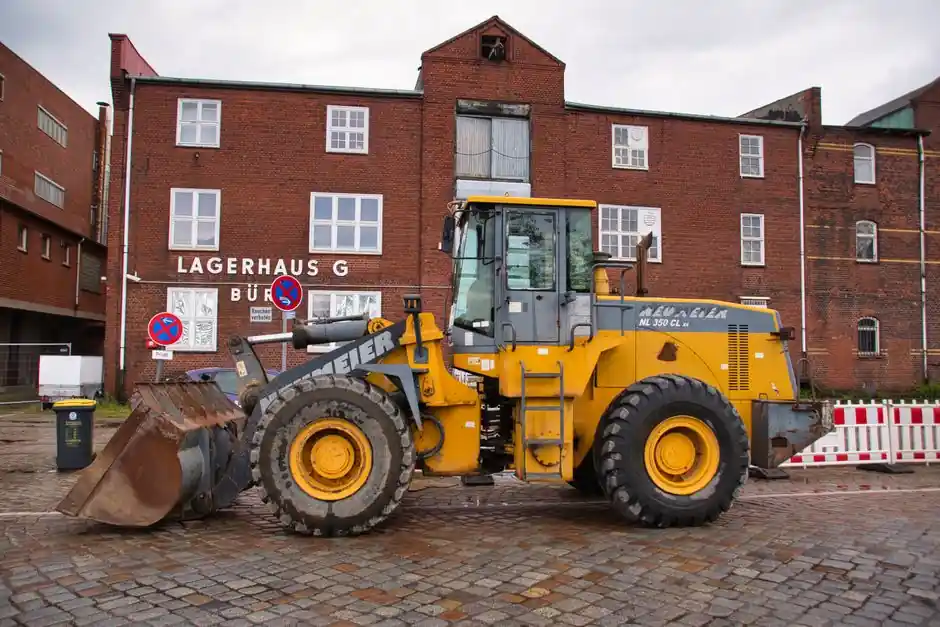
Lift-path geometry matters here. Radial-lift variants (Bobcat SR series, Case) and vertical-lift variants (Bobcat SV, Cat, Kubota) generate different wear patterns on the loader arms, cylinder mounts, and pivot pins, so the inspection focus shifts by variant, and a single commissioning template applied across a mixed fleet misses the right pins on half the units [S2]. For broader context on compact equipment geometry, see the skid steer loader reference page and the wheel loader comparison for lift-arm kinematics.
Commissioning Differences vs. Backhoe Loaders

A skid steer and a backhoe loader are not interchangeable on the commissioning bench. The skid steer is frame-based with left/right wheel differential drive for zero-radius turning, quick-change attachments over a universal plate, and is sized for confined indoor/outdoor spaces (warehouses, basements, tunnels, farms) [S4].
A backhoe loader has a central articulation point with a loading bucket at the front and a digging arm at the rear, combining excavation and loading for larger earthmoving scopes [S4]. Their pre-start, function-test, and PM templates therefore branch at the very first checkpoint, and fleets running both should keep separate forms; see the backhoe loader page for the matching sequence. For attachment-side safety controls used on commissioning pads, the two-hand control reference and the safety relay selection guide cover the bench-test rig side.
Common Commissioning Failures and Limits
Three failure modes recur on commissioning day. First, calendar-based service triggers miss the 250-hour mark on high-utilization rental units and over-service low-hour jobsite units; hour meters, not dates, drive the PM clock [S2]. Second, applying a chain-drive inspection template (chaincase oil, chain tension) to a hydrostatic unit wastes time and skips the right checks (hydraulic motor case drain, charge-pressure verification) [S2].
Third, attachment inspection is treated as optional. The universal skid-steer plate accepts 100+ attachments, buckets, forks, augers, snow blades, brush cutters, grapples, cold planers, each adding hydraulic quick-couplers and wear surfaces that the walkaround must cover, separately from the host machine [S2]. Pre-operational checks should also include confirming fuel, lubricating oil, and coolant levels, thoroughly testing the brake system, and verifying all light signals before the first lift cycle [S4].
Trackable signals for the next 90 days: (1) log whether the fleet has converted PM triggers from date-stamps to hour-meters, and (2) verify that used-unit commissioning captures baseline hydraulic pressure and engine compression for trend tracking against the next 500/1000-hour service.