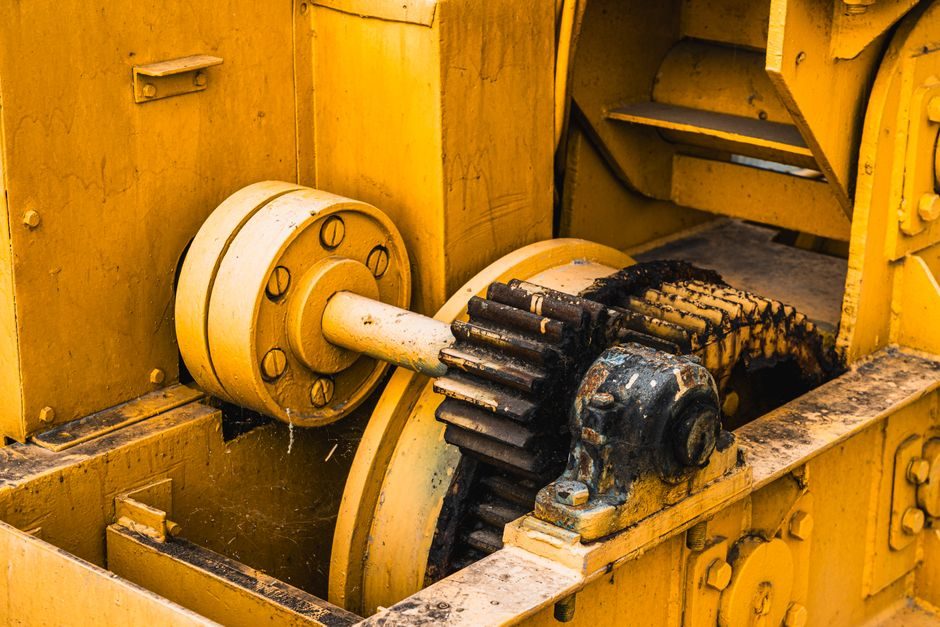
A 2026-06-30 export-channel scan of China-origin slewing rings shows light flanged four-point-contact ball units priced from roughly US$100 per set at 1-set MOQ on Nanjing-based listings, while triple-row roller pelletizer bearings land in the US$720–900 band on 1-set MOQ from Luoyang mill-direct shops [S1][S3]. Smaller OD 061.20.0630.100.11.1503 outer-geared ship-crane rings also sit at US$450–500 per piece at 1-piece MOQ, anchoring the mid-tier of the price curve [S3].
Cost drivers stack predictably from there: raceway type (single-row ball vs double-row ball vs cross-roller vs triple-row roller), bore/OD envelope, gear option (no-gear vs internal-tooth vs external-tooth), hardening depth on 50Mn or 42CrMo rings, and the cage material (nylon, brass, or steel ball-cage retainers) [S2][S6]. The LYXQL Henan manufacturer page published 2026-06-30 lists large-size wind-turbine and foundry-class slewing rings as its core catalogue, with GEM-listing status and 42CrMo/50Mn raceway material as standard [S2].
Price bands by raceway type and OD (FOB China, 2026-06 snapshots)
Single-row four-point-contact ball slewing rings dominate the low-to-mid price bracket: a 061.20-series outer-geared unit for ship cranes listed at US$450–500 per piece on 1-piece MOQ, with the lower-bound typically associated with small OD and 50Mn rings [S3][S6]. Crossed-roller and double-row ball types sit roughly 60–120% above equivalent-diameter single-row ball units on the same listing pages, reflecting the additional row of rolling elements and the tighter raceway geometry that raises both raw-material and grinding cost [S2].
Triple-row roller slewing bearings, used on pelletizers and large mining equipment, anchor the top of the public price band at US$720–900 per set on 1-set MOQ, with light flanged series dropping as low as US$100 per set at 1-set MOQ for low-load automation and tracking roles [S1][S3]. DRE Engineering's 2026-07-01 catalogue and SWBTEC's 2026-07-01 cross-roller and double-row ball series confirm the same hierarchy: single-row ball < double-row ball < cross-roller < triple-row roller, with light-flange variants undercutting their no-flange equivalents by 15–25% on weight-driven applications.
What is a slewing bearing — and where the price actually comes from
A slewing bearing is a large-profile rolling-element bearing that handles combined axial, radial and moment loads in a single raceway, typically supplied as a complete ring with optional integral gear teeth (internal or external) for direct drive-coupling to a pinion or slewing drive [S2]. Raceway steels are most commonly 50Mn and 42CrMo per Chinese mill practice, with induction or through-hardening of the ball/roller paths to a depth that is the single largest metallurgical cost variable [S6][S4].
The 2020-08 Springer modelling study on quenched soft zones quantifies why induction-hardening depth matters: the unquenched soft zone at the ring ends shifts load distribution outward and reduces cage-rated load capacity under extreme wind or moment overload — engineering rationale for the premium that induction-through-hardened 42CrMo races command over case-only 50Mn [S4]. Cage choice compounds it: a steel ball-cage retainer adds roughly 8–15% to ring cost over a molded nylon cage but raises permissible rpm and operating-temperature ceiling, a fact visible in Nanjing Suntay's 2026-06-01 retainer listings for slewing-bearing cages [S1].
Selection gates that move the number on the quote
Four gates drive the final price on a 2026 slewing-bearing RFQ, and engineers should lock them before approaching a mill [S2]. Gate 1: raceway type — single-row ball for tracking/solar and small cranes, double-row ball for mid-duty cranes, crossed-roller for high-precision indexing and machine-tool bearings, triple-row roller for pelletizers and large port cranes. Gate 2: OD/bore envelope — OD scales superlinearly with material and grinding time, so a 2 m OD ring is not 2× a 1 m OD ring of the same type, it is closer to 3–4× on a like-for-like basis. Gate 3: gear option — no-gear units are cheapest, internal-tooth units add 10–20% over no-gear, external-tooth units add 5–15% but require gear-mesh clearance verification with the mating slewing ring bearing pinion. Gate 4: certification — ISO 9001 is baseline, while wind-turbine main-bearing applications typically add DNV, and offshore/marine add classification society scope on top of base price [S2].
Mounting hardware is a sleeper cost: bolt circles, grease fittings, and sealing lips all live on the same ring, and a flanged mounting face (the "L" edge that gives flange-type slewing rings their name) typically adds 5–10% over a flat face on equivalent OD — useful when axial envelope is constrained but a clear cost adder on the quote [S6].
Comparison: four raceway options on a like-for-like OD
Stacking the four common raceway options on a hypothetical 800–1200 mm OD ring with no integral gear, 42CrMo raceways, and steel ball-cage retainer, public 2026-06 listing data maps the price stack as follows [S1][S2][S3]. Single-row ball four-point-contact: lowest price band, US$450–500 per piece on 1-piece MOQ for small OD ship-crane rings, scaling upward with diameter. Double-row ball: 60–90% above single-row ball at the same OD, with the two-row load-angle 90° geometry delivering higher axial and tipping capacity. Crossed-roller: 80–120% above single-row ball, with the highest precision class and lowest deflection under moment load. Triple-row roller: highest cost per OD, US$720–900+ per set on pelletizer listings, justified only where three-row load geometry is structurally necessary.
For procurement engineers, the practical takeaway is: if the application is a tracking actuator, solar tracker, or small automation turntable, single-row ball or light-flange single-row ball is the cost-correct answer; for a wind-turbine yaw or pitch bearing, the decision is forced upward to double-row ball or crossed-roller by the moment-load envelope, regardless of cost [S2].
Manufacturer landscape and sourcing signals worth tracking
LYXQL (Henan, founded 2003) is positioned on its 2026-06-30 homepage as one of China's "national key high-tech enterprises" with GEM listing and large-size slewing bearings as its core catalogue, including wind-turbine main bearings and foundry-class rings [S2]. SWBTEC (Anhui-based, 2026-07-01 site) publishes a catalogue that spans cross-roller, double-row ball, single-row ball, and light slewing rings, with explicit application notes for excavator, crane, and aerial-work-platform. DRE Engineering (2026-07-01 site) carries a wider portfolio including wire-race slewing bearings, slew drives, lazy-Susan bearings, linear guides, and ball screws, useful when the slewing ring is one item in a multi-axis motion package.
Alibaba's 2026-05-01 supplier directory for slewing-ring-bearings lists multiple Chinese suppliers in the US$5–10 million total-revenue tier, with Northern Europe 15% and North America 12% as top export markets, and 92.9% response rate as a top-tagged supplier metric — useful as a sourcing-side benchmark when comparing mill-direct vs trading-house quotes [S5]. Made-in-China's 2026-06-01 page 6 of slewing-bearing listings and 2026-05-29 product-search page 6 are the cleanest public price-discovery surfaces, with explicit MOQ and Diamond/Audited supplier flags that correlate with the quoted FOB price tier [S1][S3].
Limits, failure modes and quoting traps
The biggest quoting trap in 2026 is MOQ: a US$100 flange-type unit at 1-set MOQ is not the same economic proposition as the same drawing at 50-set MOQ, where unit pricing typically drops 10–20% but tooling amortization may need to be amortized into the first PO [S1]. The second trap is the cage material default — many Chinese-mill listings default to nylon 66 or molded-polymer cages in the headline price, with steel retainer as an upcharge that is sometimes buried in the fine print [S1]. The third is raceway-hardening specification: induction-hardened 50Mn is the default, but for wind-turbine and large-port-crane duty, 42CrMo with through-hardening is the metallurgically defensible answer, and the price adder for it is rarely published on B2B listing pages — confirm it on the mill certificate before PO [S2][S4].
For deeper selection criteria and 2026 sourcing signals, the Slewing Bearing 2026 Buying Guide covers the four-gate spec framework in detail, while the Pillow Block Bearing 2026 Price & Cost Guide gives a useful cost-stack contrast for housed versus unhoused bearing formats. Engineers sourcing motion packages alongside slewing rings should also reference the Roller Bearing 2026 Buying Guide for adjacent rolling-element cost context. The next node to watch is the 2026-Q3 wind-turbine main-bearing pricing reset from LYXQL and other Henan mill-direct suppliers, which historically drops 5–8% on large OD units as the new capacity comes online.