The four load-case dimensions that govern a slewing bearing purchase are static axial load capacity, static radial load, overturning moment, and the tilting-moment versus radial-load interaction — every catalogue curve is plotted against those four axes [S1].
Surveyed 2026 OEM catalogues from XuZhou FengHe, DRE Engineering, and Nice Bearing list standard 4-point contact ball units from 100 mm bore upward, cross-roller and 3-row roller designs in the 200–5000+ mm range, with internal gear, external gear, and gearless configurations supplied on the same flange envelope [S1][S2][S3].
Load-Case Triage: Which Numbers Drive the Curve
Specifying a slewing bearing starts with the maximum combined load envelope: the static axial Fa, static radial Fr, and the overturning moment M are read off the same load-curve chart on the manufacturer's datasheet, and the application point must sit inside the curve at the design safety factor (commonly 1.0–1.25 for static checks, 1.0 for dynamic) [S1][S3].
For mobile machinery such as excavators, crane jibs, and aerial work platforms, the dominant input is overturning moment, with axial load a secondary input — a configuration where 4-point contact ball slewing rings remain the workhorse because a single ball transmits load from any one direction [S1][S2].
For high-precision indexing tables, medical imaging gantries, and machine-tool turrets, the load is closer to pure combined axial-plus-moment with very low radial — a regime where cross-roller slewing ring bearings deliver higher moment stiffness per millimetre of height than a 4-point ball of equivalent bore [S3][S4].
Raceway Type vs Application Matrix
Three raceway families dominate 2026 commercial offerings: 4-point contact ball (single-row), cross-roller (cylindrical rollers alternating 90°), and 3-row roller (separate axial, radial, and moment tracks) [S1][S3].
Cross-roller units trade speed and moment capacity for axial stiffness and runout accuracy in the arc-second band, and are stocked in bores 100–1500 mm [S3][S4]. 3-row roller designs push into the 1500–5000+ mm range for port cranes, ship unloaders, and large mining shovels where moment capacity is the binding constraint [S1][S3].
Nice Bearing also flags thin-section and YRT precision turntable bearings as a fourth family, typically 100–800 mm bore, used when axial runout under combined load must stay below 0.01 mm and the load envelope is modest [S4].
Gear Integration: Internal, External, or No Gear
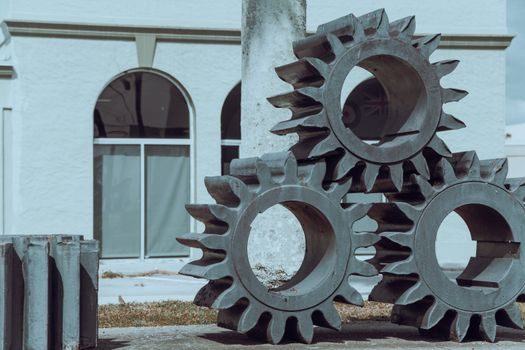
Gear choice is set by the pinion layout on the host machine, not by the bearing's load rating. Internal-geared units (ring gear inside the bolt circle) simplify guarding and protect the teeth from direct debris and rain; external-geared units expose the teeth for easier field inspection and re-shimming, at the cost of contamination exposure [S1][S2].
DRE Engineering's 2026 catalogue lists both internal and external gearing as standard options on most single-row 4-point ball slewing rings above 500 mm bore, with module selection typically m=4 to m=12 for general machinery and m=14 to m=20 for heavy-duty mining and port equipment [S3].
Gearless units — also called gearless slewing rings or flanged rings without integral teeth — are specified when the host machine bolts a separate external ring gear, when the drive enters through a worm or pinion mounted on a stationary sun shaft, or when the application runs in continuous slow rotation where a wrapped gear is preferred to a stub-tooth pinion [S1][S3].
Sealing, Lubrication, and the IP Rating Question
Sealing is the single most cited cause of premature slewing-bearing failure in mobile equipment, with rubber-encased lip seals standard on most surveyed 2026 units and a higher-spec nitrile or polyurethane upgrade available for dusty and marine environments [S1][S2].
XuZhou FengHe specifies grease lubrication as standard with grease nipples on both raceway tracks, and oil-bath lubrication as an option on 3-row units and on slewing drives above roughly 1000 Nm output torque [S2]. Oil-bath is preferred on continuous-rotation port and steel-mill applications where relubrication intervals would otherwise drive the maintenance schedule.
IP rating is governed by the overall slewing drive enclosure rather than the bare bearing, so a sealed slewing ring with integral gear typically carries IP65 on the housing and IP54 on the output seal area in standard configuration, with IP66 or IP67 specified for offshore and washdown environments [S1].
Bolt Pattern, Hardness, and Mounting Flatness
The mounting interface is the second most common field-failure source after sealing. Surveyed 2026 datasheets call out a flatness tolerance of 0.05 mm across the bolt-circle diameter on both the inner and outer ring mounting faces, with a recommended surface roughness of Ra 3.2 µm or better [S1][S3].
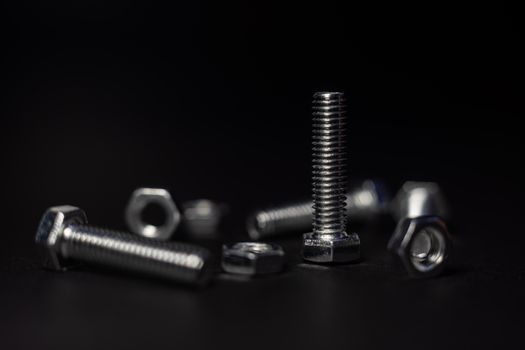
Bolt grade matters: high-strength 10.9 or 12.9 socket-head or hex bolts are the default on 4-point ball units, pre-loaded to roughly 70% of yield to keep the raceway from slipping under moment reversal. Induction-hardened raceways (surface hardness in the 55–62 HRC band) are standard on the larger 3-row and cross-roller offerings, while through-hardened or case-carburised raceways are common on the smaller 4-point ball lines [S3][S4].
For a pillow block bearing vs slewing ring bearing spec cut, the divider is the load direction: pillow blocks are shaft-on-centre with pure radial load, slewing rings are bolt-circle-mounted with combined axial, radial, and moment — different geometries, not interchangeable even when the bore matches.
Operating Temperature, Speed, and Material Choices
Standard raceway steel is 42CrMo or 50Mn quenched and tempered, with operating temperature range roughly -30 °C to +80 °C for grease-lubricated units; above +80 °C the grease base oil oxidises and the relubrication interval collapses, while below -30 °C standard nitrile seals stiffen and lose lip pressure [S1][S3].
For arctic applications, low-temperature seal compounds (silicone or fluorocarbon) and synthetic polyurea or PFPE greases extend the lower limit to about -50 °C; for high-temperature environments such as steel-mill ladle turrets, high-temperature seal materials and oil-air lubrication push the upper limit above +150 °C [S3].
Rated rotational speed on surveyed 2026 single-row 4-point ball units sits between 1.5 and 5 rpm continuous for the larger bores and up to 10–15 rpm for bores under 500 mm, while cross-roller units are generally limited to 1–3 rpm continuous because of the line-contact roller loading and the heat it generates [S1][S4].
2026 Sourcing and Cost Levers

Chinese OEM-supplied standard 4-point ball slewing rings in 500–1500 mm bore cluster around FOB bands of roughly USD 800–3500 for single-piece quantities, with cross-roller and 3-row designs commanding 1.5–3× premiums on the same bore envelope, and integrated slewing drive units (housing + motor interface + slewing ring) running 2–4× the bare-ring price [S1][S2][S3].
Lead time is a material lever: catalogue-standard 4-point ball units ship in 15–25 working days from XuZhou FengHe and DRE Engineering, while custom-bore, custom-gear, or induction-hardened premium units run 45–75 working days [S1][S3].
For buyers comparing options against adjacent bearing types, a self-aligning bearing selection workflow shares the load-case-first approach but stops at pure radial alignment, and a ceramic vs steel ball bearings review is relevant only when a slewing ring specification calls out hybrid ceramic balls for vacuum, semi-conductor, or chemical-isolated service — a niche rather than a default.
Trackable signals for the next sourcing cycle: ISO 6336 gear-strength calculation updates that affect 3-row and high-module external-geared industrial valve and slewing-ring pinion ratings, plus revised ABMA STD-11 load-zone definitions for thin-section and YRT-style turntable bearings [S1][S3][S4].
