
Pillow block bearings and slewing ring bearings sit at opposite ends of the mounted-bearing spectrum: a UCP206-class pillow block unit typically supports shaft diameters from 12 mm to 140 mm in a bolted cast or pressed-steel housing, with individual-unit pricing starting around US$0.10-10 per set on 2026-06 B2B listings [S6], while a large slewing ring for crane, excavator, or wind-turbine yaw duty routinely exceeds 1 m in diameter and is quoted on a project basis by specialist manufacturers such as LYXQL, Xuzhou Xinda, and Hefei King [S2][S3][S4].
Both are catalog "mounted bearings" on the same pillow block bearing family page, but their load geometry, rotational speed envelope, and mounting interface diverge enough that misapplication is a common shop-drawing error, which makes the criteria cut more useful than a price cut. This piece lays out the load, speed, diameter, and material gates that determine which one belongs on a 2026 drawing.
Definition and Mechanical Scope
A pillow block bearing is a unit bearing insert (usually a deep-groove ball bearing or spherical outer-race insert) pressed into a solid rectangular or oval housing with two bolt-down feet, designed to support a rotating shaft whose axis is fixed in space [S1]. The insert can be self-aligning within the housing, which compensates for minor shaft-to-housing misalignment, and the housing is typically cast iron, pressed steel, stainless steel, or — in corrosive or washdown duty — a tribopolymer such as igus igubal [S1].
A slewing ring bearing, by contrast, is a large-diameter rolling element bearing (commonly four-point contact ball, cross-roller, or three-row roller) that simultaneously carries axial load, radial load, and overturning moment, with gear teeth cut into either the inner or outer race so the whole ring doubles as a swing drive [S2][S3]. Standard four-point contact ball slewing rings cover diameter ranges from roughly 200 mm up to 5 m+ in single-row form, and three-row roller designs push the envelope further for very heavy moment duty such as crawler-crane turntables and ship unloaders [S2].
Load Vector and Moment Capacity
Pillow block inserts are radial-load devices first; the deep-groove ball geometry tolerates modest axial thrust in both directions and a small misalignment angle (typically under 2°), but the cast housing cannot react a significant overturning moment because the bolt-down feet are 60-180 mm apart and the shaft sits in single-point support [S1]. When the application needs to hold a shaft against bending loads from a heavy pulley or an overhung coupling, a second pillow block is added on the adjacent shaft span, and the moment is reacted by the pair as a beam.
Slewing rings are rated explicitly for a moment load Fr × a + Fa × b combinations across the full ring diameter, and that moment rating is usually the first number on the manufacturer's data sheet (e.g. a 1 m four-point contact ball slewing ring commonly carries a rated moment in the 50-200 kN·m range depending on ball size, raceway hardness, and bolt pattern) [S2]. That single part replaces what would otherwise be a kingpost, thrust bearing, and a large slew drive gearbox on a crane turret or solar tracker, which is the structural argument for paying the cost premium [S2][S3].
Speed Envelope and Operating Duty
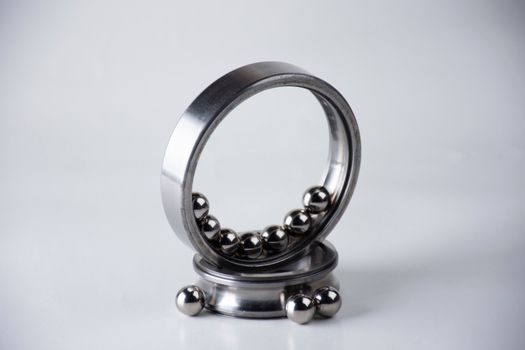
Pillow block inserts ride in the same envelope as the ball or roller bearings inside them, typically up to 3,000-5,000 rpm for 62-series deep-groove inserts with grease lubrication, and derated for heat, seal friction, and balance grade on the driven shaft [S1]. Continuous-duty conveyors, fans, and small electric motors are the canonical match.
Slewing rings are slow-rotation devices: typical operating speeds sit between 0.5 rpm and 20 rpm for crane slew, wind yaw, and solar tracker duty, with the absolute ceiling around 100 rpm for small-diameter units used on indexing tables or small radar pedestals [S2][S3]. Above that ceiling, the gear-mesh noise, lubricant film starvation on the raceway, and seal heat become the limiting factors, not the rolling-element fatigue life. The bearing production technology behind this — ring forging, raceway induction hardening, and profile grinding to ISO 1328 grade — is detailed in this bearing production technology piece and explains why raceway accuracy scales with the bearing diameter class.
Mounting, Materials, and Standards Discipline
Pillow block housings are standardized at the insert-fitment level so a UCP205 insert (25 mm bore) drops into any maker's P205 housing, which is why the catalog price band is so tight (US$1.30 per set for UCP206 in 2026-06 spot quotes) and why ISO 7225 dimensional interchangeability matters more than any vendor name [S6]. For washdown, food-grade, or marine duty, the same insert is offered in a stainless housing or a polymer housing (igubal), trading temperature ceiling and load rating for chemical resistance [S1].
Slewing rings are overwhelmingly project-engineered: the bolt-circle, gear module (typically m5-m30 module spur or helical, with hardened teeth to 50-55 HRC), seal type, and raceway treatment (induction vs through-hardened 42CrMo / 50Mn) are specified per drawing [S2][S4]. Buyers evaluating slewing bearing suppliers on Made-in-China in 2026 should look for ISO 9001 certification, evidence of in-house gear-cutting and heat treatment, and a stated range of OEM/ODM service — the four manufacturers cited (LYXQL, Xuzhou Xinda, Hefei King, and the larger exporters catalogued under Sx Bearing) all tick those boxes at different scale points [S2][S3][S4][S5].
Selection Criteria: A Side-by-Side Cut
Engineers at the drawing board usually weight four variables: load vector, shaft diameter vs ring diameter, rpm, and mounting stiffness. The matrix below is the honest shortlist. [S1]
• Load type — pillow block for predominantly radial + light axial; slewing ring for combined axial + radial + overturning moment [S1][S2].
• Diameter — pillow block supports shaft bores from ~12 mm to 140 mm; slewing ring pitch diameters from ~200 mm to 5,000 mm+ [S1][S2].
• Rotational speed — pillow block happy at 500-5,000 rpm; slewing ring engineered for 0.5-20 rpm continuous [S1][S2].
• Cost and lead time — pillow block is a 1.30-10 USD catalog item with stock delivery; slewing ring is a 4-12 week project item with pricing on RFQ and 30-50% deposit typical for OEM Chinese suppliers [S4][S6].
• Mounting — pillow block bolts to a flat surface with two through-bolts; slewing ring needs a precision-machined bolt circle on both races, often with customers supplying the mating flange drawing for the manufacturer to match [S2][S4].
Failure Modes and Limitations
The dominant failure on pillow block inserts is seal failure followed by grease washout and raceway brinelling from contamination — the fix is a sealed-for-life insert (2RS, 2Z) or a polymer housing in washdown zones, and never specifying a cast-iron unit where the wash chemistry attacks it [S1]. Shaft-to-housing misalignment above ~2° will hammer the outer race; either re-shim the pillow block feet or step up to a self-aligning insert family.
Slewing ring failure modes are different and more expensive: raceway spalling from over-moment, bolt-looseness fatigue on the mounting flanges, gear-tooth wear from inadequate lubrication, and seal extrusion on outdoor units exposed to UV and freeze-thaw [S2][S3]. For outdoor wind or solar-tracker duty, specifying through-hardened raceways (rather than induction case-hardened) and a proven grease specification (e.g. Klüberplex, SKF LGEP 2-class) is the difference between a 5-year and a 20-year service interval. The wider ball bearing selection spec-gate framework applies at the insert level but not at the ring level, so the slewing-ring decision should be reviewed by a structural engineer who can verify the bolt-circle and moment reaction.
Sourcing and Standards Reference
For pillow block inserts and housings, the relevant cross-vendor interchangeability specs are ISO 15 (radial bearing boundary dimensions) and ISO 3228 (insert bearing dimensions), with JIS B 1557 and ANSI/ABMA Std 20 covering the inch-series variants; most UCP and UCF part numbers reconcile across these systems for bore sizes up to 140 mm [S6].
For slewing rings, the dominant standards are ISO 9001 for the manufacturer QMS, JB/T 2300 (Chinese industry standard for slewing ring geometry) and the OEM-specific drawings for bolt circles, gear modules, and raceway hardness, which is why a factory audit or a third-party inspection (SGS / BV) is standard practice for crane and wind-turbine buyers sourcing from LYXQL, Xuzhou Xinda, or Hefei King [S2][S3][S4]. When the slewing drive is the final assembly (a slewing ring + worm or planetary gearbox packaged together), additional gear standards apply (AGMA 2001 for tooth strength, ISO 1328 for accuracy grade), which drive the supplier shortlist further.
Trackable signals for the rest of 2026: (1) Chinese slewing-ring makers' continued shift from 42CrMo case-hardened to through-hardened 50Mn raceways for wind-turbine yaw duty, with at least one of LYXQL / Xuzhou Xinda / Hefei King expected to publish updated fatigue-test data; (2) pillow block insert pricing pressure from polymer-housing suppliers (igus igubal class) in washdown segments where stainless pricing has risen with nickel cost; (3) growing Chinese OEM/ODM activity on small-diameter slewing rings (200-500 mm pitch diameter) for AGV and solar-tracker mass production, which would compress the price gap between the two bearing families at the low end.