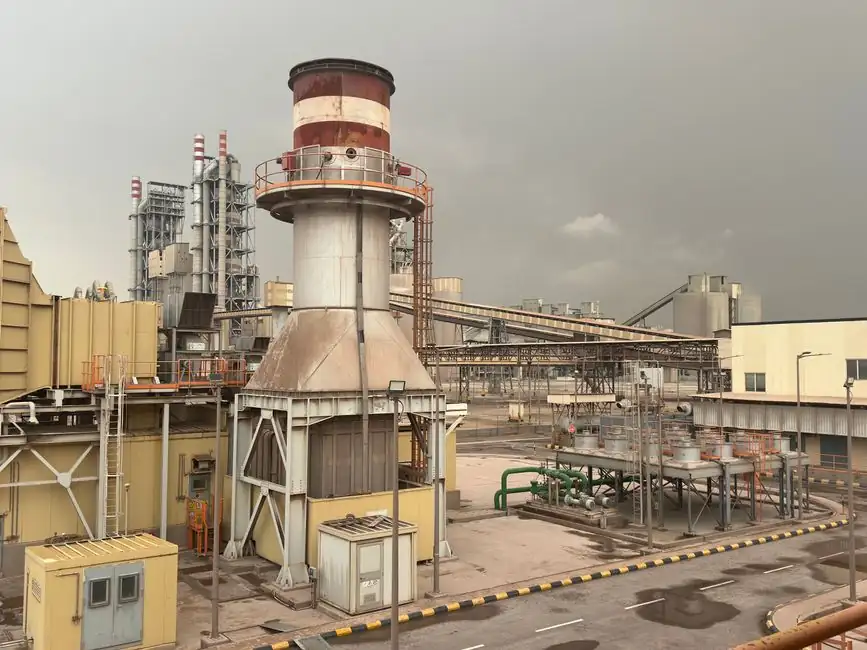
Slewing bearings on cement-plant rotating equipment see combined axial, radial, and tilting-moment loads while running in airborne cement dust at ambient temperatures up to about 150°C near preheater towers, and the four-point contact ball and crossed roller formats dominate the installed base in this industry [S1][S3].
Selection on a cement kiln, preheater, cooler, or stacker-reclaimer is driven less by bore diameter and more by the static load envelope, the raceway hardness band, the seal arrangement, and whether an internal, external, or non-geared ring matches the available pinion envelope [S1][S4].
Where Slewing Bearings Sit in a Cement Plant
The four practical stations in cement and concrete plants are rotary kilns, preheater and cooler rings, stacker-reclaimer booms, and crusher or slewing concrete-mixer pedestals, and each station imposes a distinct combined-load signature that dictates the bearing type rather than the supplier brand [S1][S3].
Preheater and cooler rings run slowly, often below 5 rpm, and the dominant load on these units is the overturning moment from the suspended cyclone tower weight plus thermal growth, not pure axial thrust; slewing rings on stacker-reclaimers instead see high radial loads from boom luffing combined with shock from reclaiming [S1][S3]. For a working definition of the bearing family itself, the slewing bearing overview treats axial, radial, and moment loads as a simultaneous load set, which matches what cement-plant duty actually looks like. Process background for kiln, cooler, and preheater service is summarised in the cement process reference and the cement and concrete applications page, both useful when an engineer is asked to justify a bearing spec to plant management.
Load Case: Axial, Radial, and Tilting Moment Together
Under a tilting moment the most-loaded rolling element in a slewing ring can carry 3 to 5 times the average rolling-element load, and that peak is the figure that controls raceway pitting life rather than the nominal equivalent load [S2].
Engineers building a real load case should treat axial, radial, and moment loads as acting simultaneously and sum the worst credible combination, not the typical one, because a slewing ring sized only for average duty will fail at the heavily loaded raceway quadrant well before the calculated L10 life is reached [S3]. For a 10 t payload on a 5 m outreach the static tilting moment is already 490 kN·m before wind, dynamics, or structural deflection are added, and dynamic deflection in large lattice structures can push the effective moment 5 to 15% above the static calculation [S2]. The slewing ring rather than the slewing ring bearing naming is the industry convention for the same component, and the slewing ring bearing page gives the interchangeable terms designers will meet in vendor datasheets. Where a pinion drives the ring, the slewing drive overview describes how the geared housing integrates with the ring gear, which is the common configuration on stacker-reclaimer booms.
Bearing Types Compared for Cement Duty

Four-point contact ball slewing rings are the default choice for preheater and cooler service where the moment-to-axial ratio is moderate and the operating speed is below 5 rpm, while crossed roller slewing rings are specified when higher tilting stiffness and tighter rotational accuracy are required, such as on slewing concrete-mixer pedestals and small crusher rotators [S3][S4].
The core decision criteria for cement-plant selection are tilting-moment capacity, raceway hardness, sealing against abrasive dust, and gear arrangement, and a side-by-side read against those criteria is what separates a working spec from a generic catalogue purchase.
Four-point contact ball slewing rings deliver lower friction and are cheaper in diameters above 1500 mm, but their peak element load under moment is at the high end of the 3 to 5x range and their stiffness is lower than an equivalently sized crossed roller unit [S2][S3]. Crossed roller slewing rings carry axial, radial, and moment loads through one position with higher rigidity, but they are more sensitive to mounting-face flatness, preload drift, and contamination, which is why the preload or running-clearance requirement, accuracy class, and seal arrangement must be confirmed before order, not after [S4]. Three-row roller slewing rings add a dedicated moment load row and are reserved for the largest stacker-reclaimers and ship unloaders, where a single moment row in a four-point contact design would be undersized. [S3]. For the slewing mixer application, the concrete-mixer bearing line summarised in the concrete and cement applications page shows why mixer OEMs often move to crossed roller or three-row designs above about 3 m³ drum capacity.
Material, Hardness, and Temperature Bands
Raceway hardness for cement-plant slewing rings is typically specified at 55 to 62 HRC through-hardened or induction-hardened 42CrMo or 50Mn, and induction-hardened raceways on a through-hardened ring are common on preheater service where surface compressive residual stress improves pitting resistance under the moment load peak [S3].
Operating temperature on a preheater or cooler pedestal is usually 80 to 150°C at the bearing outside diameter, which rules out standard nitrile seals and pushes the seal material toward Viton or hydrogenated nitrile, with relubrication intervals shortened to about 200 to 500 hours under dust load [S1][S3]. For kilns and preheater towers that handle special cement with high-alkali or sulphur-rich clinker, raceway corrosion under stopped-and-soaked conditions is the slow-acting failure mode, and grease selection should be a calcium-sulphonate or polyurea thickener with a base oil viscosity of ISO VG 220 to 460 to keep the EHL film intact at slow slew speed.
Sealing, Lubrication, and Dust
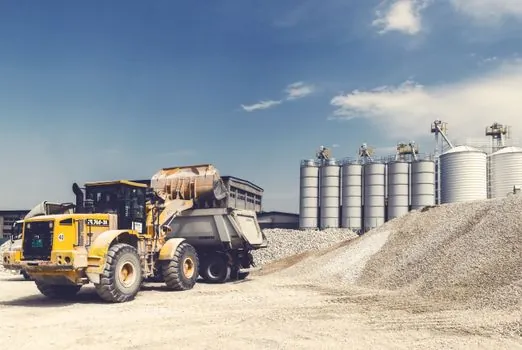
Cement dust is abrasive and hygroscopic, so the standard nitrile double-lip seal is rarely adequate above 4 m/s equivalent rim speed or in any outdoor pedestal; the practical cement-plant specification is a multi-stage seal combining a primary nitrile or Viton lip, a dust deflector, and a grease-filled labyrinth, with the seal faces ground rather than cut [S1].
Relubrication is the cheapest reliability intervention on a slewing ring, and a properly plumbed greasing point set with a remote grease line lets the maintenance crew purge the seal every 200 to 500 hours without breaking the seal-housing interface, which is the single most common cause of premature raceway wear on outdoor units [S1][S3]. For plants in coastal or high-humidity regions, breather valves should be specified with desiccant cartridges to keep moisture out of the gear-mesh cavity, because stopped condensation inside the ring is the root cause of many unexplained white-etching-crack failures reclassified after teardown [S3].
Mounting, Bolt Pattern, and Gear Arrangement
Mounting bolts on cement-plant slewing rings are usually grade 10.9 or 12.9 at M20 to M36, tightened to the supplier's published torque in a star sequence over at least two passes, and the supporting structure flatness must be held to about 0.1 mm per metre across the ring footprint or the preload on a crossed roller unit will be lost within the first year [S4].
Gear arrangement is the most common source of procurement error: an external-gear ring needs a pinion that engages the outside diameter, an internal-gear ring needs access to the inside diameter from above, and a non-geared ring needs a separate drive, and these three options are not interchangeable because bolt patterns, ring thickness, and overall mass differ between them even when the boundary dimensions match [S4]. For new stacker-reclaimer builds, most OEMs now spec the internal-gear arrangement because the pinion and drive can sit inside the boom envelope, which protects the gear mesh from dust and dropped material; for preheater and cooler service where the rotation is intermittent and slow, a non-geared ring driven by hydraulic rams or external gear segments is often the cheapest and most reliable configuration [S3][S4]. Related selection logic for high-dust, heavy-load rotating equipment is covered in the marine slewing ring bearing spec map, which is a useful cross-check for offshore-bound cement terminals.
Common Failure Modes and What They Tell You
Three failure modes dominate teardown reports on cement-plant slewing rings: raceway pitting under the moment-load quadrant, false brinelling at parked positions, and premature raceway wear from seal failure and dust ingestion [S1][S3].
Raceway pitting localised to a 30 to 60 degree arc on the loaded side is the fingerprint of a moment-load underspec and points back to the 3 to 5x peak element load that was not captured in the original equivalent load calculation [S2]. False brinelling marks at the load zone of a stationary ring, usually spaced to the rolling-element pitch, indicate that the bearing has sat under load without periodic rotation for weeks, which is common on standby stacker-reclaimers and is fixed by an automatic slow-rotation routine during plant stoppages. Uniform raceway wear across the full circumference with abrasive scoring points to seal failure, and the corrective action is to upgrade the seal stack and shorten the relubrication interval, not to replace the bearing without changing the sealing arrangement [S1]. Where cement dust combines with stop-start moisture cycles, a harder raceway of 60 HRC plus induction case depth of 3 to 5 mm buys measurable extra life over a through-hardened 55 HRC alternative, at a small cost premium that pays back inside one planned shutdown [S3].
Track the next procurement cycle: a measurable signal is how many cement OEMs move from four-point contact ball to three-row roller rings on new preheater towers above 6000 t/d clinker capacity, and whether induction-hardened raceways become the default rather than the optional upgrade in vendor quotations through the rest of 2026.