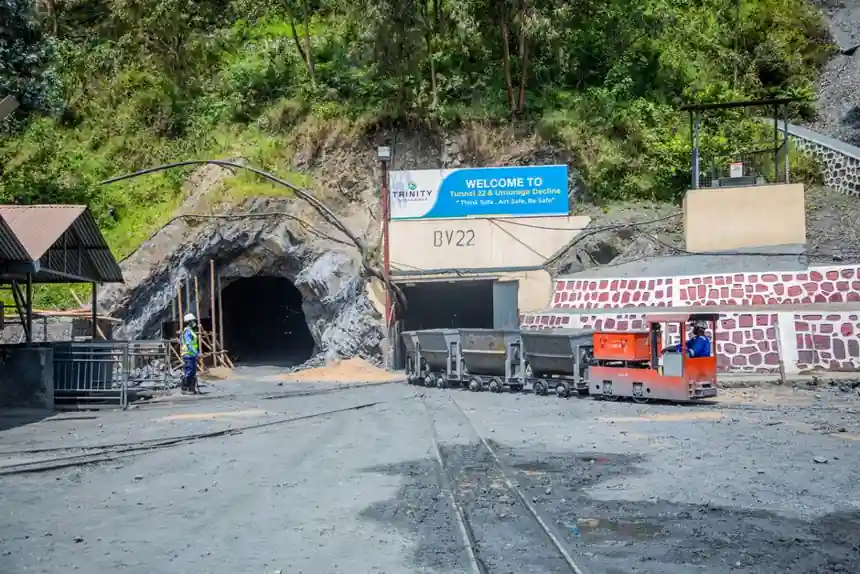
Slewing bearings for mining service span bore diameters of 200 mm to 6,000+ mm, with mining-class machines typically running in the 1,500–6,000 mm window and specialty reclaimers exceeding 8 m [S1].
Unlike general-purpose slewing rings, mining-duty units must simultaneously support axial load from the upper structure, radial load from boom/attachment reaction, and an overturning moment that can swing sharply with each digging cycle; selecting a bearing here is a static-capacity and rigidity problem first, a fatigue-life calculation second [S6]. A practical baseline reference for the bearing family itself is the slewing bearing overview, which frames the three-load geometry that drives every mining selection.
Mining Service Loads: Why Static Capacity Dominates Selection
Mining slewing bearings are sized on static load capacity, structural rigidity, and a safety margin first, with L10 fatigue life treated as a check rather than the primary driver [S6]. A mining excavator's upper house imposes a near-constant axial load equal to its own weight (cab, engine, counterweight), a radial reaction that shifts with boom reach, and a tilting moment that can change sign within a single dig cycle as the bucket is loaded and slewed [S3][S5].
This is fundamentally different from wind-turbine yaw or radar pedestal service, where the load is steady and reversing slowly; a 4,000 mm wind yaw bearing is loaded similarly in size but in a far gentler load spectrum. For mining, the conservative practice is to apply a static safety factor on the order of 1.2–1.5 against the worst-case combined load case before any fatigue check, because a single overload event can brinell the raceway and end service life immediately. Rings are usually forged from 42CrMo4 or 50Mn alloy steel with raceways surface-hardened to HRC 55–62 to resist that brinelling risk [S1][S5].
Type Comparison: Four-Point Ball, Crossed Roller, Double-Row Ball, Three-Row Roller
Four structural families cover essentially every mining slewing bearing, and the choice is made on load type, not bore size alone [S3][S4].
Single-row four-point contact ball bearings are the lightest, cheapest, and most common configuration for small to medium excavators in the roughly 800–2,500 mm bore range, where combined loads are moderate and the swing motor is modest [S3][S5]. Crossed roller bearings use a 1:1 roller arrangement for higher precision and stiffer moment capacity, which is why they show up on mining drills and precision slewing platforms, but they are more sensitive to mounting flatness and shock load. Double-row ball bearings carry higher static load than a single-row four-point design with a simpler package, and they are the common choice for deck cranes on mining vessels and mid-size stacker-reclaimers [S3]. Three-row roller slewing bearings place separate axial, radial, and moment roller sets in the same ring, giving the highest load density of any configuration; they are the standard on large mining excavators above ~200 t and on bucket-wheel stacker-reclaimers where the moment load dominates [S3].
For a mining buyer the trade-off is concrete: a four-point ball unit is typically 30–50% cheaper than a three-row roller of the same bore, but it accepts a lower moment rating and is less tolerant of shock; once the machine class exceeds roughly 200 t operating weight or 6 m boom reach, three-row roller is the default specification, and a slewing ring bearing of that class routinely runs above 8,000 operating hours between rebuilds [S3].
Raceways, Materials, and the Rolling-Element Decision
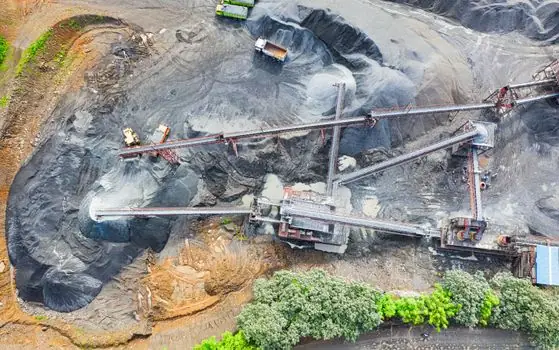
Raceways on mining slewing bearings are induction-hardened to HRC 55–62 on a tough core of 42CrMo4 or 50Mn, the same family used in mining ground-engaging tools, which is why brinelling resistance and toughness are the metallurgical priorities rather than maximum hardness [S1][S5].
The ball-versus-roller decision is the most consequential single choice in selection [S1]. Balls make point contact with the raceway, so they have lower friction, smoother rotation, and tolerate misalignment better, but per-element load capacity is lower and they deflect more under shock. Cylindrical rollers make line contact, which roughly doubles static load capacity per element and improves shock resistance, at the cost of higher friction and tighter mounting tolerances; mining excavator slew rings above ~120 t class almost universally use rollers for that reason, and three-row roller designs carry extreme load densities in bucket-wheel reclaimers and ladle turrets [S3][S5]. A practical rule of thumb: if the application's peak overturning moment exceeds what a four-point ball of that bore can carry with a 1.3 static factor, move to a roller design; do not try to "beef up" a ball design by stepping bore, because the moment rating scales worse than capacity.
Seals, Lubrication, and Contamination: Where Mining Units Actually Fail
Seal failure, not rolling-contact fatigue, is the dominant field-failure mode for mining slewing bearings, because the operating environment is dust-laden, wet, and frequently washed with high-pressure water [S5].
Lip seals on both faces of the bearing keep grease in and contamination out, and on mining equipment they are typically paired with a labyrinth geometry and a grease-relief path so that over-greasing cannot burst the seal. Many large-diameter mining slewing rings are greased at intervals measured in hundreds of operating hours rather than the thousands common in wind service, and the relubrication schedule is part of the bearing specification, not an afterthought. Ring deformation from improper installation is a leading cause of premature failure [S5], which is why mining-class bearings are mounted on machined pads flatness-checked to roughly 0.05 mm across the mounting face, with bolts torqued in a star pattern to a controlled preload, and why the supplier typically specifies the bolt grade (commonly 10.9 or 12.9) and the torque value in the installation drawing. Contamination ingress and raceway brinelling from shock are the two failure modes to design against; rolling contact fatigue is rarely the limiting factor in mining service life [S3][S5].
Driven Rotation: Internal vs External Gear and Pinion Sizing
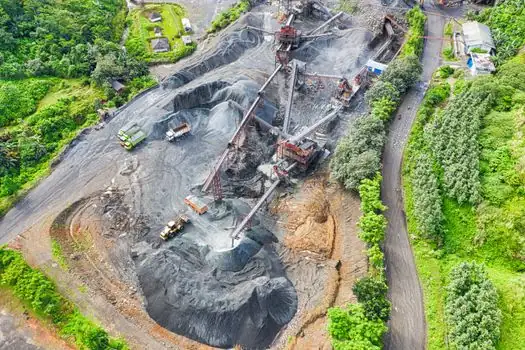
Most mining slewing rings integrate gear teeth on one race, either internal (teeth cut into the bore of the outer ring) or external (teeth on the outer diameter of the inner ring), and the pinion that drives them must be sized to the same load class as the bearing itself [S4][S5].
External gearing is the more common mining-excavator configuration because the swing motor and pinion are easier to package below the upper structure, and external teeth are easier to inspect for wear and damage in service; the teeth are induction-hardened for wear resistance [S5]. Internal gearing gives a smaller swing-motor envelope and better tooth-protection from falling debris, which is why some stacker-reclaimers and cranes prefer it. The mechanical interface of bearing plus integrated gear is the same architecture used in slewing drive packages, where a worm or planetary gearbox is bolted directly to the slewing ring; for high-power mining service the gearbox ratio is typically in the 50:1 to 150:1 range, with a hydraulic motor driving the input stage. The pinion module and number of teeth must be matched to the bearing's gear-tooth specification; mismatched modules are a common commissioning defect and a source of tooth-root cracking within the first 1,000 hours.
Selection Criteria Checklist for a Mining Slewing Bearing
Selection for mining should follow a fixed sequence: worst-case combined load case (axial, radial, moment) with a static safety factor of 1.2–1.5 applied; bore and width set by mounting envelope; structural type (four-point ball, crossed roller, double-row ball, three-row roller) set by the dominant load direction; material and raceway hardness confirmed at 42CrMo4/50Mn core with HRC 55–62 case; gear type and module selected; seal system and relubrication interval defined; and finally a fatigue-life check confirming that the calculated L10 exceeds the planned overhaul interval with a margin that accounts for the shock-loaded nature of the service [S3][S6].
For reference, a typical hydraulic mining excavator in the 200–400 t class uses a three-row roller slewing ring roughly 2,500–3,500 mm in bore, mounted on 10.9- or 12.9-grade bolts torqued in a controlled star pattern, grease-lubricated with relubrication every 250–500 operating hours, and integrated with a hydraulic swing motor through an external pinion [S3][S5]. Lighter off-highway trucks and underground LHDs sometimes use slewing-ring-style bearings in their articulation joints, but the dominant mining slewing-bearing application remains the excavator swing circle and the stacker-reclaimer slew, and selection discipline for those machines is largely settled. For buyers comparing supplier quotes, the variance that matters is not headline static capacity but mounting flatness tolerance, gear-tooth specification, and seal design, because those determine whether the rated life is actually achieved in a dusty, shock-loaded pit. Related process context for the heavy mobile side of the same equipment family is covered in Rotary Drilling Rig Selection for Mining: Torque, Depth and Mobility Spec Bands, and adjacent mobile-equipment selection criteria appear in Rotary Drilling Rig Selection for Demolition Projects: 2026 Spec Map.
Track the next revision of ISO 6336 for gear-load capacity on the integrated pinion interface, and watch supplier-published brinelling-resistance data for HRC 55–62 raceways under combined shock load, since these are the two parameters that move first when mining-class slewing bearing design tightens.