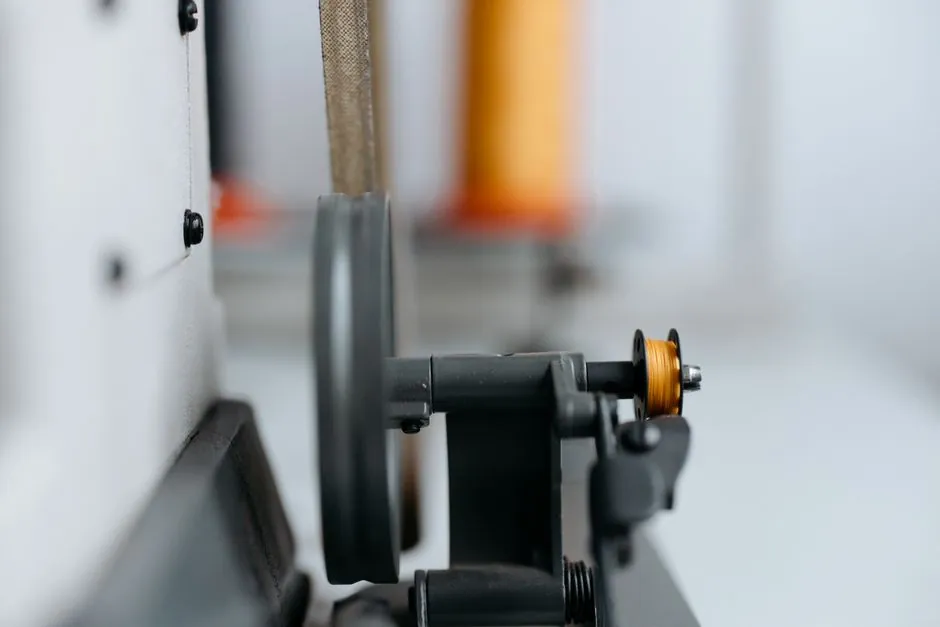
Slewing bearings in a textile mill do almost no high-RPM work. They index fabric rolls, bobbins, creels, and stenter frames at slow rotational speeds, often under 10 rpm, while carrying combined axial, radial, and moment loads from roll weight and unbalanced fabric tension. Specifying the wrong type costs the plant far more in seized raceways and lint contamination than in purchase price.
Selection therefore centres on three numbers: static axial load rating (C0a), static radial load rating (C0r), and the limiting speed with grease lubrication, all of which must be cross-checked against the real operating envelope rather than the catalogue headline. A 4-point contact ball slewing ring typically suits light, fast-indexing creels; a crossed-roller slewing ring, such as the XSU08 series from INA/Schaeffler, suits heavier stenter and tenter frames where moment stiffness matters [S2].
Where a slewing ring actually lives inside a textile mill
Typical slewing-bearing positions inside a mill include the rotating creel on a weaving preparatory line, the take-up and let-off roll turrets on a weaving loom, the chain-and-bobbin indexing head on a ring spinning frame, and the exit frame of a stenter or heat-setting range. Spinning, winding, and knitting machines themselves run much faster and rely on thin-section deep-groove and angular-contact bearings rather than slewing rings [S1].
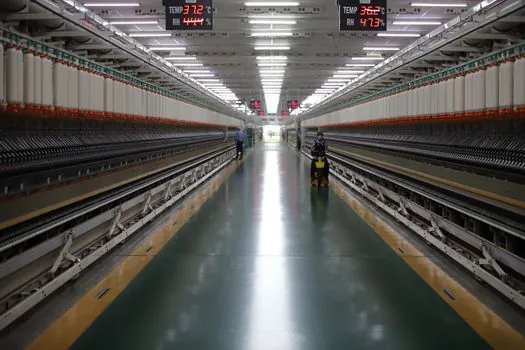
Textile-mill duty is therefore characterised by slow rotation (typically 1 to 10 rpm), continuous operation across 3-shift production, airborne lint and short fibre, and relative humidity that often sits between 60 and 85 percent in weave preparation and dyeing halls [S3]. Compared with a crane or excavator slewing bearing, the textile duty is lighter on peak load but harsher on sealing, lubrication retention, and corrosion.
Four-point contact vs crossed-roller: the core decision
A 4-point contact ball slewing ring (series Q, often marketed as "light" or "thin-section" slewing bearings) carries combined axial, radial, and small moment loads through a single row of balls engaging four raceway shoulders. It is the lowest-cost option for creel turrets and small let-off rolls where the dominant load is axial roll weight and moment loads are modest. [S2]
A crossed-roller slewing ring replaces balls with cylindrical rollers set 90 degrees to each other, so every roller carries load in both axial and radial directions simultaneously. The published example XSU080218, 180 mm bore x 255 mm OD x 25.4 mm height, lists C0a = 310,000 N axial static and C0r = 151,000 N radial static, with a limiting speed of 175 rpm in grease and an operating temperature window of -30 to +80 degrees C [S2]. That envelope is comfortably above the 1 to 10 rpm textile indexing range, so a crossed-roller unit is normally selected for its higher moment stiffness and smaller cross-section for a given load, not for any speed advantage. Mills should compare C0a, C0r, and weight (4.2 kg for XSU080218) directly against the heaviest fabric or bobbin stack plus any unbalanced-tension moment, and avoid over-specifying diameter simply because a larger ring is on the shelf.
For very heavy tenter frames and palletising-type fabric towers, double-row ball slewing rings (series 2R or WA) are a third option, trading cost and weight for higher axial and moment capacity than a single-row 4-point unit. Mills that buy Chinese-sourced rings through trading houses should still demand the same C0a and C0r data plus mounting-hole pattern drawings, since housing-bearing inventories carried for general industrial users do not automatically cover large slewing-ring SKUs [S3].
Sealing, lubrication, and corrosion: the textile-specific risks

Short fibre and lint are the enemies of any open slewing ring. A mill should specify nitrile or polyurethane lip seals on both faces as a minimum, and consider lamellar seals (as fitted to XSU series) where airborne contamination is heavy [S2].
Grease retention matters as much as sealing: high-speed greases designed for electric-motor bearings can shear at the slow oscillating duty of a creel turret and bleed out, so a lithium-thickened or polyurea grease with a base oil viscosity around ISO VG 100 to 220 is a more common choice for textile slewing rings. The XSU080218 data sheet caps operating temperature at +80 degrees C, which is consistent with grease-lubricated slow-indexing duty and well below the temperature limits of heat-setting stenter frames that need external cooling or high-temperature grease [S2].
Humidity and the occasional wash-down in dye-house areas drive the corrosion specification. Mills that route slewing rings through wet zones should specify black-oxide, zinc-flake, or Dacromet-coated rings rather than bare phosphatised steel, and pair that with stainless or plated mounting hardware. The same logic that pushes general textile bearing buyers toward sealed-for-life thin-section units in high-speed positions also pushes slewing-ring buyers toward factory-sealed, greased-for-life units [S1].
Sizing procedure a maintenance engineer can run on the floor
Step 1, list the loads. Take the maximum fabric or bobbin stack weight (W), the support-arm length (L) from the slewing-ring centreline to the centre of gravity, and any side load from unbalanced tension. Compute the equivalent axial load Fa = W and the overturning moment M = W x L. Step 2, pull candidate rings whose C0a is at least 1.25 times Fa and whose C0r is at least 1.25 times the computed radial load, then check that the published moment rating (or a supplier calculation) covers M. Step 3, confirm the limiting speed with grease is well above the indexing speed, leaving at least a factor of 2 margin. [S2]
For a 4-point contact slewing ring on a creel, use the supplier's static-curvature and ball-pass-frequency charts to confirm the contact angle (commonly 45 to 60 degrees) suits the axial-versus-moment ratio. For a crossed-roller ring, follow the XSU series calculation factor published for the chosen size: XSU080218, for instance, lists a maximum radial load through the fixing screws of 13,600 N, which is the binding constraint when the ring is bolted rather than welded [S2]. Mills that ignore that bolt-load limit tend to see fatigue cracks in the inner ring rather than raceway spalling.
For peer reference on the moment-load logic, the broader slewing-bearing engineering treatment under the slewing ring bearing entry covers the same axial/radial/moment triple in greater depth, while the slewing bearing page maps the four main construction types (4-point contact, crossed-roller, three-row roller, double-row ball) onto typical industrial applications. Mills that need a powered indexing drive rather than a passive ring should also review the slewing drive entry, since most modern creel and stenter turrets now use a worm-gear slew drive instead of a manual pin.
What not to specify, and what to verify on receipt
Avoid generic "crane-type" slewing rings above 500 mm bore for textile duty: they are dimensioned for peak shock loads and ship with harder grease than a mill needs, and their mounting patterns rarely match creel or stenter fabrications. Equally, do not reuse a slewing ring pulled from a wind turbine yaw or a port crane: the original operating-temperature, lubrication, and inspection intervals are not transferable to a humid lint-loaded hall. [S2]
On receipt, verify the bore and outside diameter against the data sheet (for XSU080218: d = 180 mm with 0/+0.025 mm tolerance, D = 255 mm with 0/-0.032 mm tolerance), the running accuracy of 0.01 mm, the number and pitch-circle diameter of the 20 fixing holes on each ring, and the absence of grease leakage past the lamellar seals [S2]. Reject any ring shipped without end-cap protection on the mounting faces, and reject any whose serial-number plate is missing, because the static-load calculation depends on the exact variant. Finally, log the greasing interval (typically 6 to 12 months for slow-indexing textile duty) and bolt-torque re-check into the mill's CMMS so the first failure mode, bolt loosening, is caught before the second, raceway brinelling.
Trackable signals over the next two quarters: rising use of factory-sealed, greased-for-life crossed-roller rings in new stenter and creel builds as a substitute for re-greasable 4-point contact units; tighter supplier focus on humidity-rated surface coatings as more mills add wet-zone slewing positions; and broader adoption of bolt-load rather than weld-load mounting so failed rings can be swapped without cutting the structure, a practice that mirrors the maintenance-friendly design of marine slewing rings covered in marine slewing bearing selection: salt-spray coatings, ship-motion loads, and class docs.