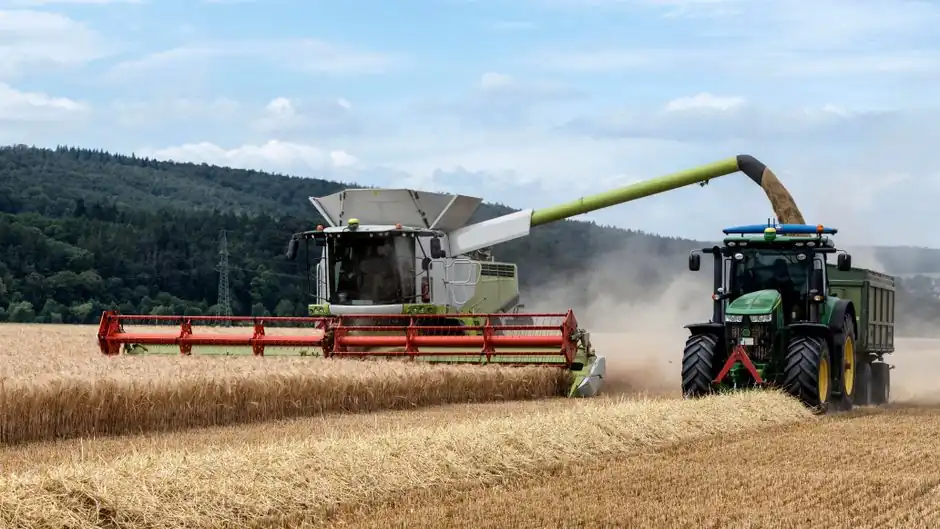
For harvesters, sprayers, spreaders and irrigation booms, a slewing bearing is the structural joint that carries axial load, radial load and overturning moment simultaneously, so selection is driven by static load capacity and moment rating rather than L10 life in the conventional sense [S1][S5].
Agricultural duty is harsher than indoor industrial duty: abrasive dust, fertilizer corrosion, daily wash-down, and seasonal thermal swings between -30 °C and 80 °C on typical operating envelopes [S1][S4]. In practice, that means the bearing is chosen more for sealing, gear-teeth option and raceway hardness than for the rolling-element count alone.
Agricultural Duty Profile vs. Industrial Slewing Duty
Agricultural slewing bearings are explicitly built to withstand harsh outdoor environments with exposure to moisture, dust, fertilizer and pesticide chemicals, which sets them apart from the slewing rings used in indoor cranes and packaging machinery [S2][S3]. Common host machines are sprayer booms, fertilizer spreaders, round-bale wrappers, combine headers, GPS-guided irrigation pivots and beet-harvesting turrets.
Typical bore range for an agricultural machine is 200 mm to 2,000 mm; the 486–1,198 mm segment is heavily stocked in four-row ball, cross-roller and double-row executions with internal, external or no gearing [S3]. Stocked sizes of 1,100–1,600 mm with 32 mm rolling elements are the workhorse for sprayer and pivot mounts that see continuous slow rotation in dusty conditions [S3].
Rolling-Element Family: 4-Point Contact Ball vs. Crossed Roller vs. Double-Row
A single-row 4-point contact ball bearing handles axial load, radial load and moment load in one raceway, which is why it dominates agricultural slewing designs where one ring must replace a king-post, bearing and gear set [S1]. Cross-roller slewing rings such as the XSU080218 series carry higher moment and tilting rigidity per unit width and are specified when boom deflection under spray mass must stay below a defined threshold, with a published 75 kN axial / 54 kN radial dynamic load rating and 310 kN / 151 kN static ratings on a 180 × 255 × 25.4 mm envelope [S4].
Double-row ball slewing rings sit between the two: more rolling elements and higher static capacity than a 4-point design, lower friction than a cross-roller, and they tolerate mounting-face imperfections better. For wide booms and offset loads on planters, the double-row pattern is commonly the first design tried.
Material, Raceway Hardness and Corrosion Stack-Up
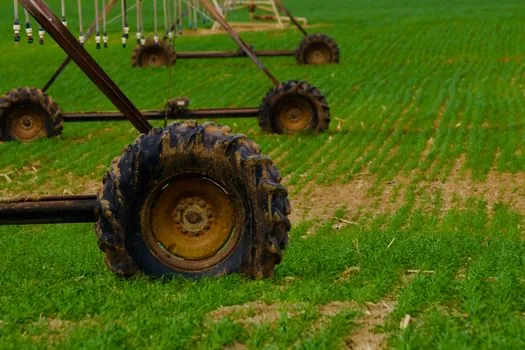
Standard slewing rings use medium-carbon alloy steel (typically 42CrMo4) with raceways surface-hardened to HRC 55–62 to resist rolling-contact fatigue, and that specification is the baseline for agricultural units as well [S1]. Where machines see liquid fertilizer (UAN, ammonium nitrate solution) and chloride-bearing foliar sprays, the raceway is fine; the failure point is the seal lip and the bolt-circle corrosion, not the rolling contact.
Agricultural slewing rings therefore frequently pair the same 42CrMo4 raceway with a hot-dip galvanized or zinc-nickel plated ring, stainless (A2/A4 grade) mounting fasteners, and a black-oxide or Dacromet-treated gear on the driven ring. A measured operating temperature range of -30 °C to +80 °C covers most field duty in temperate and continental climates, and is the published limit for the XSU080218 cross-roller reference unit [S4].
Sealing and Lubrication for Field Service Intervals
Agricultural slewing bearings are almost always grease-lubricated with relubrication nipples on both rings, and the seal stack is what separates a one-season bearing from a ten-year one. Lip seals with secondary lamellar (multi-stage) seals are common on stocked units, and the lamellar seal on both sides is a published feature of the XSU080218 cross-roller series [S3][S4].
For combine and forage-harvester mounts, IP65 is the practical floor; for pivot irrigation and lagoon mixers that see partial submersion or daily high-pressure wash, IP67 with a grease-bleed channel is the typical spec. Limiting speed is rarely the issue (the XSU080218 is rated at 175 rpm) but continuous slow rotation in contaminated conditions is harder on seals than high speed, which is why relube interval (commonly 250 h) is the realistic maintenance KPI [S1][S4].
Gearing Option: Internal, External or No Gear
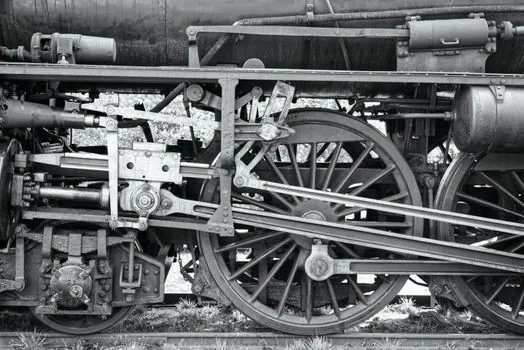
Three gearing options dominate the agricultural stock catalogue: internal gearing, external gearing, and no gearing (plain ring), and the choice is set by the drive layout on the host machine [S3]. External gear is preferred when the pinion can be mounted on a stub shaft outside the ring envelope (most spreaders and trailed sprayers); internal gear is preferred when the pinion sits inside the ring, protecting it from stone strike and crop wrap (pivot irrigation, mixer turrets); and no-gear rings are used where a separate hydraulic motor drives a sprocket or a hydraulic motor is flanged directly to the rotating column [S3].
For a baseline load spec on the no-gear cross-roller path, the XSU080218 reference gives 75 kN axial and 54 kN radial dynamic capacity on a 25.4 mm cross-section, with 20 fixing bores on each ring at 6.8 mm hole diameter, which is a useful reference when scaling to larger bores [S4].
Selection Procedure and Load Case for the Spec Sheet
Selection of agricultural slewing bearings is based primarily on static load capacity, structural rigidity and safety margin, with a static safety factor of 1.25–1.50 typically applied to the worst combined load case [S5]. The required inputs are: boom mass, payload mass, offset distance from the bearing axis, dynamic amplification from field travel (commonly 1.5× for trailed units, 2.0× for mounted units over rough ground), wind load on the boom, and slope-induced moment.
Once the equivalent static axial load Fa,eq and equivalent static moment M are calculated, the chosen bearing must satisfy C0a ≥ Fa,eq × fs and the catalogue static moment rating C0M ≥ M × fs. The dynamic rating then becomes a fatigue check over the design life, not the primary selection criterion [S5]. For comparison context, the same selection logic and load-case discipline is described for steel-mill slewing duty in this slewing-bearing selection map for steel mills, and the seal/gear option logic parallels cement-plant service in this slewing-bearing spec map for cement plants.
Failure Modes and Field-Trackable Signals
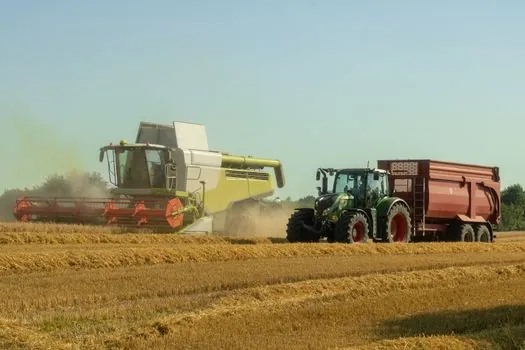
The three failure modes that dominate agricultural warranty returns are: (1) seal failure followed by raceway brinelling from ingested grit, (2) mounting-bolt loosening from bolt-circle corrosion and missing preload, and (3) gear-tooth pitting on external-gear rings where the pinion is misaligned. Trackable signals are grease purge at the seal lip (seal failure), increased rotational torque above the seasonal baseline (raceway damage), and audible clicking on each revolution (tooth wear). [S1]
The actionable follow-ups are: replace the seal set and re-grease on first purge, re-torque the mounting bolts to the catalogue value (commonly 8.8 or 10.9 grade) on a 250 h interval, and verify pinion mesh pattern with marking compound at every seasonal service. The practical reference for torque grade and fastener selection on rotating assemblies is the same pattern used for static pressure molding line fasteners and NBR service-band selection in construction: match the elastomer or fastener to the contaminant, not the other way around.
The underlying component specifications are covered under slewing drive, and slewing ring bearing.