
For a small plant running a handful of work orders a week on stable routings, an ERP covering purchasing, inventory valuation, and finance is typically the right first move, and a separate MES adds cost without changing throughput [S1].
Once the operation adds tight lot traceability, real-time yield tracking, regulated process steps, or frequent schedule shifts on the floor, ERP's planning view stops being enough, and an MES starts to earn its license, integration, and training overhead [S2][S3].
Decision rule based on plant complexity, not headcount
The right answer is not driven by how many people work at the plant but by three operational signals: regulatory traceability depth, real-time visibility need, and production volume variance [S1][S4].
ERP answers "what should happen and at what cost" through demand and supply planning, work order management at the planning level, inventory balances, procurement, and standard cost rollups; it is not designed to react at machine speed [S2]. MES answers "what is happening right now" through production tracking, downtime capture, yield monitoring, scan and label verification, and lot-level traceability events [S2][S3]. When supervisors start asking line-level questions the ERP cannot answer in real time, that is the trigger to evaluate MES [S3].
Who can stay on ERP alone
Plants that fit a "make-to-stock, low SKU count, simple routing" profile generally do not need an MES in 2026 and would benefit more from cleaning up master data inside the ERP than from buying a new platform [S1][S4].
Indicators that ERP is enough include: stable routings with few operation steps, low mix or low volume change, no regulatory mandate for unit-level traceability, paper or barcode travellers that already capture the data the business needs, and a finance team that owns the cost-of-goods picture [S1][S4]. In this profile, the highest-value move is tightening ERP modules for inventory accuracy, purchasing, and scheduling before adding anything else, since ERP implementation is itself where most small plants lose the first six months [S4]. A useful adjacent read on implementation friction is covered in practical MES vs ERP integration guidance and in the food-plant floor gap analysis, both of which document the same pattern: the gap is execution, not planning [S2][S3].
Who should add an MES, and what to add it on top of
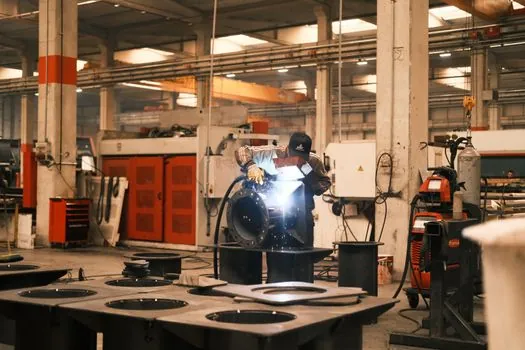
Plants in food, pharma, medical devices, aerospace, and other regulated or high-mix discrete sectors usually land on MES once a real defect, recall, or customer audit forces the issue, not before [S3][S4].
The strongest triggers are: lot-level or unit-level traceability mandated by regulators or customers, real-time OEE reporting, label and scan verification at each step, and active monitoring of giveaway, yield, or scrap by line, shift, and product [S3]. In those cases MES is layered on top of the ERP, not swapped in: the ERP keeps the BOMs, routings, and financial rollup, while the MES owns the shop-floor events, downtime, and quality captures that the ERP cannot see at machine speed [S2][S3]. The ISA-95 boundary between levels 3 and 4 is the standard reference frame vendors use to keep these two systems from overlapping and conflicting, and MESA International's MES definitions are the practical reading list for any small plant starting this evaluation [S2].
Selection criteria when MES is on the table
When an MES is justified, the evaluation criteria are operator adoption speed, native integration with the existing ERP, and the ability to capture data without forcing the operator to leave the workstation, since these three factors decide whether the system is actually used on shift one [S4][S5].
Small-plant buyers should also weight: implementation time measured in weeks not quarters, mobile-first operator screens, support for the specific traceability model the plant needs (lot, serial, or unit), and whether the MES can run on a PLC and flow meter data feed without a custom middleware layer [S2][S5]. Vendor demos that show polished executive dashboards are a weak signal; a step-by-step walkthrough of a clock-in, report-quantity, scan-component, and exception-handle workflow tells the real story, because that is what an operator will do 200 times per shift [S4]. Pricing models in 2026 skew toward per-user cloud subscriptions, with implementation partners offering fixed-scope packages sized for sub-50-seat plants, which is the typical small-manufacturer bracket [S5].
Where ERP and MES overlap, and how to keep them from duplicating

Both systems hold a version of the work order, the item master, and inventory balances, and that overlap is where most small-plant implementations bleed budget [S2][S6].
The clean separation is: ERP owns planning, cost, and the financial record; MES owns execution events, exceptions, and shop-floor performance; the integration layer pushes completion, scrap, and consumption events from MES back into ERP so costing and inventory stay accurate without double entry [S2][S3]. On a small plant, this is usually a nightly batch or near-real-time API push, not a full bidirectional sync, and the integration scope should be locked in the MES contract before signing [S2][S5]. A related consideration for any data-capture device on the line is how a pressure sensor or pressure transmitter feeds the MES, since time-stamped process data is often the difference between a usable OEE report and a generic one [S2].
Limits and failure modes small plants hit in 2026
Three failure modes show up repeatedly in small-plant MES and ERP rollouts: scope creep into a full ERP replacement, operator rejection of slow data-entry screens, and integration that quietly breaks when one side updates [S4][S5].
Scope creep usually starts when the MES vendor offers to also "handle" purchasing or scheduling; the safer path is to keep the ERP as the system of record for those functions and let the MES focus on execution [S2][S4]. Operator rejection is preventable only by piloting the MES screens on the actual shop floor with the actual operators before contract signature, not after go-live [S4]. Integration fragility is a vendor-management issue: API versioning, middleware ownership, and a single named owner of the ERP-MES boundary are the three items to write into the implementation statement of work [S2][S5]. The underlying industrial valve and additive manufacturing material data sources feeding the MES are rarely the failure point, the failure is almost always on the human or integration side [S4].
Signals to watch between now and 2027

Two verifiable signals will tell the market where small-plant MES adoption actually lands in the next 12 to 18 months: the share of 2026 cloud-ERP releases that ship a native MES module versus a partner MES connector, and the number of small-manufacturer MES implementations completed in under 90 days as reported by the major vendors in their 2026 customer summaries [S5].
A third signal worth tracking is whether MES vendors continue to publish food, pharma, and aerospace reference customers with under 100 employees, since that bracket is the proof point that MES has moved from a large-plant tool to a small-plant option [S3][S5]. Plants evaluating in 2026 should ask each shortlisted vendor for a same-vertical reference with headcount under 100 and a go-live date inside the last 18 months, and treat the absence of that reference as a hard disqualifier rather than a negotiating point [S4][S5].
For related coverage, see Alloy Steel Bar vs Plate for Forged Components: Spec-Level Selection.