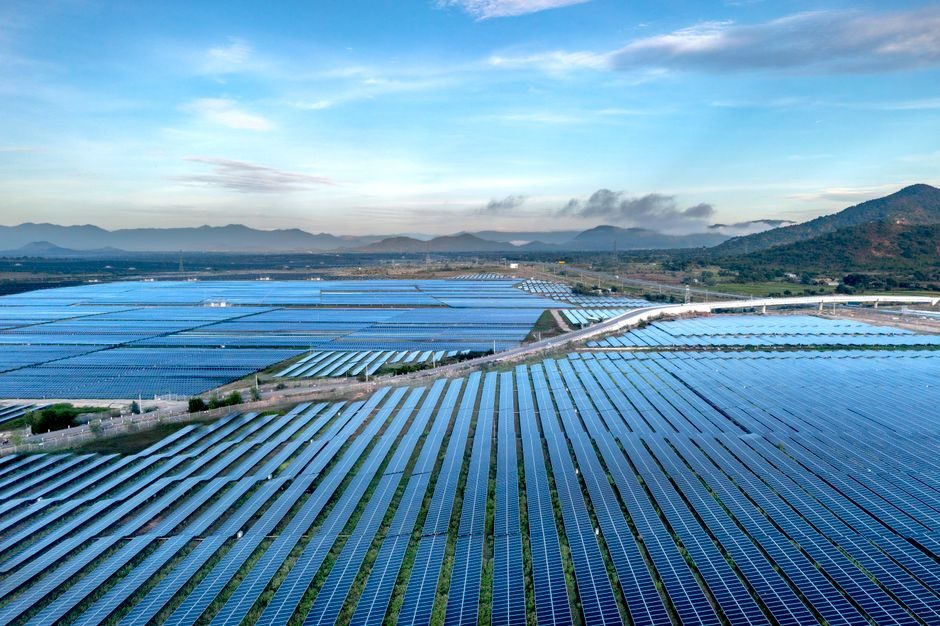
Global solar energy market value is forecast to expand from $268.93B in 2026 to $606.18B in 2030 at a 22.5% compound annual growth rate, with the 2025 base set at $217.51B and the 2026 year-on-year growth rate printed at 23.6% [S1]. The figure covers the full value chain — solar cell panels, solar cell paste, and solar silicon wafers — not module shipments alone, so it is the right denominator for capacity and capex planning rather than GW installations.
Asia-Pacific was the largest regional block in 2025, and the forecast attributes growth to five drivers: investment in next-generation solar tech, supply-chain localisation, emerging-market adoption, solar-plus-storage integration, and policy support [S1]. On the panel-type axis, the same source splits demand across mono-crystalline, thin-film, and poly-crystalline, with bifacial panels now explicitly broken out as a subsegment of solar cell panels [S1].
Cell-Type Mix: Mono, Poly, Thin-Film, Bifacial Compared
Mono-crystalline silicon is the default technology in utility-scale and commercial rooftop tenders, and the broader solar cell panel subsegment in 2026 reporting lists monocrystalline, polycrystalline, thin-film, and bifacial as the four tracked panel types [S1]. For process engineers buying modules by the pallet, the practical difference is efficiency per m² and weight tolerance: mono-crystalline typically delivers the highest conversion efficiency in the ~20-22% range, polycrystalline sits a few points lower, and thin-film trades peak efficiency for better low-light and high-temperature behaviour. Bifacial modules, which capture albedo on the rear side, are listed as a distinct subsegment rather than a cell chemistry, which matters when matching them to ground-cover ratio and racking height.
The forecast calls out rising adoption of high-efficiency solar cells and expansion of integrated solar manufacturing as two of the headline trends for 2026-2030 [S1]. For buyers, that translates into a procurement calendar where p-type PERC lines are being replaced or supplemented by n-type TOPCon and HJT capacity — a change that affects not just panel pricing but also string-voltage design, inverter sizing, and the bill of materials for related balance-of-system hardware like the HMI panel that monitors string-level performance.
Portable Solar Panel Adjacency: A $1.3B Sub-Track by 2027
The portable solar panel segment is forecast to reach $1.30B by 2027, growing at a 17.5% CAGR from 2022 to 2027, with crystalline cells — split into mono and poly — projected as the fastest-growing cell type at 12.2% CAGR over 2026-2031 [S2]. Cell chemistries in this segment include monolithic and amorphous types, and the panel formats tracked are small portable, semi-portable, foldable, and others [S2].
Power capacity bands in the same report run below 50 W, 50-150 W, and above 150 W, which maps directly to the application split of emergency power backup, leisure and recreational use, remote monitoring and maintenance, mobile lights, and others [S2]. End-user verticals covered are transportation, military and defence, telecom, industrial, commercial, and residential — meaning portable solar is a real procurement line for industrial buyers, not a camping-goods niche. APAC held the largest regional share in 2020 on the back of government incentives and adoption of portable energy-efficient devices [S2], a positioning that has not changed materially in subsequent reporting.
Solar Panel Recycling: $404.6M in 2026 to $609.7M by 2033

The solar panel recycling market is estimated at $404.6M in 2026, up from $384.4M in 2025, and is projected to reach $609.7M by 2033 at a 6.0% CAGR for 2026-2033 [S3]. The segment is structured by recycling type — thermal, mechanical, laser — and by incoming panel technique covering monocrystalline, polycrystalline, and thin film [S3]. The 6.0% CAGR is well below the 22.5% headline rate for the broader solar market, which is the correct signal: recycling scales with first-wave panel retirements, not with new installations.
Shelf-life splits are tracked as normal loss versus early loss, where early-loss panels are the units that fail within the first few years of service and are typically returned through insurance or warranty channels [S3]. For a process engineer, the practical implication is that recycling feedstock through 2030 is dominated by panels installed in the 2010-2015 wave, not by today's high-efficiency n-type modules, so thermal and mechanical lines sized for older cell architectures remain the right investment through the decade. Early-loss volumes, while a smaller share, are the segment where mechanical and laser techniques compete for higher-value silver and silicon recovery.
Manufacturing Stack and What 2026 Buyers Should Track
The forecast period drivers for the broader solar market are listed as next-generation solar tech investment, supply-chain localisation, emerging-market adoption, solar-plus-storage integration, and policy support, with module durability and cost reduction across the value chain as two cross-cutting themes [S1]. For industrial buyers, that maps to four trackable signals: localisation announcements that change lead time, panel-efficiency roadmaps that change inverter pairing, recycling-capacity buildouts that change end-of-life compliance cost, and storage attach rates that change the AC:DC balance of new projects.
A useful comparison frame for 2026-2030 procurement: mono-crystalline panels lead on efficiency and are the default for space-constrained commercial and utility work; polycrystalline remains relevant where capex per watt dominates; thin-film suits high-temperature and low-light sites plus flexible-format portable products; bifacial is the gain lever where ground albedo and racking allow. On the back end, recycling capacity at a 6.0% CAGR [S3] is too slow to be a compliance risk for projects commissioned in 2026-2030, but it becomes a budgeting line for assets reaching year 25-30 of service.
Industrial Sourcing Cross-Reads: Power, Monitoring and Safety Adjacencies

Solar demand growth has knock-on effects on the industrial electrical stack that process engineers also specify. Larger PV plants push harder on switchgear, on monitoring cabinets with the HMI panel as the operator interface, and on fire detection — including fire alarm control panel architectures for rooftop and carport arrays where DC arc-fault behaviour differs from AC systems. Indoor electrical rooms housing inverters and battery racks continue to be a relevant adjacency for the aluminum veneer panel cladding used on clean and EMI-conscious enclosures. [S1]
For buyers sizing site infrastructure, the UPS system manufacturing process and 2026 audit anchors piece lays out the bill of materials and line stages relevant to inverter-coupled backup, while the UPS for smart manufacturing topology and 2026 integration map article covers sizing decisions that intersect directly with solar-plus-storage. Industrial fire detection budgets also have a trackable 2026 cost line in the infrared gas detector pricing 2026 sourcing tiers coverage, which is relevant where PV installations co-locate with hydrogen or battery storage.
Trackable signals through 2030: (1) annual cell-type mix disclosures from top-tier module makers to see whether TOPCon and HJT displace PERC on volume; (2) bifacial share within the solar cell panel subsegment reported in 2026 [S1]; (3) recycling capacity announcements in Europe and the U.S. that move the $404.6M 2026 base [S3]; (4) APAC portable-panel shipment data as a proxy for distributed-generation adoption beyond utility-scale.