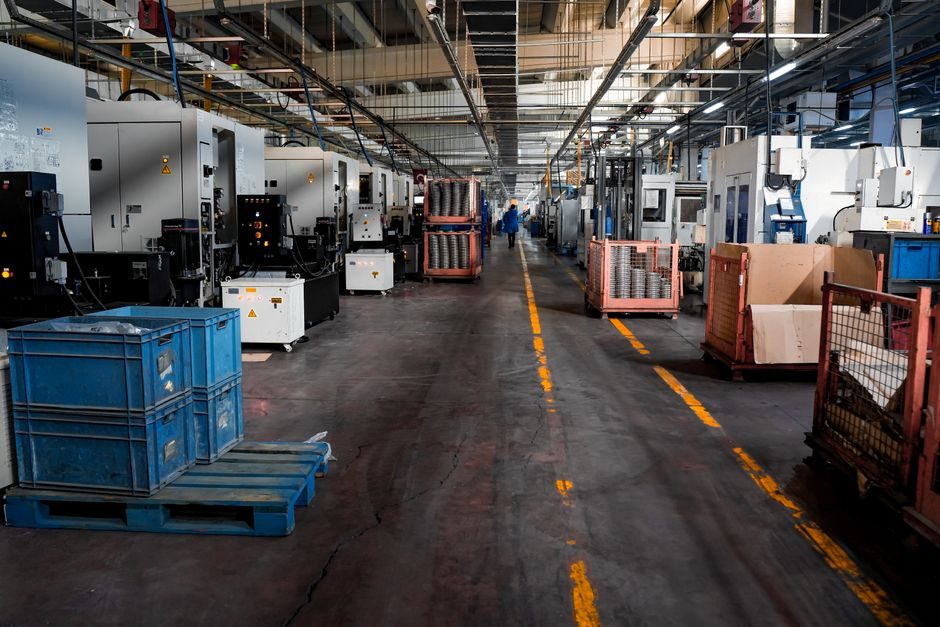
On a smart-manufacturing line, the uninterruptible power supply is no longer a server-room accessory — it is a cell-level asset that has to sit next to PLCs, vision cameras and AGV chargers, ride out a 10–30 s generator start, and quietly log every event into the MES. Online double-conversion units in the 1–6 kVA range with lithium-iron-phosphate (LiFePO₄) battery packs are now the default form factor specified for control-panel and DIN-rail retrofits [S4][S7].
The driver is simple: a hard shutdown of a robotics cell forces a full re-teach, recipe reload and re-referencing — typically 20–60 minutes of lost OEE per event, on top of the scrap from in-flight parts [S3][S6]. Sizing the UPS for a controlled-stop window of 5–15 minutes, rather than for full generator bridging, keeps battery cost and floor footprint inside what a cell engineer will sign off on [S4][S7].
Topology: Why Online Double-Conversion, Not Line-Interactive
Online double-conversion is the only topology that isolates the load from raw mains at all times — the rectifier feeds DC to the inverter continuously, so sags, swells, transients and frequency drift never reach the PLC or servo drive [S4]. In normal mode, incoming AC is corrected by an input power-factor-corrected (PFC) rectifier, converted to DC for the inverter, and a parallel branch charges the battery string; on mains loss the inverter draws from the battery with no transfer time [S4].
Line-interactive units, by contrast, only regulate on limited excursions and pass transients straight through during a brownout — unacceptable for 24 VDC sensor buses, encoders and EtherCAT/Profinet segments where a 4 ms dip corrupts a cycle [S3][S5]. Industrial automation guides consistently call out clean, continuous power as a hard requirement for PLC, SCADA and robotics cells, not a nice-to-have [S3][S5].
Form Factor and Battery Chemistry for the Cell
Two mechanical packages now dominate new cell builds: a flat-mount DIN-rail or panel-mount module designed to live inside the control cabinet next to the PLC, and a short-depth 1U rack unit for shallow industrial enclosures [S7]. The panel-mount class is fanless, accepts flat, wall or DIN-rail mounting, and is sized so a standard UPS physically cannot be dropped in beside a Siemens S7-1200 or an Allen-Bradley CompactLogix — the unit has to be sub-rack depth [S7].
Battery chemistry has moved decisively to LiFePO₄. Published industrial-UPS datasheets quote a 15-year service life for the LiFePO₄ pack inside a sealed enclosure, eliminating the 3–5 year sealed-lead-acid (SLA) replacement cycle that drives the highest lifetime cost on a panel-mounted UPS [S7]. For comparison, the 1U online lithium rack unit is positioned for industrial networking switches, cell controllers and edge gateways where 1U depth is the hard constraint [S7].
Selection Criteria and Comparison of the Three Industrial Classes
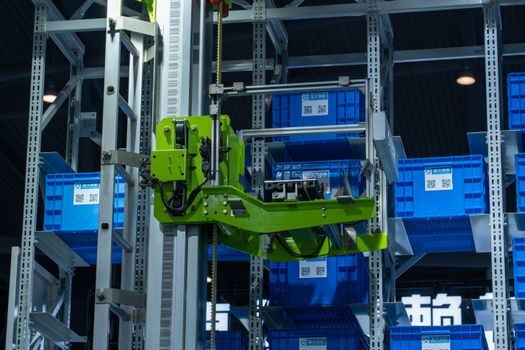
Three UPS classes compete for the same DIN-rail or rack slot in a smart-manufacturing cell. The table below lines them up against the four criteria a control engineer actually specs against: transfer behaviour, battery chemistry, mounting, and service interval [S4][S7].
Industrial online double-conversion 1–6 kVA: zero-transfer (inverter always supplies load), LiFePO₄ option, free-standing or 1U rack, 10–15 year service life with LiFePO₄ — fits a full robotics cell [S4][S7]. Panel-mount / DIN-rail online UPS, sub-1 kVA: zero-transfer, LiFePO₄, flat/wall/DIN, 15-year service life, fanless — fits a single PLC or vision-cabinet branch [S7]. Line-interactive tower/rack, 1–3 kVA: 2–6 ms transfer on brownout, typically SLA, free-standing, 3–5 year battery — adequate only for non-critical monitoring loads [S3][S5].
The decision rule used by most system integrators: if the load includes a PLC, servo drive, vision processor or any industrial Ethernet switch carrying real-time traffic, specify online double-conversion; line-interactive is acceptable only for the SCADA terminal PC and the printer [S3][S5].
Integration with MES, BMS and the Power-Quality Alarm Stack
A modern industrial UPS exposes more than a relay-contact card. Typical I/O on a 1–6 kVA online unit includes a network management card (SNMP v1/v3, Modbus TCP or Ethernet/IP), a serial console, dry-contact inputs for ambient temperature and door status, and a battery-monitoring stream that reports cell voltage, internal resistance and state-of-health per string [S2]. The broader UPS monitoring system wraps this into a power-and-environment view — UPS state, battery health, room temperature, humidity and smoke sensors — and pushes it to the SCADA or BMS layer [S2].
For a smart-manufacturing deployment the practical wiring is: UPS → Ethernet/IP or Modbus TCP → cell PLC or edge gateway → MQTT or OPC UA → MES historian. The UPS-monitoring screen in the MES then shows input voltage THD, load percentage, estimated runtime at current load, and battery SOH, alongside the same metrics from the cell's smart camera and ASRS system feeds. The DC-bus reference for the plant DC system — battery, charger, DC distribution — is documented in the Chinese power-system encyclopaedia as the energy source for control, signal, protection, automatic devices and breaker tripping, and is the same conceptual block a UPS replaces on the AC side of an IT/OT cabinet [S1].
Use Cases on a 2026 Smart-Manufacturing Line
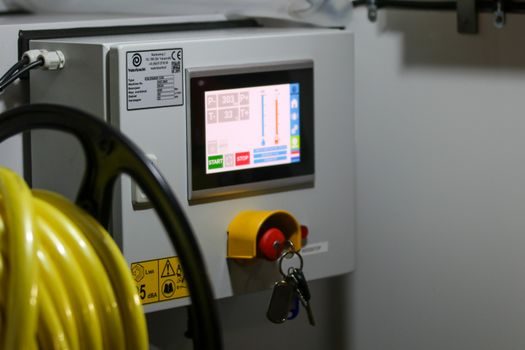
Cell-level (1–6 kVA online): ride-through for a robotic welding cell, a CNC tending robot or an ASRS system mini-load crane. Sized for a 5–15 minute controlled stop, this class prevents the 20–60 minute re-teach penalty that a hard shutdown imposes [S3][S7]. Cabinet-level (sub-1 kVA panel-mount DIN-rail): a single branch feeding one PLC, one smart camera and an industrial Ethernet switch inside a sealed cabinet, where 1U of depth is the binding constraint and a 15-year LiFePO₄ interval is the only acceptable service model [S7].
Process-level (10–80 kVA online three-phase): feeds an entire smart valve positioner rack, a control room, or a cleanroom HVAC loop where loss of pressure or temperature control creates a safety event, not just a scrap event [S3][S5]. The same class is what the industrial UPS reference page documents as the heavy-duty, dust- and vibration-tolerant build used in chemical, food-and-beverage and automotive plants [S3][S5]. Across all three classes, the integration pattern is the same: keep the cell alive long enough for a controlled stop or for the generator to close — never try to ride out a multi-hour outage from the UPS alone.
Limitations, Failure Modes and Sizing Pitfalls
The dominant failure mode on a panel-mounted industrial UPS is thermal, not electrical. A sealed cabinet with no fan, in a 45 °C ambient, derates the LiFePO₄ pack and can cut published runtime by 30–50% — the datasheet number is for 25 °C, and the cell has to be sized against the actual cabinet air temperature, not the room setpoint [S7]. The second most common fault is generator-to-UPS handshake: if the generator frequency is outside the UPS input window on cold start, the UPS drops to battery and can deep-discharge the pack before the generator stabilises [S4].
A sizing pitfall specific to smart-manufacturing cells is forgetting the inrush of the servo drive. A 3 kVA servo at stop draws 1.2 kW; on command pulse it can pull 4–5 kW for 200–500 ms. A UPS sized only on running watts will trip to bypass on the first move command. The fix is to size the UPS on the higher of running load and peak inrush, with a 1.3–1.5× margin, and to confirm with the vendor that peak handling is specified, not just continuous rating [S3][S4]. A third pitfall is treating the UPS as the primary power source for a cell — it is a bridge, sized in minutes, not hours, and the upstream generator or feeder's reliability determines the actual cell availability target [S3].
Track next: vendor releases of UL 9540-listed UPS-plus-lithium SKUs for cell-level use, and IEC 62040-3 second-edition (2021) compliance statements on the 1U online lithium datasheets — both are the gate items a 2026 cell-engineering checklist will check before sign-off on a retrofit. For the wider smart-manufacturing automation stack, see the EV traction motor smart manufacturing 2026 line map and the chip packaging AOI/digital-twin stack.