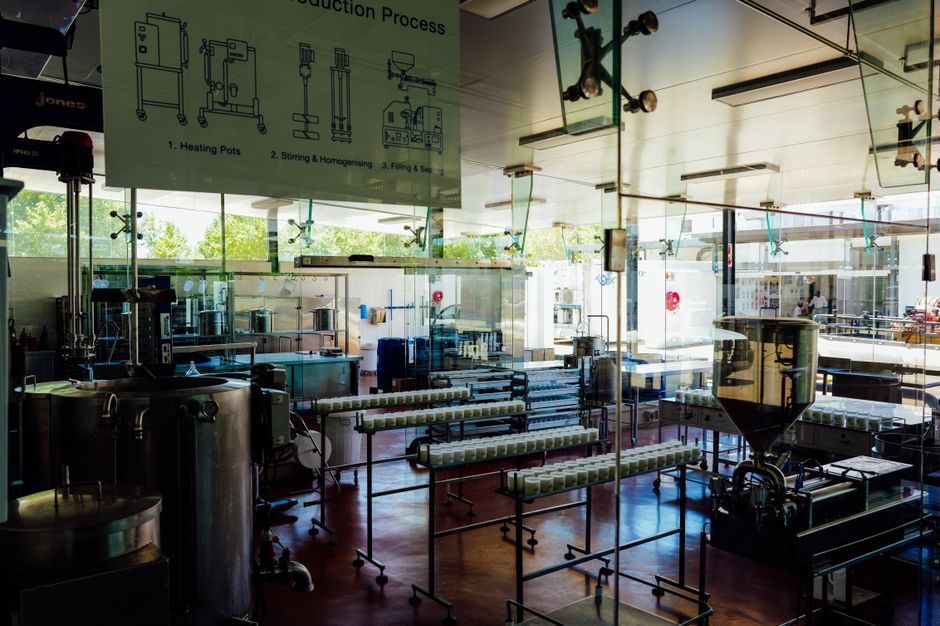
An industrial uninterruptible power supply (UPS) is built around four functional blocks — a rectifier/charger, a sealed VRLA or lithium-ion battery bank, a PWM inverter and a static bypass switch — all integrated into a single floor-standing or rack-mount enclosure that must ride through AC loss without dropping the protected load [S1][S4].
Delta's published RT-series datasheet defines the typical small-to-mid range: 5 kVA/5 kW, 6 kVA/6 kW, 8 kVA/8 kW, 10 kVA/10 kW, 15 kVA/15 kW and 20 kVA/20 kW power ratings, single-phase 2-wire + ground input at 100–280 V, and three-phase 4-wire + ground input at 138–485 V with linear de-rating from 50–100 % load between 138–305 V [S4]. This power-banding is the baseline most process engineers use when sizing a UPS for SCADA, DCS or substation battery-backed loads.
Bill of Materials: Power Stage, Energy Store and Control PCB
The power stage is dominated by an IGBT-based rectifier and inverter bridge; Delta's RT-5K through RT-20K3P family is a documented production example of this topology, with the inverter section sized to deliver unity-power-factor output (kVA = kW) across the entire 5–20 kVA band [S4].
The energy store is a string of sealed lead-acid cells, sized so that the DC bus holds the inverter through the ride-through window defined by the buyer — typically 5–30 minutes at full load for process-control cabinets, longer for substation tripping duty [S1].
The control PCB runs the DSP/MCU that supervises rectifier regulation, battery charging profile, inverter PWM and the static-transfer-switch logic. On Delta's documented production line this PCB is built under an ISO 9001 quality system and an ISO 14001 environmental management system, both independently certified, with the certificate scope explicitly covering hazardous-substance process management [S4].
Incoming QA and Sub-Assembly Stages
Incoming inspection covers three families: power semiconductors (IGBT modules and rectifier diodes), electrolytic DC-link capacitors, and the battery cells themselves, each lot accepted against a vendor datasheet and an AQL plan documented inside the ISO 9001 quality manual [S4].
Sub-assembly follows three parallel work streams. The power sub-assembly mounts the IGBT modules, toroidal or laminated transformers, chokes and DC-link capacitors onto a heatsink assembly. The battery sub-assembly strings, torque-connects and labels individual cells, then installs the string into the lower compartment of the enclosure. The control sub-assembly places the DSP/MCU board, the HMI/display board and the communication-option cards (relay, Modbus, SNMP) on a separate chassis.
Just as a HDPE-pipe line ends with a rotary automated cutter closing on the extruded wall at controlled feed rate to produce uniform cuts, the UPS line ends enclosure fabrication with a programmed CNC or laser cutter trimming busbars and panel openings to a fixed tolerance [S3]. The analogy is useful for any auditor walking both kinds of plants: the discipline is identical — repeatable machine cuts, not free-hand fabrication.
Main Assembly, Wiring and Torque-Controlled Busbar Joints
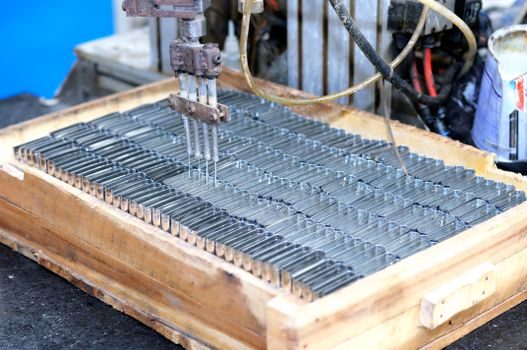
Final assembly marries the three sub-assemblies inside a powder-coated steel enclosure rated to the IP class called out on the nameplate. Wiring harnesses are pre-cut to length, crimped with controlled tooling and routed through dedicated cable channels to keep power and signal runs physically separated. [S1]
Busbar joints between the IGBT stack, the transformer and the battery string are torqued to a documented Nm value with a calibrated wrench; the torque number is logged against the unit serial number so any field failure can be traced back to a specific joint on a specific shift.
For context on how a process-engineer view of an assembly line translates across industries, the immersion-cooling tank-and-loop build follows a comparable flow: incoming QA, sub-assembly, torque-controlled joints, and per-unit traceability — and the EV traction-motor line carries the same torque-and-log discipline on its three-phase hairpin joints.
Factory Acceptance Test: Voltage, Current and Transfer-Time Checks
Every unit rolls off the line into a factory acceptance test (FAT) bay. The standard checks, derived from the IEC 62040-3 performance topology used industry-wide for double-conversion UPS, are: input voltage range, output voltage regulation, output frequency, transfer time to battery, transfer time to bypass and efficiency at 25 / 50 / 75 / 100 % load [S4].
Delta's published spec lists efficiency above 96 % in double-conversion mode across the 5–20 kVA band, AC-AC at unity power factor, with the input frequency window of 40–70 Hz and the output frequency selectable at 50 / 60 Hz ± 0.05 Hz on battery [S4]. The FAT bay is where the auditor should physically watch these four numbers being logged per unit, not just the nameplate.
For process engineers who want a more process-manufacturing oriented FAQ on the underlying product, the industrial UPS encyclopedia entry is the most concise on-site reference and pairs naturally with this article.
Quality and Environmental Management Anchors

The audit anchors a serious buyer should request are the certificates, not the marketing claims. Delta's documentation is dated 2007–2008 for ISO 9001 + ISO 14001 certification of the manufacturing system that builds the RT-series, with hazardous-substance process management explicitly inside the scope statement [S4].
Translated into a buyer's checklist: the vendor must show a current ISO 9001 certificate naming the manufacturing site, a current ISO 14001 certificate with the same site address, and a RoHS / REACH statement covering the bill of materials. Anything less than those three documents is a yellow flag on a process-control or substation UPS buy.
Two further cross-references sharpen the picture: a solar-inverter process map uses the same ISO 9001 / 14001 anchor structure, and a data-center CDU line routes the audit logic through identical torque-and-log discipline. The common thread is that audit anchors live in the certificate scope statement, not in the brochure.
Limitations, Failure Modes and What the Line Cannot Catch
Three failure modes the production line cannot fully screen out: electrolytic-capacitor drift that emerges only after 2–3 years of thermal cycling, cell-to-cell capacity mismatch in a VRLA string that only shows up under partial-state-of-charge duty, and dry solder joints on the control PCB that survive in-circuit test but fail under vibration. [S2]
Two design limits a buyer should be aware of: the 100–280 V single-phase / 138–485 V three-phase input window is a rectifier-side rating, not a generator-side rating, so the upstream generator must be sized to keep the UPS inside its own input envelope across all load steps [S4]; and the linear de-rating band from 50–100 % load between 138–305 V three-phase means a UPS name-plated at 20 kVA can deliver less than 10 kVA at low-line three-phase, which matters for any site with a weak utility feed [S4].
Two failure-mode mitigations the line can and should include: a burn-in step of at least 8 hours at full load with periodic load-stepping to surface early-life component defects, and a final insulation-resistance (hipot) plus earth-bond test logged to the serial number before pack-out.
Sourcing Signals and What to Track Next
The verifiable next nodes on a 2026 procurement are: (a) a current ISO 9001 + ISO 14001 certificate PDF from the named manufacturing site, with the URL the auditor can resolve; (b) a published efficiency curve at 25 / 50 / 75 / 100 % load in double-conversion mode, with the AC-AC number and the unity-power-factor condition stated; and (c) a documented transfer-time number to battery and to bypass, with the test load condition stated. If any of the three is missing from the vendor's public datasheet, the buyer's RFI should request it before PO release. [S3]
For component-level specifications, see additive manufacturing material, and multifunction process calibrator.