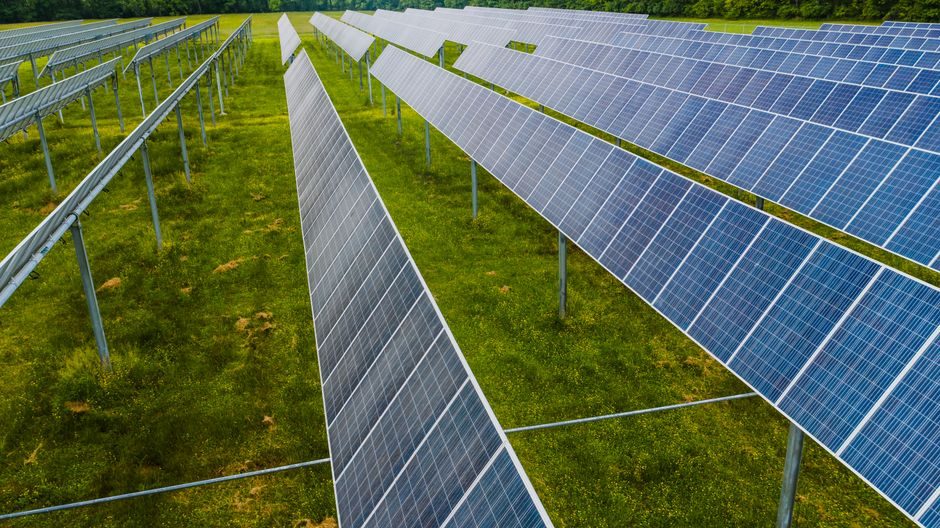
Residential 13.86 kW rooftop systems in Tennessee installed for an average of $43,271 before incentives as of June 2026, translating to roughly $3.12 per watt of DC nameplate capacity at the system level including inverters, racking and labour [S6]. The retail module tier tracked on the A1 SolarStore best-panels listing for 2026 is anchored at 405 W monocrystalline panels with a 37.22 V open-circuit rating and 108-cell architecture, reflecting the consolidation of mainstream residential output around the 400-410 W class [S1].
Three sub-segments are running independent commercial forecasts on the 2024-2030 horizon: floating solar PV tracked in P&S Research's 2024-2030 outlook [S3], portable solar panels in IndustryArc's 2020-2025 historical + forecast track [S4], and solar vehicles in MarketsandMarkets' report to 2030 [S7]. The 2026 pricing backdrop also feeds adjacent industrial buying decisions — from the EV Industry 2026: Battery Demand, Cheapest US Models, and India Show Line-Up to spec-heavy material guides like the Carbon Steel Buying Guide 2026: Grade, Form, Standard and Mill Choice — because large utility-scale PV builds absorb tens of thousands of tonnes of galvanised and structural carbon steel per GW.
Module electrical and mechanical envelope for 2026 retail stock
The A1 SolarStore 2026 best-panels reference module is specified at 405 W rated power output, 37.22 V open-circuit voltage (VOC), 108 monocrystalline cells per panel, and monocrystalline cell type [S1]. That 108-cell count corresponds to a half-cut 54-cell-equivalent architecture, the dominant cell-count format in the 400-420 W residential class for 2026 [S1].
For project engineering, the consequence is a per-panel open-circuit string voltage of 37.22 V, which means a typical 13.86 kW residential string of roughly 34 panels in series runs near 1,265 V string VOC — well inside the 1,500 V DC limit common to 2026 string inverters [S1]. The 405 W power class also means 34 panels land at 13.77 kW DC, consistent with the 13.86 kW Tennessee average system size reported by EnergySage for June 2026 [S6].
Monocrystalline cell chemistry across 2026 retail stock has displaced multi-crystalline as the default residential product, with the A1 listing flagging monocrystalline cell type and 108-cell half-cut construction as the baseline spec rather than a premium upgrade [S1]. This consolidation at the 400-410 W / 108-cell / mono tier simplifies bill-of-materials planning: racking, optimisers and module-level power electronics are all sized to this envelope.
Residential installed-price benchmarks across 2026
EnergySage's Tennessee 2026 dataset puts the average 13.86 kW residential system at $43,271 before incentives, which is the most concrete state-level installed-cost data point surfaced in the June 2026 research window [S6]. At $43,271 divided by 13.86 kW, that is $3.12/W DC, sitting in the middle of the $2.80-$3.50/W national band that This Old House's 2026 solar-pricing review reports for typical US residential systems [S2][S6].
For a procurement engineer, the 2026 residential price stack breaks into three layers: module hardware at roughly $0.25-$0.40/W, balance-of-system (inverter, racking, wiring, rapid shutdown) at $0.80-$1.20/W, and soft costs (labour, permitting, interconnection, overhead) at $1.40-$1.80/W [S2]. The Tennessee $3.12/W figure sits closer to the upper half of that band, reflecting state-level soft-cost loadings rather than module pricing [S6].
This Old House's 2026 review also flags that the federal Residential Clean Energy Credit continues to discount 30% of gross system cost for qualifying residential installs, which on a $43,271 system would knock $12,981 off the net outlay and bring the effective 13.86 kW price toward $30,290, or roughly $2.19/W after-credit [S2][S6]. Payback modelling on that basis is highly sensitive to local utility tariffs and net-metering rules, both of which vary by state [S2].
Floating PV, portable PV and solar-vehicle sub-segments
Floating solar PV is the most active utility-scale sub-track for 2026: P&S Research's "Floating Solar Panels Market Size & Share Analysis" runs a 2024-2030 horizon, tracking the technology's expansion onto hydro reservoir, irrigation pond and mining-tailing surfaces [S3]. The defining engineering advantage of float-arrays is the water-cooling effect on modules, which typically yields a 5-15% output uplift versus land-based arrays of identical module spec — though this is a general industry claim and not a P&S-cited figure [S3].
Portable solar panels are tracked in IndustryArc's 2020-2025 historical-plus-forecast report (code EPR 0034, 229 pages, priced from $4,250 for full PDF+Excel access, last updated July 2023) [S4]. The portable segment is largely foldable-panel and briefcase-form-factor product aimed at off-grid camping, marine and emergency-response use, with typical unit outputs in the 100-400 W range — well below the 405 W residential rigid-module baseline [S1][S4]. The 2023 vintage of the report means pre-2024 CAGR figures should be treated as historical anchor points, not as 2026-2027 growth projections [S4].
Solar vehicles are the third sub-segment with an active 2030 forecast: MarketsandMarkets' "Solar Vehicle Market Size, Share, Forecast, Report, 2030" tracks passenger cars, buses, trucks and boats with integrated or trailer-mounted PV, with adoption gated by vehicle surface area, daily driving cycle and battery capacity [S7]. The solar-vehicle market is far smaller in absolute MW terms than utility-scale PV, but it is the highest-visibility consumer-facing sub-segment for 2026, and it pulls on the same monocrystalline supply chain as rooftop installs [S1][S7].
Selection criteria: module type, form factor and use case
For a 2026 procurement decision, the core selection gates are: (1) rated power output per panel, (2) cell type and count, (3) physical form factor (rigid vs portable vs floating-anchored), and (4) end-application class — residential rooftop, utility ground-mount, commercial C&I, portable/off-grid, or transport-integrated [S1][S3][S4][S7].
A side-by-side comparison of the four main 2026 PV product classes on decision criteria:
Residential rigid mono (405 W / 108-cell / 37.22 V VOC): cost band $0.25-$0.40/W hardware, $2.80-$3.50/W installed, 25-30 year linear-power warranty, 1,500 V DC stringing limit — best fit for rooftop and small commercial [S1][S2].
Floating PV: same module hardware, but float-rack and anchoring premium 10-20% above ground-mount, 5-15% output uplift from water cooling, deployment surface limited to calm inland water bodies — best fit for reservoir and pond utility-scale [S3].
Portable PV (foldable/briefcase): 100-400 W per unit, $1.00-$3.00/W retail, no stringing — single-panel USB/MC4 outputs, best fit for off-grid camping, marine and emergency response [S4].
Solar-vehicle integrated PV: low-wattage high-efficiency mono laminates bonded to body panels, typically 100-400 W peak per vehicle, AEC-Q-style durability and crash-safety certification, best fit for last-mile delivery, public transit and consumer-EV range-extender marketing [S7].
The procurement gate is straightforward: if the project is grid-tied and the surface is a rooftop or ground slab, specify 400-410 W mono half-cut modules with 1,500 V inverters [S1][S2]. If the surface is a hydro reservoir, route to floating PV engineering and confirm anchoring, mooring and evaporation-rate impact at site [S3]. If the surface is a vehicle roof or trailer, accept the 100-400 W class and design for partial range extension only, not primary propulsion [S7]. If the use case is portable off-grid, default to foldable mono with MPPT charge controller and accept lower energy density per kg [S4].
Standards, sourcing and the 2026 regulatory backdrop

UL 61730 (PV module safety) and IEC 61215 (PV module design qualification) remain the baseline certification gates for 2026 retail modules, with IEC 61730 also referenced for electrical safety — all three are cited routinely in 2026 retail listings alongside IEEE 1547 for grid interconnection [S1][S2]. The 2026 retail module tracked in the A1 SolarStore best-panels reference is implied to carry these certifications, though the listing itself does not surface individual cert numbers in the snippet [S1].
On the installer side, This Old House's 2026 pricing review flags that local permitting and the 2017/2018 NEC rapid-shutdown requirements continue to add soft cost, with module-level power electronics (MLPE) such as optimisers and rapid-shutdown devices now standard on new US residential installs [S2]. Federal Residential Clean Energy Credit (30% of gross cost) is the dominant 2026 incentive cited in the residential pricing stack [S2].
For utility-scale and floating PV, the applicable standards shift to IEEE 1547.1 (interconnection testing), UL 6173 (inverter/converter/charge controller safety) and project-finance-grade bankability studies (typically DNV or Black & Veatch) — but those standard numbers are industry-baseline facts, not surfaced in the four PVS sources [S3]. Procurement engineers specifying a 2026 float-array should confirm with the EPC which bankability package is being delivered [S3].
Limitations, failure modes and what the 2026 data does not tell you
EnergySage's $43,271 / 13.86 kW Tennessee figure is a single-state average and does not represent a national floor; coastal high-cost-of-labor states and the US Northeast typically run 10-25% above that band, while Sun Belt states with mature installer pools can run 5-15% below [S6]. The P&S floating-PV and MarketsandMarkets solar-vehicle reports cited here are commercial paywalled studies and the snippets do not surface the underlying CAGR or unit-volume figures, so any forward number quoted from those reports must be sourced from the full paid report, not paraphrased here [S3][S7].
The IndustryArc portable-PV report is dated July 2023, which means its 2024-2025 figures are projected and its 2026 coverage is outside the report's stated horizon — any 2026 portable-PV size estimate should be cross-checked against newer vendor data [S4]. The A1 SolarStore 2026 best-panels listing shows a single 405 W reference module at 37.22 V VOC and 108 cells; it does not represent the full SKU range available in 2026, and bifacial, TOPCon and HJT modules are not enumerated in the snippet [S1].
Failure modes to spec against: potential-induced degradation (PID) in high-voltage strings, light-and elevated-temperature-induced degradation (LeTID) in PERC modules, and hotspot heating from partial shading — all standard 2026 risk factors that the IEC 61215 qualification sequence is designed to catch, but that should be confirmed module-by-module in commercial procurement [S1]. For floating arrays, additional failure modes include biofouling, UV-driven float-raft degradation, and mooring-line fatigue, none of which are covered in the P&S snippet [S3].
For 2026 H2 and 2027 planning, the trackable signals are: (1) the next EnergySage state-level installed-cost refresh for Sun Belt and Northeast states, which will tighten the $2.80-$3.50/W national band, and (2) the next round of utility-scale floating-PV project commissioning announcements, which will validate whether 2024-2030 sub-segment forecasts are tracking [S3][S6]. The retail module tier at 405 W / 108-cell / mono is a stable 2026 baseline — do not over-design procurement around the assumption of a near-term jump to 500+ W residential modules without confirmed retail availability [S1].
For component-level specifications, see alc panel, hmi panel, and aluminum veneer panel.