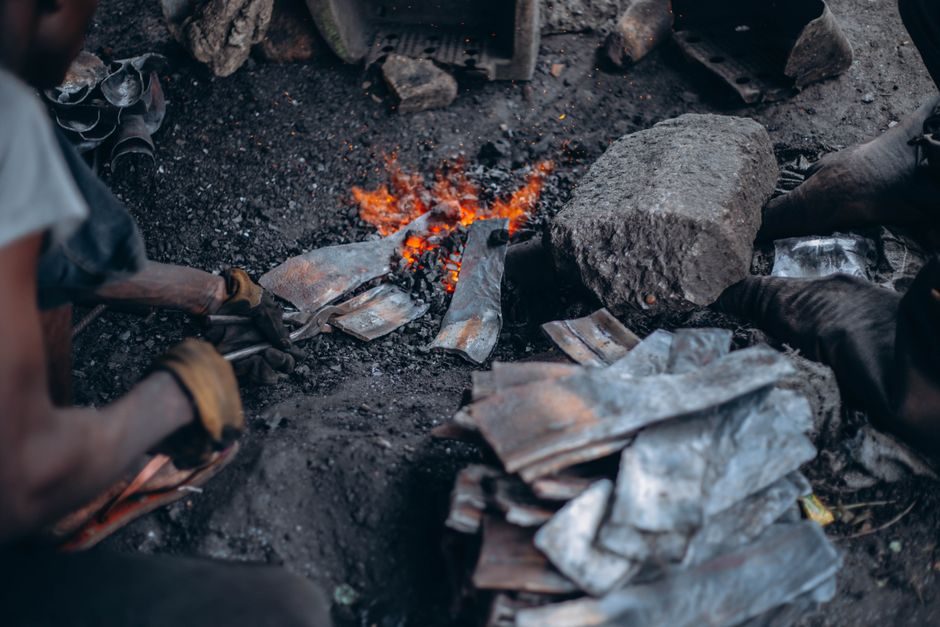
For 2026 procurement, a carbon steel buy is decided by four gates — grade family (low/medium/high), product form (plate, bar, wire, tube, fitting), governing standard (ASTM A36/A516, EN 10025, JIS G3101) and mill test certificate per EN 10204 3.1 — and price is the fifth gate that follows the first four.
Carbon steel is the iron-carbon alloy workhorse (typically <2.0% C, with Mn, Si, S, P residuals) used wherever structural strength, weldability or machinability matters more than corrosion resistance; when the duty is corrosion or heat, stainless steel or alloy steel overtakes it. eFunda splits the family into low (≤0.30% C), medium (0.30–0.60% C) and high (>0.60% C) categories, and that split — not price — is what should drive a 2026 RFQ [S2].
Grade Bands and the Numbers That Decide Weldability vs Hardness
eFunda lists AISI 1030, 1035, 1040, 1045, 1050, 1060 and 1095 as the canonical medium- and high-carbon steels, with carbon in roughly 0.30–1.00% [S2]. Low-carbon grades (A36 plate, S235/S275 structural, 1010/1020 bar) sit at ≤0.30% C and are the only band a structural welder can run without preheat in heavy sections.
Carbon content trades directly against formability: every 0.10% C jump raises tensile strength by roughly 50–100 MPa and drops elongation, which is why 1095 (0.90–1.03% C) is sold as spring wire and cutlery stock, not as welded plate [S2]. Hardness scales the same way — 1045 induction-hardens to ~55 HRC, 1018 case-hardens to a much shallower depth because the carbon isn't there.
Selection rule for a 2026 buyer: pick the lowest carbon band that still meets the duty's strength/hardness number, because every step up the carbon ladder costs weldability, formability and, usually, fabrication labour.
Product Form Drives the Quote More Than the Grade
Made-in-China's hot-product lists in 2026 show the carbon steel market is fragmented by form, not by grade: cast iron/steel impellers on the ventilation side, spring wire and galvanised wire on the wire-rope side, buttweld fittings and IBR-approved flanges on the pressure-piping side, and cookware (skillet/pan) on the consumer side [S3][S4][S6]. One 'carbon steel' line item can mean five different sub-markets with different MTC requirements.
Form-by-form price and process baseline seen on 2026 catalogs: a 10-set MOQ carbon steel impeller from a Dongguan ventilation maker sits at US$ 500–550 per set on Made-in-China [S3]; a Pearls Metals buttweld/flange catalogue ships IBR-approved carbon and alloy fittings with EN/JIS/ASTM traceability [S4]; a Chinese high-carbon wire listing pulls 44,216 suppliers across carbon spring, galvanised, binding, low-carbon and stainless variants [S6].
For buyers, that means an RFQ must lock form first (plate/bar/wire/tube/fitting/forging) and finish second (HR, CR, galvanised, black, machined) — otherwise mills will quote a price that mixes stock they don't have with tolerances they can't hold.
Standards, MTCs and the Documentation Gate Most RFQs Skip

International carbon steel trade still runs on a small stack of standards: ASTM A36/A516/A53 for plate and pipe, EN 10025-2 for structural, JIS G3101 SS400 for the East Asian structural market, and EN 10204 3.1/3.2 for the mill test certificate itself [S4]. Pressure-side fittings typically add IBR (India) or PED (EU) cover, and Pearls Metals' catalogue explicitly carries IBR-approved buttweld fittings, flanges and pipes [S4].
EN 10204 3.1 is the single most-skipped line in 2026 carbon steel RFQs from new buyers: it is a mill-issued test certificate with the actual heat chemistry and mechanical results, signed by the mill's QA independent of production. Type 3.2 adds a third-party validation (e.g. TUV, BV, LR). Forging buyers, pressure-vessel plate buyers, and any spec that ends up in a CE/PED/ASME U-stamp assembly should hard-require 3.1 minimum.
Buyers who do not pin the standard and the MTC type in the RFQ get what a process engineer would call 'the four-digit heat trap' — a quoted price that looks fine until the inspector asks for the cert and the mill substitutes a 2.1 'mill statement' that carries no chemistry, no mechanicals and no traceability.
Form-to-Application Decision Matrix
Pulling the research into one decision table: low-carbon plate (ASTM A36 / EN 10025 S235JR, ≤0.25% C) suits welded structures, building frames, general fabrication and is the default for fabricators [S2][S4]. Medium-carbon bar (AISI 1040/1045, 0.40–0.50% C) suits shafts, gears, couplings and machine components where higher tensile strength (570–700 MPa) is needed and welding is secondary [S2].
High-carbon wire (AISI 1060/1080/1095, 0.60–1.00% C) suits springs, PC strand, prestressed concrete wire, binding wire and cutlery [S6]. Carbon steel fittings and flanges (ASTM A234 WPB / A105) suit pressure piping at ambient and moderate temperature, and pair with IBR or PED certification for regulated plants [S4]. Cast or fabricated carbon steel impellers suit ventilation and process-fluid handling where dimensional casting and balance matter more than alloy chemistry [S3].
Cookware (skillet/wok) is technically the same family — a thin low-carbon pan, often under 2 mm, seasoned rather than plated — and IKEA's VARDAGEN frying pan lists the carbon-steel body as compatible with induction hobs, which is unusual for a non-stainless body and depends on the pan's base plate [S5].
Lead-Time, MOQ and Sourcing Levers Specific to 2026
Made-in-China category data from April–June 2026 shows typical MOQ for industrial carbon steel components running from 10 sets (cast impellers) to full-container loads (wire rod) [S3][S6]. Domestic Chinese mills still dominate plate, bar and wire supply; Indian stockists (Pearls Metals and peers) act as value-added re-sellers for IBR and ASTM fittings with warehouse cutting and beveling [S4].
Two 2026-specific levers worth pricing: (1) finish and dimensional tolerance — HR plate vs CR sheet, black bar vs peeled/ground bar, hot-dip galvanised vs electro-galvanised wire — each adds a clear cost step; (2) heat-treatment state — supplied as-rolled, normalised, annealed, or Q&T. A 1045 bar in HR + peeled + Q&T condition costs several times the same nominal diameter in HR + black condition, and a 2026 RFQ that does not split these states will see quote-to-quote scatter of 30–60%.
Buyers should also treat the steel strand and steel fibre markets as adjacent, not separate — both pull from the same high-carbon wire rod pool, so a wire-price spike typically hits PC strand, springs and steel fibre in the same month.
Failure Modes and Inspection Gates on Receipt
Three failure modes show up repeatedly on 2026 carbon steel receipts: chemistry drift (actual C/Mn/S outside the MTC band), dimensional out-of-tolerance (plate thickness below nominal after milling, bar diameter out by 0.1–0.3 mm), and surface defect (lamination, scab, cracks on plate; straightness or decarburisation on bar). Each has a different inspection gate. [S1]
Chemistry: PMI (positive material identification) XRF gun on a sample of every heat against the 3.1 cert; flag any heat >0.05% C off the nominal. Dimensions: caliper plate thickness at four corners and centre, micrometer bar diameter at both ends. Surface: visual + dye-pen on plate edges, magnetic-particle on bar ends if specified for fatigue duty.
Buyers sourcing for fabrications that feed conveyors or structural lines — for example, frames for a screw conveyor or a roller conveyor — should spec the structural plate (A36 / S275JR) and the bar (S355JR / AISI 1045) on the same PO with the same MTC type; mixing 2.1 and 3.1 certs inside one welded assembly is a documentation headache that holds up final inspection more than the steel itself.
When Carbon Steel is the Wrong Choice
Carbon steel is the wrong pick when (1) the fluid or atmosphere is corrosive without a coating budget, (2) the service temperature pushes past ~400 °C for prolonged creep life, (3) the duty requires non-magnetic behaviour, or (4) the as-welded hardness on a heavy section is going to crack in service. In all four, stainless steel or alloy steel is the right family — not a higher-carbon carbon steel. [S2]
The 'just go up to 1045 instead of switching to alloy' reflex is a classic 2026 RFQ mistake: 1045 still rusts, still loses tensile above 400 °C, still welds poorly above ~25 mm section, and still responds to a magnet. If the spec actually needs stainless or alloy, raising carbon only burns fabrication cost and adds none of the required properties.
For low-volume precision parts, carbon fibre composites are an entirely different material class — not a 'lighter carbon steel' — and should not be benchmarked against A36 or 1045 in the same RFQ; the comparators there are aluminium, magnesium or GFRP.
Trackable signals worth watching into the second half of 2026: Chinese wire-rod mill capacity announcements in Q3 (the same pool that feeds high-carbon wire, PC strand and steel fibre) and any revision to EN 10025-2 or ASTM A36/A516 mill-spec tables. These two move the carbon steel buy more than spot iron-ore headlines, and a process engineer should pin them to the next supplier review.