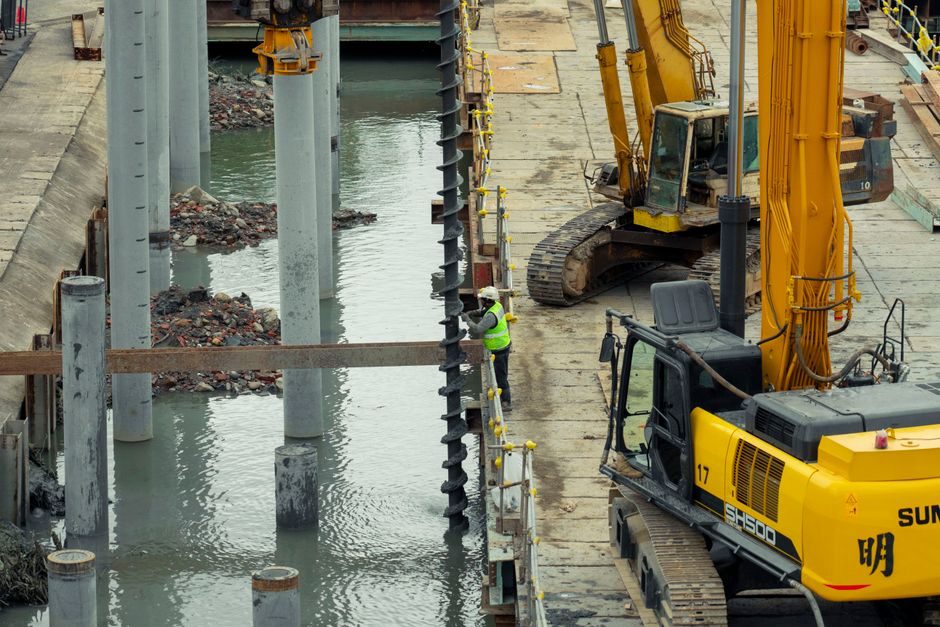
Vermeer's PD5-class solar pile driver is engineered for sub-compact PV jobsites, with machine-integrated controls that let the operator walk beside the rig during set-up and driving [S5]. An optional laser receiver plus a compatible third-party GPS feed provides visual cues so piles land on the design stake rather than at the operator's eye estimate [S5].
For larger utility-scale solar fields, Vermeer's broader pile driver line uses an optional laser/GPS-ready system to drive piles at the correct location, depth, and angle, with stated intent to keep the field on grid layout and on the install schedule [S4].
Pre-Set Survey and Staking Tolerances
A pile driver arrives on a solar jobsite only after the civil survey has set the A/B horizon, panel-string azimuth, and pile grid on the ground, because the machine is a placement tool, not a survey instrument. Misalignment greater than the designer's pile-cap tolerance propagates into racking fit-up and module clamp gaps downstream, so the surveyor must hand off a staked grid before any drop-hammer cycle starts. [S5]
Field practice on modern solar installs is to verify every pile location with GPS and to re-shoot the perimeter after any rain event that visibly moves surface soils, since the laser/GPS stack is only as accurate as the initial ground control [S4]. Crews that skip the re-shoot routinely discover post-driving that a string line drifted enough to clip a row alley.
Positioning, Mast Plumb, and Drop-Hammer Calibration
With the rig on the surveyed mark, the operator walks alongside the machine rather than riding it, with conveniently placed controls arranged for intuitive single-person operation [S5]. The mast is plumbed to within the manufacturer's published tolerance (typically well under 1° off vertical) before any hammer cycle, because a leaning pile creates an eccentric bearing stress that the racking torque tube is not designed to absorb.
For a compact PD5-class machine, the lightweight, small-footprint chassis is the defining set-up advantage on tight jobsites where a larger rig cannot turn around between row ends [S5]. Heavier utility-scale drivers in the same Vermeer line-up use the same integrated control philosophy but carry a taller mast for longer piles, which the installer must match against local transport-height limits before mobilising [S4].
Laser and GPS Verification During Driving

The laser/GPS-ready package is what separates a 2026 solar pile driver from a 2010-era analogue rig, and it is the verification layer that gets recorded against each pile ID for as-built documentation [S4]. Visual input to the operator from the optional laser receiver and compatible third-party GPS lets the crew hold the design location, depth, and angle on every strike instead of trusting the hammer operator's line of sight.
Operators should treat the laser receiver and GPS as primary alignment instruments, not as aids: if either signal drops (overhead power line, passing cloud bank on GPS, sun strike on the laser sensor) the cycle pauses until the signal returns, because a pile driven blind cannot be re-aligned without extraction [S4]. For broader rig-class context and how the PD5 sits inside the family, see the pile driver reference.
Drive Depth, Set, and Blow-Count Acceptance
Acceptance on a solar field is not "did the pile go in" — it is whether the pile reached the design embedment depth within the geotech bearing-capacity set, which is read off the last 10–20 blows of the log. A refusal criterion (blows per 25 mm or per 10 cm, depending on the soil report) is set in the project spec, and the operator flags any pile that exceeds the criterion for engineer review rather than driving it harder. [S4]
Heave or bounce-back in soft cohesive soils is the most common reason a solar pile fails the set test even though it visually reached depth; the fix is a sit-cycle (hold the hammer on the pile for a timed interval) or a re-drive after a waiting period, not more hammer energy. If refusal still cannot be met, escalate to the geotech engineer — do not shorten the pile without a written revision, because the racking supplier's uplift rating assumes the full embedment length.
When to Stop and Escalate, Not Repair
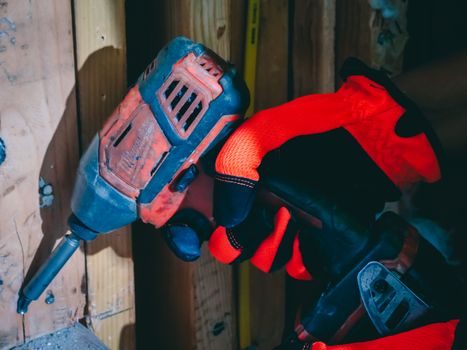
Stop driving immediately if the hammer stroke sounds change from a clean ring to a dull thud, because a fractured pile cap or a buckled section means the steel is damaged and any further driving will only spall concrete or mushroom the steel tip. Pull the pile, inspect the section, and replace rather than driving through the anomaly — a buried defect becomes a future torque-tube failure under wind load. [S3]
Stop and escalate if the laser/GPS system reports a horizontal position error larger than the design tolerance for three consecutive piles, since that points to a benchmark shift or a receiver calibration drift rather than operator error. Reset the base station or re-shoot the control before resuming, and document the reset against the affected pile IDs so the as-built record is auditable.
Standard-Work Method vs Free-Form Set-Up
Standard-work method: control-point verified → mast plumb checked → laser receiver + GPS active → drive to set → log last-blow count → release rig to next pile. Free-form set-up (skip survey reset, drive on operator sight-line, ignore set count) is the most common cause of racking fit-up rework, and on utility-scale sites the cost of rework dwarfs the time saved by skipping the control step. [S4]
For crews moving between string sections, treat the GPS base and laser datum as a single instrument cluster that must be re-validated on every rig move, not only at start of day. This is the same disciplined control logic used on a rotary drilling rig installation, where mast plumb and tool-face verification are gated before any cutting cycle begins.
Closeout: require the contractor to deliver an as-built pile map (location, depth, set count, plumb, pile ID) in machine-readable form before the racking crew mobilises, and verify the rejection-rate for the pilot string is below the project quality plan threshold before authorising full-field production driving.
Spec-level background on the components involved: linear guide, and crossed roller guide.