Pile drivers fall into five operational families — drop hammer, hydraulic impact, diesel hammer, vibratory, and rotary piling rig — with selection governed by pile material, soil class, and required bearing capacity rather than a single energy rating [S3].
Modern construction sites specify hydraulic and diesel units for driven precast concrete and steel H-piles, while solar-farm pole installation favours compact tractor-mounted hydraulic rigs rated 50–65 hp [S3]. Vibratory drivers dominate sheet-pile extraction and water-front work, and piling rigs cover bored/drilled shafts outside the impact-driver envelope.
Drop Hammer Pile Drivers: Gravity-Energy Baseline
Drop hammers deliver impact energy purely from a falling weight, with the ram mass and stroke height (typically 1.2–2.5 m) defining the per-blow energy output — no combustion, no hydraulics, no fuel cycle [S3]. Stroke-height calibration is the only field-adjustable parameter, and consistent release mechanism maintenance is the dominant cause of hammer-stuck failures. Drop hammers are suited to small-diameter timber or short precast piles in soft-to-medium cohesive soils where driveability is not a constraint. They are NOT for dense granular profiles, long steel H-piles, or noise-restricted urban sites: per-blow energy caps at roughly 30–60 kN·m for a 3–5 t ram, which is insufficient for driving piles past dense sand or hardpan layers.
Hydraulic Impact Hammers: The Modern Default
Hydraulic impact hammers use a nitrogen-gas accumulator and twin lift cylinders to drive the ram downward, delivering 2–6 blows per minute at controllable impact energy from roughly 30 kN·m to over 200 kN·m depending on the model class [S3]. The S3 product spec describes a fully hydraulic configuration with "drilling down at the same time by two large tonnage oil cylinder[s] promote drill bore into the downward, largely improve the work efficiency" [S3]. Hydraulic units are the workhorse on solar-farm pole installation sites because a single operator can finish a hole, drill cycle is integrated with drive cycle, and 50–65 hp tractor-class rigs cover the duty envelope [S3]. Tractor-mounted hydraulic hole diggers from this category claim drilling speeds "five or six [times] than other hole digger" products on the same duty [S3]. Cross-country mobility is built in via the tractor chassis, making these units standard for remote and uneven-site deployment.
Diesel Hammers: Heavy-Energy Civil Works
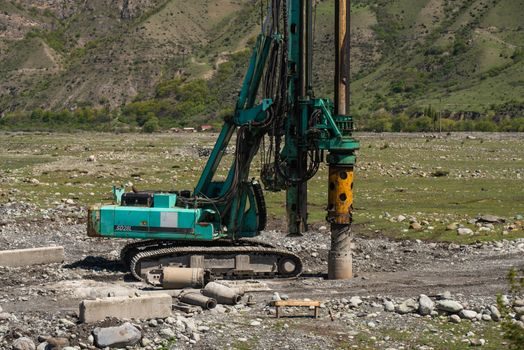
Diesel hammers are closed-cycle, self-contained impact units where a falling ram compresses a fuel-air mixture that ignites to add a second downward impulse — boosting per-blow energy well above the equivalent drop-hammer mass. They are sized by ram weight (commonly 1.5 t to 15 t) and are specified for large precast concrete piles, long steel H-piles, and marine jetty work where per-blow energy in the 100–800 kN·m range is required. Limitations are real: cold-start delays below roughly 5 °C, exhaust emissions on confined urban sites, and the fact that soft-soil conditions can starve the compression cycle and reduce effective energy. For offshore and harbour projects diesel hammers remain common, but onshore civil works in noise-restricted or air-quality-controlled zones typically shift to hydraulic impact units.
Vibratory Drivers and Extractors: Sheet Piles and Resonant Cases
Vibratory pile drivers use counter-rotating eccentric weights driven by hydraulic motors to produce vertical vibration at 20–50 Hz, liquefying surrounding granular soil and allowing the pile to sink under combined self-weight and static crowd force. They are the preferred tool for driving and extracting sheet piles, H-piles in sandy soils, and steel casings in cohesionless profiles, and they pair naturally with flow-meter-style hydraulic power packs where flow and pressure telemetry are monitored. They are NOT suitable for clay-dominant soils (vibration does not displace cohesive material efficiently) or for dense gravel profiles where the pile refusal criterion can be met before the rated depth. Extraction mode is a genuine advantage: pulling sheet piles out of a cofferdam with the same rig that drove them in cuts crane-and-chain-block labour to near-zero on temporary works. [S1]
Rotary Piling Rigs: Drilled Shafts and CFA
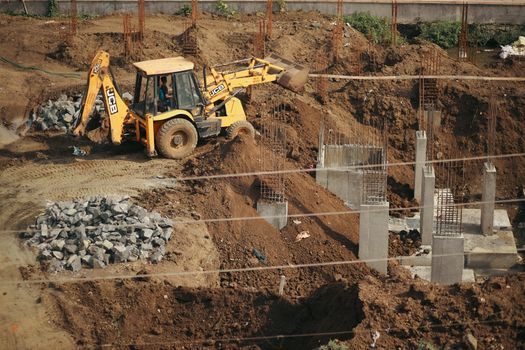
Rotary piling rigs — including CFA (continuous flight auger) and bored-pile variants — sit outside the impact-driver family and address the spec gap where vibration or percussive energy is forbidden, soil is cohesive, or bearing capacity must be verified through a cast-in-place shaft. They drill a bore, place reinforcement, and concrete in a single or staged operation. The S3 reference platform frames these alongside impact drivers in the same product category, and the duty overlap with pressure-transmitter-equipped hydraulic systems is direct: drilling fluid pressure, crowd-force cylinder pressure, and rotary head torque are all instrumented for real-time logging on modern rigs. The category trades raw drive speed for pile-quality verification, and is non-substitutable for cast-in-situ deep foundations on hospital, bridge, and high-rise projects. [S1]
Selection Criteria: Matching Pile Type, Soil, and Site
A direct comparison of the five families against four decision criteria — pile type suitability, per-blow energy class, soil profile, and site mobility: [S2]
• Drop hammer: short timber / small precast piles, 30–60 kN·m, soft–medium cohesive soils, low mobility (track or skid). • Hydraulic impact: steel H-piles, precast concrete, solar poles, 30–200+ kN·m, mixed soils, high mobility (tractor 50–65 hp or carrier-mounted) [S3]. • Diesel hammer: large precast / long H-piles, 100–800 kN·m, dense granular / marine, medium mobility (crane-suspended). • Vibratory: sheet piles, steel casings, no discrete per-blow, granular (sand/gravel) only, medium mobility. • Rotary piling rig: cast-in-situ bored/CFA, N/A per-blow, cohesive or restricted-vibration, low–medium mobility.
Selection rule of thumb: start from the pile type and soil profile, then pick the family; energy class is the result, not the input. For industrial-valve and hydraulic-system buyers sourcing from the same tier-2 Chinese supply base that kitairu.net catalogues, hydraulic and tractor-mounted impact drivers dominate the small-to-mid solar and rural-electrification duty [S3].
Standards, Sourcing, and Spec Discipline
Major international references governing pile-driving equipment include ISO 11886 for hydraulic hammers, AISC steel-pile construction standards, and regional codes such as JGJ/T 79 in China for building pile foundation construction. The kitairu.net product page (2026-05-04) documents a fully hydraulic pole-drilling machine design that integrates drilling and driving in a single tractor-mounted unit, with "driving and operation integration" as the explicit OEM design claim [S3]. Buyers comparing similar Alibaba-listed road pile drivers [S2] should treat per-blow energy, hammer weight, and stroke rate as the load-bearing specs — not marketing-class energy ratings, which on some listings inflate by a factor of two versus field-measured output. For related process-equipment sourcing see our note on linear actuator types and applications, which covers the same hydraulic cylinder and pressure-control discipline that sits underneath a hydraulic hammer's power pack.
Trackable signals for the next quarter: (1) greater OEM disclosure of measured per-blow energy at field conditions rather than rated nameplate, (2) tighter integration of impact hammers with pressure-sensor-logged crowd-force and hydraulic-circuit telemetry for driveability analysis, and (3) a clearer split between vibratory and hydraulic impact units in solar-farm pole-installation tenders as the 50–65 hp tractor-class hydraulic rig becomes the default [S3].