
For any irrigation zone above roughly 3/4 in. pipe size, pilot-operated solenoid valves using line pressure to actuate the main diaphragm are the practical default; direct-acting magnetic-force valves stay useful only on 1 in. and smaller lines, fertigation dosing, and zero-differential metering [S1].
Commercial and agricultural systems move single zones at hundreds of GPM from 40 to 150+ PSI sources, run thousands of cycles per season, and sit outdoors in UV, dust, and heat, an envelope that destroys residential-grade plastic valves built for 10 to 20 GPM at low pressure [S1].
Pilot-Operated vs Direct-Acting Architecture
Pilot-operated diaphragm valves use a small low-wattage solenoid to open a pilot orifice; line pressure then lifts the main diaphragm, letting a 2 to 4 W coil control flow paths up to 2 in. and 250 PSI, or 3 in. NPT at 400 PSI in higher-pressure series [S1]. Direct-acting valves move the closure element with raw magnetic force, so they can open at zero PSI differential but are uneconomic above 1 in. because the coil and magnet scale with port area [S1][S2]. For a one-valve-per-zone irrigation manifold feeding drip tape, rotors, or sprinklers, the pilot-operated architecture is the correct starting point; for a fertilizer injector on a bypass line, a direct-acting 2/2-way brass valve is the typical pick [S2].
The other key electrical decision is 24 VAC vs 9 VDC latching: 24 VAC is the standard for hardwired controllers with a common wire and one hot per zone, while 9 VDC latching bi-stable coils are used where a single battery must last a full season on a remote or retrofit manifold [S2][S3]. AC coils hold position continuously and tolerate dirty power from long runs, while latching DC coils draw a brief pulse to flip state, so the controller, wire gauge, and valve must be specified as a set, not independently [S3].
Sizing for Flow, Not Just Pipe Diameter
The single most common selection error is matching the solenoid valve to the nominal pipe size instead of the required Cv at the available pressure drop; a 1 in. valve on a 1 in. line that needs 25 GPM at 5 PSI drop will starve the zone, while the same 1 in. valve at 10 GPM will chatter and fail to open [S1][S4]. For Hunter PGV, ICV, and Jar-Top lines, published sizes run 25 mm (1 in.), 40 mm (1.5 in.), and 50 mm (2 in.), with operating envelopes to 150 PSI (about 1,035 kPa) on standard models [S8].
Residential 24 VAC valves typically reach about 10.3 to 14 bar (150 to 200 PSI) static rating and are designed for drip and spray zones measured in single-digit to low-double-digit GPM [S2]. Commercial and golf-course systems need valves engineered for the upper end of that pressure range plus continuous cycling, with Cv curves published by the manufacturer so the specifier can match zone flow to a realistic 5 to 10 PSI working pressure drop rather than a 1 PSI near-full-open point that guarantees chatter [S1][S8]. When the source pressure is above 150 to 200 PSI, install a pressure regulator upstream of the manifold, not downstream, to keep the diaphragm and pilot within their rated differential [S2].
Material Selection: Plastic, Brass, Stainless
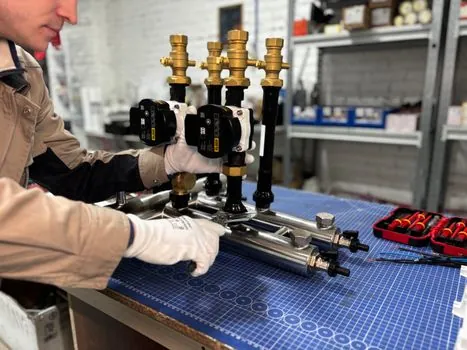
Plastic-bodied valves are the default for residential and light commercial drip and spray manifolds because they are corrosion-resistant in damp valve boxes, lightweight, and inexpensive, but they are bounded by lower pressure and temperature ratings and can be attacked by certain fertilizers and chlorine chemistries [S4]. Brass-bodied valves cost more and weigh more, but the threaded body survives repeated assembly and incidental mechanical abuse, and they hold up better on permanent manifolds that will be opened for service over many seasons [S4].
Stainless steel solenoid valves are rarely justified in irrigation; they appear in fertilizer or chemical injection skids where media compatibility, not pressure, is the constraint, and on premium landscape installations where long service life and cosmetic finish are part of the spec [S4]. For a typical municipal or well-fed garden manifold with clean water and a pressure regulator upstream, plastic is the right starting point, brass is the right upgrade, and stainless is over-spec [S4]. The wider valve comparison space, including ball valves for manual isolation and butterfly valves for large mainline isolation, sits one level up from the solenoid layer in the typical irrigation control stack [S5].
Water Hammer, Surge, and Closing Time
Long lateral runs of hundreds to thousands of feet and high static pressures above 100 PSI are the two ingredients that turn a normal valve closure into a pressure surge capable of splitting a pipe; a fast-closing solenoid on a 1,500 ft main at 120 PSI can generate transient spikes well above the static rating [S1]. Mitigation has three layers: a slow-closing valve or one with a controlled closing rate, a pressure regulator sized to the working flow, and a physical surge protection device or air chamber on dead-end lines [S1][S2].
On a properly sized Hunter PGV-family valve in the 25 to 50 mm range, the diaphragm pilot geometry is tuned for moderate closing speed, but the specifier must still check the Joukowsky estimate for the worst-case single-zone closure before committing to a standard valve; high-pressure B and D series above 150 PSI add internal geometry aimed at slower close, at the cost of higher price and slightly higher head loss [S1][S8]. Skipping this check is the single most common cause of season-one pipe and solenoid failures in pivot and drip-tape systems that were otherwise correctly sized [S1].
Voltage, Controller Wiring, and Electrical Envelope

Standard irrigation controllers in North America switch 24 VAC at 50/60 Hz to one common wire plus one hot per zone, and the solenoid coil is sized to inrush on that supply; long wire runs drop voltage, and a marginal coil at the end of a 1,000 ft run will overheat, chatter, or simply not pull in [S2][S3]. The 24 VAC figure is not nominal; it is a 22 to 28 VAC working window for most residential-class valves, and going below 20 VAC at the coil terminals is a frequent cause of "valve that won't open" service calls [S2][S3].
DC latching coils, typically 9 VDC pulsed, eliminate the holding current draw but require a controller that knows the latching protocol, two wires per valve rather than a shared common, and a battery budget large enough to fire every valve in the manifold several times a day for a full season [S2]. For typical site-power installations with a transformer and a common wire, 24 VAC pilot-operated valves are the lower-risk choice; for remote sites with solar and battery, DC latching wins on energy [S2].
Failure Modes and Pre-Season Inspection
The dominant in-service failure modes for irrigation solenoid valves are debris-jammed pilots, worn diaphragms that pass water when supposedly closed, scorched coils from brownout or lightning, and stuck plungers from mineral buildup or chemical attack; a solenoid that hums but does not open is almost always a low-voltage or jammed-pilot symptom, not a dead coil [S2][S3]. Pre-season inspection should include a manual bleed to confirm the diaphragm moves freely, a voltage check at the coil terminals under load, and a filter inspection upstream of the manifold [S2].
Selection discipline cuts most of these failure modes before they start: a filter ahead of every valve, a pressure regulator that holds the working pressure inside the valve envelope, a 24 VAC supply that stays above 22 VAC at the coil, and a Cv that matches the zone at a 5 to 10 PSI drop instead of fighting the system [S1][S2]. For chemical plants and industrial sites that share irrigation-style control manifolds on washdown or process water, the same solenoid valve selection logic applies, with the addition of media-compatibility checks on seals and body [S2]. When the application calls for finer proportional control, air solenoid valves and solenoid coil replacement parts are often stocked from the same supply chain as the irrigation units, and that cross-stock is itself a selection factor for large multi-site operators [S2].
Trackable near-term signals for specifiers: manufacturer-published Cv curves at 5, 10, and 20 PSI drop for the 1 to 2 in. pilot-operated models you carry as standard, updated water-hammer calculators that accept the 100 to 400 PSI commercial envelope, and stocking notices for 24 VAC replacement coils ahead of the spring commissioning window.
For related coverage, see Strapping Band Selection for Food and Beverage Lines.