
Industrial robots imported from China clear customs under HS code 8479.50, with EU and UK duty at 0% and US Section 301 duty at 25%, making tariff route a first-order budget line for any 2026 procurement plan [S2]. Buyers buying direct from Chinese producers typically realise a 30–60% landed-cost reduction compared with sourcing through Western resellers, according to a March 2026 sourcing guide [S1].
China now produces over 50% of the world's industrial robots and supplies more than 92% of its own cobot market by volume, a base that has shifted the global supply baseline for collaborative arms, delivery robots, agricultural drones, and quadrupeds [S1][S3]. For European and North American buyers, the trade-off is a larger share of logistics and customs coordination in exchange for a distributor margin that historically runs 15–30% on a USD 40,000–80,000 robot [S2].
Define the Spec Before You Open Alibaba
A complete technical brief is the single most cost-saving document in the entire workflow, and it must be written before any RFQ is sent [S1][S2]. The brief should fix payload, reach, mounting configuration (floor, ceiling, wall), application type (welding, handling, palletizing), duty cycle, site voltage and frequency, ambient temperature, dust or washdown exposure, and the destination country's required safety marks (CE, UL, KCs, ISO 10218, ISO 13849) [S2][S3].
For cobots specifically, payload range alone narrows the field: Chinese makers typically span 3–20 kg, with Elite Robots' CS Series extending to 30 kg across six models (CS63 to CS530H) [S3]. Pinning the spec at the brief stage prevents the most common failure mode in Chinese sourcing, which is receiving three valid quotes that price three different products.
Supplier Vetting: Audit the Self-Development Rate, Not the Brochure
The single best predictor of long-term reliability in a Chinese cobot vendor is the self-development rate of core components (operating system, controller hardware, servo motors, software stack) [S3]. Manufacturers that self-develop these parts report reliability advantages measured in MTBF, with Elite Robots claiming 100,000 hours against an industry benchmark of 30,000–50,000 hours, though that figure is vendor-published and should be cross-checked against third-party test reports before contract signature [S3].
Vetting should also confirm ISO 9001 on the quality side and product-specific marks (CE, UL, KCs) on the compliance side, plus factory age (5+ years), headcount (50+ employees), and a real engineering team rather than an assembly-only operation [S1]. Channels to source candidates include the Canton Fair, the World Robot Conference in Beijing, Made-in-China, Global Sources, and direct outreach to manufacturer websites; third-party inspection companies are the standard way to audit a production line you cannot visit [S1].
When the application involves precision motion components, buyers also cross-reference automation hardware selection through the linear guide and crossed roller guide reference pages to confirm the robot's stated repeatability is supported by the bearings the supplier actually sources.
Quote, Incoterm, and Contract: Lock the Risk-Transfer Point in Writing
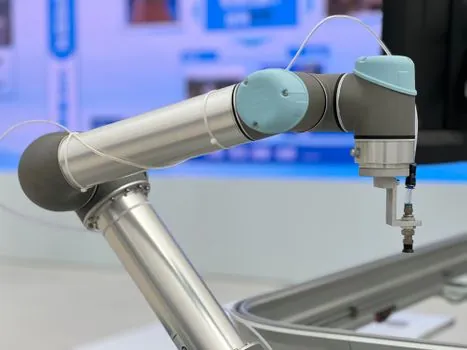
Most direct buyers start with FOB pricing for like-for-like comparison and then negotiate CIF or DDP for the actual purchase order, with EXW reserved for buyers who already run their own freight forwarder [S1][S2]. The Incoterm must be written into the sales contract alongside the payment schedule, delivery timeline, warranty terms, and the documentation obligations, because this clause is what determines who pays for demurrage when a container sits at Rotterdam [S2].
For industrial arms, controller cabinets now ship with switchable 380V/480V capability to cover both 50 Hz and 60 Hz markets, eliminating the need for a step-down transformer at most European and North American sites [S2]. Quotation requests should specify order quantity against the supplier's tier breaks (commonly 1 / 5 / 10 / 50 / 100+ units), destination port, required certifications, and any branding or software customisation, since each line item shifts the per-unit price [S1].
Pre-Shipment Inspection and the CE/UL Documentation Package
Pre-shipment inspection is the gate where most quality failures are caught, and it must include a factory acceptance test against the locked specification, not a generic power-on check [S2]. The documentation package that accompanies the shipment determines how fast the container clears customs: a compliant set includes the commercial invoice, packing list, bill of lading, certificate of origin, CE/UL or other safety marks, and the SGS or TUV third-party certification where required by the destination authority [S2].
For collaborative arms specifically, ISO 10218-1 (safety requirements for industrial robots) and ISO 13849 (safety-related parts of control systems) are the two standards most often cited in CE technical files, alongside ISO/TS 15066 for collaborative-mode applications, and buyers should confirm file ownership before payment of the final balance [S3][S4]. Process engineers who also spec fluid handling will recognise that the same documentation discipline applies to a pressure transmitter or a flow meter shipment, where the calibration certificate and material traceability are the customs-clearance triggers.
Shipping, HS Code 8479.50, and the Tariff Routing Decision

Sea freight remains the default for full industrial cells on a 25–40 day transit, while air freight is reserved for spare parts, teach pendants, or single-arm samples under 200 kg where a one-week transit justifies the 4–6x cost premium [S1][S2]. HS code 8479.50 covers machines and mechanical appliances having individual functions not specified elsewhere, which is the heading customs authorities apply to most industrial robot arms imported from China [S2].
The tariff routing decision matters as much as the freight mode: EU and UK imports enter at 0% duty, while the US applies Section 301 tariffs of 25% on the same HS code, and the difference on a USD 60,000 robot is USD 15,000 of pure landed cost before VAT or brokerage [S2]. Buyers running a multi-robot installation should model the Section 301 line item against a bonded warehouse entry or a Mexico/Canada trans-shipment option before issuing the PO, since freight terms cannot be retroactively re-routed once the container is on the vessel.
Comparison: How the Three Main Robot Categories Stack Up on a 2026 Sourcing Decision
Chinese robotics sourcing breaks into three decision-relevant categories, each with different vetting weight, MOQ, and documentation burden: [S1]
Industrial arms (6-axis welding/palletizing, 6–30 kg payload typical, price band USD 25,000–80,000 EXW) demand the deepest spec brief, the longest lead time (60–90 days from PO to FAT), and the strictest compliance file (ISO 10218, ISO 13849, CE Machinery Directive) [S1][S2].
Collaborative arms (3–30 kg payload, price band USD 8,000–25,000 EXW) require a vetting weight on self-development rate and MTBF, since these figures separate the top five Chinese makers (Elite Robots, JAKA, Dobot, AUBO, Siasun/DUCO, Rokae, Techman, Huayan, Flexiv) from the rest of the field, and most units ship with CE, UL, or KCs marks already in place [S3].
Commercial and service robots (delivery, agricultural drones, quadrupeds, warehouse AMRs) trade heavier compliance documentation for higher MOQ flexibility, with DJI and XAG together holding over 80% of the global crop-spraying drone market and Pudu, Keenon, and OrionStar leading restaurant and hotel delivery robots [S1].
For buyers already running process skids, the same vendor-qualification logic that applies to a pressure sensor or an industrial valve carryover to robots, particularly the question of whether the Chinese maker offers a regional service center within your time zone.
After-Sales, Spares, and the Risk No One Quotes

Robots ship with a standard 12-month warranty, but the real procurement risk sits in the spare-parts lead time and the field-engineer response window, both of which the sales contract should quantify in days, not in vague service-level language [S2][S3]. Top-tier Chinese cobot makers now operate direct branches in the USA, Germany, and Japan, plus service centers in India and Australia and partner networks exceeding 500 integrators, which is the benchmark against which a smaller vendor's regional presence should be measured [S3].
Buyers should also pre-negotiate the price and lead time for the second-year service contract, the teach pendant replacement, and the end-of-arm tooling interface, since these line items routinely inflate the 5-year cost of ownership by 15–25% if left to the spot market after the warranty expires [S2]. For readers cross-sourcing other industrial categories, the O-ring selection criteria field guide applies the same vendor-qualification logic to elastomer sourcing, and the conveyor sorting line spec guide covers the material-handling integration that often sits downstream of a robot cell.
Track for the next 90 days: whether any of the top nine Chinese cobot makers publish a third-party-verified MTBF figure rather than a vendor-rated one, and whether the EU publishes a revised Section-301-equivalent measure that changes the 0% duty assumption for HS 8479.50.