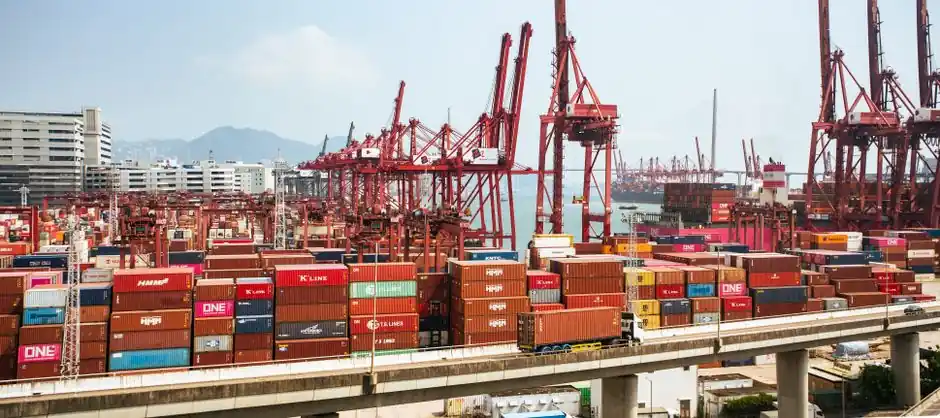
A 2026 port-logistics conveyor sorting line is rarely one machine; it is a chain of belt conveyors, induction conveyors, sorter modules, and discharge chutes sized to the parcel mix and to the vessel-side or yard-side flow that feeds it. For European container terminals, Ro-Ro berths, and inland barge hubs, the design problem starts with peak parcel or piece-good throughput, then narrows down to sorter technology, belt width, infeed angle, and the controls layer tying it to the sorting system above it [S5].
Buyers who treat a sorting line as a single purchase line item tend to over-spec belt width and under-spec induction. The real decision tree in 2026 is parcel dimension range, peak per-hour throughput, divert accuracy target, recovery time after jam, and whether the line ties to WMS/TOS event messaging rather than discrete I/O. The article below walks that tree with concrete figures, vendor-neutral criteria, and a port-side case framing.
Scope and operating envelope of a port sorting line
A port-oriented sorting line serves three flows: marine-side (containers de-stuffed onto conveyor), yard-side (trailer unloading of mixed cartons, tyres, palletised units), and rail/truck cross-dock (intermodal transfer). In 2026 deployments, the belt conveyor backbone runs light-duty rubber or PVC/PVG carcasses at 1.0-3.0 m/s for hand-load zones, medium-duty polyester/nylon fabric at 1.5-4.5 m/s for powered induction, and high-speed PU or PE belt at 2.5-6.0 m/s on the sorter take-away [S4]. The continuous-duty nature of port operations forces a 24/7 duty cycle into the design, which in turn forces CEMA Grade 4-5 idlers and sealed-for-life bearings rather than regreasable pillow blocks [S3].
Port sorter footprints typically run 30-150 m of sorter face per line, with induction at 600-1200 mm centers and discharge chute spacing of 500-900 mm. Throughput per line on a tilt-tray or cross-belt sorter lands at 4,000-10,000 pph (pieces per hour) for typical mixed parcels; line-shaft or shoe-sorter variants handle 6,000-15,000 pph for smaller, flatter items such as polybags or small cartons [S5]. Where parcel weight exceeds 50 kg, the sorter choice collapses quickly: cross-belt dominates up to ~50 kg, tilt-tray stays competitive to ~30 kg, and beyond that the system shifts to sliding shoe with chain-pusher discharge or simply to manual take-off lanes.
Selection criteria: from parcel profile to drive sizing
Start with the parcel population: minimum, maximum, and P95 dimensions plus weight. A 200 mm min footprint rules out sliding-shoe sorters and pushes toward tilt-tray; a 1200 mm max length with high aspect ratio rules out narrow cross-belt trays and pushes toward shoe sorters. The second cut is throughput: target 1.2-1.5x peak hour average, and size induction so no conveyor runs above 85% utilisation at design throughput [S5]. The third cut is footprint: cross-belt sorter loops need oval head/tail with 2.5-4.0 m bend radius, while linear shoe sorters run straight and need only end-of-line drive and tail, which often decides layout in constrained port sheds [S5].
Drive sizing should be checked against total moving mass, not just load. A 50 m cross-belt loop with 300 mm wide PU belt and 100 mm rollers at 3.0 m/s draws roughly 7.5-12 kW of continuous motor power at full load; the motor plus VFD pair must be sized for 150% short-term overload to absorb jam clearing without tripping. Where ports already standardise on a particular VFD family, sorting line vendors can be filtered for that controls interface; this is a procurement-speed issue more than a performance issue, and is covered in the spec-first VFD selection guide. Belt width selection ties to parcel size plus 50-100 mm clearance per side, which puts a 600 mm belt at the floor for cartons under 400 mm and a 800-1000 mm belt as the workhorse for mixed parcels [S3][S4].
Comparing sorter technologies on four decision criteria
The four criteria that actually drive sorter choice in a port-logistics context are: throughput per metre of footprint, parcel weight and dimensional range, divert accuracy, and total cost of ownership over a 10-year horizon. On a 1.5 t/m² floor load and a 4.5 m clear height, the comparison looks like this in 2026 field data [S5]:
Cross-belt sorter: 4,000-8,000 pph per sorter, parcel range 100-1000 mm L x 100-600 mm W, up to 50 kg, divert accuracy ±25 mm, 10-year TCO mid-to-high because each carrier has its own drive. Tilt-tray sorter: 5,000-10,000 pph, 150-1200 mm L x 100-800 mm W, up to 30 kg, divert accuracy ±15 mm, lowest 10-year TCO per pph for mid-size parcels. Sliding shoe / line-shaft sorter: 6,000-15,000 pph but only for soft, flat items under 15 kg, divert accuracy ±50 mm, lowest capex but restrictive on shape. Pouch and bombay sorters fall outside the port-parcel mix in most cases and are excluded from the comparison [S5].
The point of the comparison is not to crown a winner; tilt-tray wins on cost per pph, cross-belt wins on parcel range, shoe sorters win on throughput for soft goods, and the choice collapses to the dominant parcel type. For Ro-Ro ports, where the parcel mix skews to tyres, spares cartons, and crate-style packs, the cross-belt sorter's wider weight tolerance usually wins despite higher TCO [S6]. For greenfield container-terminal parcel hubs, tilt-tray is the default.
Who this specification is for, and who it is not for
This guidance targets port-logistics engineers, terminal-operations managers, EPC integrators specifying a sorting line for a 2026-2027 build, and procurement leads writing technical annexes. It also fits distribution-center builders working on a 50,000-200,000 m² site where parcels and small packages drive the design, and where the conveyor sorting line selection problem mirrors a port hub. It is a sister problem to the warehouse-automation selection question covered in the warehouse spec guide, but with the additional constraint of corrosion exposure, salt-air belt selection, and 24/7 duty. [S4]
It is not for cold-chain refrigerated parcel hubs (PU belt cold-flex ratings and stainless frames change the cost curve), not for mining or quarry bulk sorters (those are not parcel sorters), and not for airports where tray and tub sorters dominate. Buyers in those domains should treat this guide as a reference baseline only.
Failure modes and constraints specific to port installs
Three failure modes are over-represented in port installs versus inland DCs. First, salt-air corrosion on roller shafts, idler bearings, and electrical cabinets; specify 304 or 316 stainless on bearings, hot-dip galvanised frames, and IP55 minimum on motors, with IP65 on cabinet doors. Second, peak-shock loading from vessel-side de-stuffing; the sorter infeed must include a buffer belt of 4-8 m and a soft-start ramp so parcel arrival does not stack on the sorter at >1.0 m/s closing speed. Third, humidity-driven belt mistracking; specify crowned pulleys and self-aligning idlers at 15 m centers, and confirm that the belt carcass is rated for 90%+ relative humidity without ply separation [S3][S4].
Controls-layer risk is the one buyers miss most often. Sorter vendors default to Profinet, EtherNet/IP, or EtherCAT fieldbus on the carrier loop, but port TOS platforms (CATOS, TBA TOS, Navis N4) push event data over REST or MQTT, not fieldbus. Specifying the gap up front, with a small PLC gateway that translates sorter events to WMS/TOS messages, removes a common commissioning delay of 4-12 weeks. The controls hardware itself is in scope of the sorting system reference, but the protocol mapping belongs in the procurement spec.
Standards, sourcing, and 2026 reference points
No single ISO standard governs a complete sorting line; instead, a layered set applies. Belt-conveyor safety is covered by ISO 5048 and EN 620 for continuous mechanical handling; electrical safety by IEC 60204-1 for the controls cabinet and IEC 60079 for any zone with a defined hazardous area. For sorter mechanical design, FEM 9.341 and CEMA B105.1 are the usual references for load and fatigue on moving carriers. For belt selection, ISO 15236 covers steel-cord, and ISO 22768 covers light-duty PVC/PVG, which covers most port-side belt choices [S3][S4].
Sourcing remains broad in 2026: Chinese vendors dominate the light- and medium-duty belt conveyor and roller segment with custom-spec capability at competitive lead times [S1][S3]; European integrators lead on tilt-tray and cross-belt sorter engineering and on the controls layer [S5]; US vendors remain strong on heavy-duty terminal conveyors and on the WMS/TOS integration layer. The most common 2026 procurement mistake is splitting the sorter and the induction conveyor across vendors without naming a single controls interface owner; the fix is a single point-of-responsibility clause in the technical annex, not a more expensive vendor [S1][S3].
Use cases: where each sorter type wins in port logistics
Cross-belt sorter fits best where the parcel mix is wide and weight varies from 1 kg cartons to 50 kg crate-style packs, which is the Ro-Ro and general-cargo case. The sorter's higher capex is offset by not needing a secondary heavy-piece line [S5][S6]. Tilt-tray sorter fits the parcel-hub case where the mix is narrow (couriers, e-commerce returns) and throughput per metre of building footprint is the binding constraint; the smaller parcel range of the tray is the trade-off. Sliding-shoe and line-shaft sorters fit pure polybag, flat-pack, or apparel flows inside bonded zones, but rarely earn their place in mixed port cargo. Manual divert or roller-bed take-off lanes remain the correct choice where the downstream process is manual handling or where parcel volume is below ~1,500 pph and the sorter capex cannot be amortised [S4][S5].
For Ro-Ro terminal selection specifically, the right upstream metrics to track before picking a sorter are vehicle processing time at the gate, storage lane dwell, rail and truck access windows, and dealer distance for outbound dispatch [S6]. A sorter that exceeds gate-side vehicle processing becomes an idle asset; a sorter that runs below it creates queues on the yard side. This is why Ro-Ro ports are still more often served by roller-bed and belt conveyor networks feeding manual take-off than by a fully automated tilt-tray loop, despite the higher theoretical throughput.
The trackable signals worth monitoring for any port sorting line in 2026 are: (1) the published cycle time and divert accuracy of the named sorter module under your parcel mix, not under the vendor's demo mix, and (2) the controls-layer handoff between the sorter PLC and the port TOS, which is the single most common cause of go-live slips. Both are solvable in the spec stage, and both are missed by buyers who compare only headline pph and price.
For component-level specifications, see molding line.