
A tensile testing machine is selected by matching frame capacity (typical bench units span 1 kN to 100 kN, floor models 250 kN to 2,000 kN) to the worst-case expected force, the load-cell accuracy class to the tolerance demanded by the governing material standard, and the crosshead speed/control resolution to the strain rate the test method prescribes [S3][S4].
In practice the decision comes down to five engineering gates — load frame class, load cell, crosshead control, grips/fixtures, and software/standards pack — and any one of them can scrap a quote after delivery. For process engineers, lab managers, and OEM QA leads, those gates decide whether the equipment will pass an ISO/IEC 17025 audit or scrap good product. For a working primer on what a tensile test actually measures, the tensile testing machine encyclopedia entry covers the baseline mechanics.
Force Frame Capacity and Rigidity
Frame capacity is the rated peak tensile/compressive force the load train can sustain without permanent deformation or stop-block intervention, and it should be sized so the worst-case expected force sits at roughly 50–80% of rated capacity to keep load-cell non-linearity and frame deflection in their linear window [S4]. Single-column bench frames are common for polymers, films, and 3D-printed coupons under 5 kN; dual-column floor frames dominate metals, fasteners, and rebar work above 50 kN [S2][S4].
Frame rigidity, not just capacity, controls the strain measurement error on stiff specimens. A low-rigidity frame swallows displacement at the crosshead, which biases modulus (E) and proof-strength values upward. A typical floor frame for metals is specified in the 100–600 kN range with a stiffness budget expressed in kN/mm, and the figure is often printed in the OEM data sheet [S4][S5]. Under-specifying the frame is the most expensive mistake a buyer can make on a metals lab build.
Load Cell Class, Accuracy, and Range
Load-cell selection is governed by accuracy class, full-scale range, and creep/specimen-alignment behaviour. The general rule is to operate between roughly 10% and 100% of the cell's full scale to keep relative non-linearity and hysteresis inside the published class; readings below 1% of full scale are usually unusable regardless of how the cell is marketed [S3][S4]. For metallic coupons tested to EN 10002 (metallic materials tensile testing) and equivalent ISO/ASTM standards, Class 0.5 or better cells are common, and the cell's calibration must be traceable to national standards via a documented certificate [S3].
Buyers should also distinguish extensometer-grade strain measurement from load measurement. Crosshead displacement is not strain; it includes frame deflection and grip slip. Extensometers — mechanical, optical, or video — are required where the standard demands a strain-based modulus or proof-strength value [S2][S4].
Crosshead Speed, Control Loop, and Strain-Rate Compliance
Crosshead speed and its closed-loop control decide whether the machine can hold the strain rate the standard prescribes. Most metallic-material tests specify a target strain rate over a strain range (for example, a constant rate within an elastic/plastic window), and the controller's feedback loop — load, displacement, or extensometer (strain) channel — is the variable that determines which mode is achievable [S3][S4]. Closed-loop control on extensometer input is mandatory for modulus and proof-strength values where the standard mandates a strain rate rather than a stress rate.
Speed range and resolution should be checked at the low end, not the high end. Polymer, elastomer, and film tests often run at sub-1 mm/min crosshead speeds with sub-micron displacement resolution, while fastener and rebar tests run at 10–50 mm/min with relaxed resolution. A frame with a 0.001–500 mm/min range and a digital closed-loop controller covers both ends of that envelope [S4][S5]. Buyers who only check top speed end up with a machine that cannot run ASTM D638 or ISO 37 strain rates on rubber.
Grips, Fixtures, and Specimen Preparation
Gripping is where most test results go wrong. Self-tightening wedge grips, pneumatic side-action grips, and threaded/bolt-on grips each suit different specimen geometries; the wrong grip either crushes the gauge section, slips at peak load, or introduces bending strain that biases the result. Specimen preparation — gauge-length marking, machining tolerances, and surface finish — is governed by the material standard and is non-negotiable if the test value is to be reported against a specification [S3][S4].
For 3D-printed and additive-manufactured coupons, specimen geometry and build orientation dominate the test result as much as the frame does, because layer adhesion and raster direction produce anisotropic strength values. Tensile testing in that workflow is used both as a lot-release gate and as a process-consistency check on the printer itself [S2]. The same caution applies to welded coupons, wire-rope strands, and rebar, where the grip is sized to the as-received geometry, not to a lab-standard dumbbell.
Software, Standards Packs, and Data Integrity
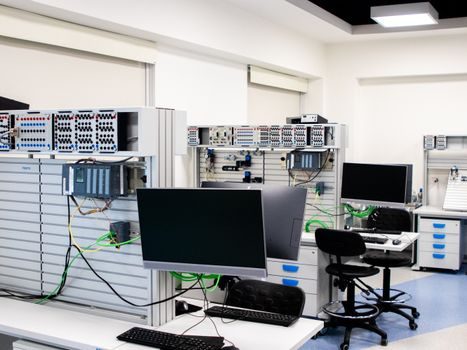
Modern tensile test stands ship with PC software that drives the test recipe, calculates the reported values (Rm, Rp0.2, A%, Z%, E), and exports the raw data. The features that matter are: (a) method templates for the standards the lab actually runs (ISO 6892-1, ASTM E8/E8M, ASTM D638, ISO 527, ISO 37, etc.), (b) raw-data export in CSV/Excel, not just PDF reports, so a downstream SPC system or a customer audit can re-calculate the values, and (c) user/role access logging for ISO/IEC 17025 traceability [S4][S5][S6].
For multi-standard labs, a single software stack that ships with templates for the 60+ tensile-test standards catalogued in international classification (covering metals, plastics, wires/cables, welds, and adhesives) reduces method-transcription errors and audit findings [S6]. The single biggest gap in cheap machines is the absence of editable, versioned method files — buyers should not accept binary-locked recipes.
Vendor Types: Bench OEM, Floor OEM, and Specialist
The market segments into three functional groups. (1) Bench-top OEMs (1–50 kN) targeting plastics, films, textiles, and additive manufacturing, where the buyer cares about extensometer resolution and small-coupon grips more than frame stiffness. (2) Floor-frame OEMs (50–2,000 kN) targeting metals, fasteners, rebar, and structural components, where frame stiffness, dual-column rigidity, and high-capacity load cells drive the spec. (3) Specialist / torque-and-tensile combination rigs for fasteners, springs, and components that need a combined axial-torsional load case [S1][S4][S5].
On a four-criterion head-to-head: a 50 kN bench unit (Instron 6800-series class, MTS Criterion, Shimadzu AGS-X) is short lead time, low cost, and ideal for plastics/films but is not adequate for full-section rebar. A 300 kN floor unit is suitable for metals to EN 10002 / ISO 6892-1 with class 0.5 load cells and extensometer-controlled loops, but it costs 3–5× a bench unit and needs a dedicated floor pit. A 1,000–2,000 kN floor unit is mandatory for rebar, wire-rope, and large structural coupons, but lead time stretches into 4–9 months and the calibration/load-cell cost dominates [S1][S3][S4].
Where a Tensile Test Machine Is the Wrong Tool
A tensile testing machine is the wrong instrument for fatigue, creep, and stress-rupture work: those tests run for hours to thousands of hours under sustained load and require dedicated fatigue/creep rigs with different load frames, displacement sensors, and software. It is also the wrong tool for hardness, impact (Charpy/Izod), or fatigue-crack-growth tests, which need different fixturing and load-train dynamics [S4][S6].
For pure shop-floor geometry checks (length, width, hole diameter, edge distance), a vision-based or optical comparator cell is faster and cheaper than a tensile rig, and engineers often conflate the two when scoping a metrology cell. The decision frame for that adjacent case is covered in the optical comparator selection guide and the vision measuring machine selection piece. Where the workflow is borderline geometry plus occasional mechanical verification, the choice comes down to test volume, traceability demand, and audit posture, not brand.
Trackable Signals for the Next Spec Window
Two signals to watch over the next 6–12 months: (1) the revision status of ISO 6892-1 metallic tensile testing methods, which historically drives load-cell and extensometer class upgrades in metals labs [S3]; (2) the spread of video and non-contact extensometers into bench-top plastics and 3D-printing workflows, where contact extensometers damage soft or thin coupons — relevant to anyone speccing a new polymer/additive lab [S2][S4]. A spec engineer should treat both as a refresh trigger for method templates and load-cell calibration intervals on existing stands, not as a forced rip-and-replace.
Related: pressure transmitter, flow meter.