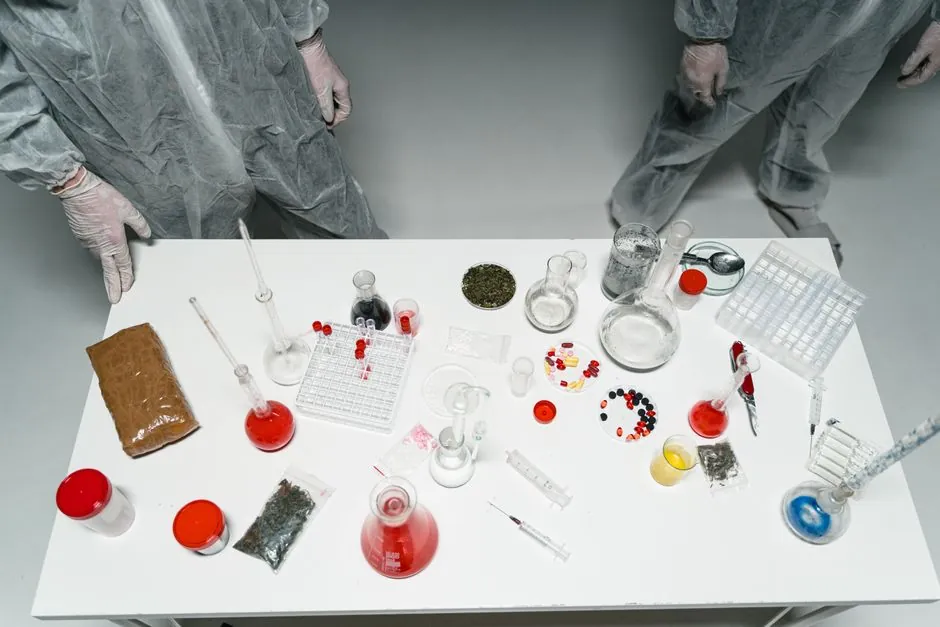
China's chemical sector exceeds 25,000 producers under the China Petroleum and Chemical Industry Federation count, and the country exports specialty volumes such as over 2,000 metric tons of sulfide dye per year into South and Southeast Asia [S1].
For downstream cosmetics, pharma, agro, and water-treatment buyers, the practical question is not whether China is competitive (it is) but how to convert a low quotation into a shipment that passes customs, matches the COA, and lands on a reproducible specification.
Define the Chemical Spec Before You Define the Supplier
A product name alone invites substitution, since sodium acetate trihydrate (CAS 6131-90-4) and anhydrous sodium acetate share a commercial root but carry different molecular weight, active content, and dosage behaviour [S2].
A defensible request for quotation includes the CAS number, chemical formula, assay window (e.g. 58-60% for the trihydrate), grade designation (industrial, food, feed, reagent), key impurities such as chloride, sulfate, iron, and heavy metals, physical form (crystals, powder, granules, liquid), packaging (25 kg bags, drums, IBCs, bulk), trial plus annual volume, and an Incoterm (FOB, CFR, CIF, DAP) with destination port and required documents (COA, SDS, TDS, certificate of origin) [S2].
For organic synthesis intermediates such as 4-(3-Chloro-4-fluorophenylamino)-7-methoxyquinazolin-6-yl acetate, purity threshold, residual solvent profile, and isotopic/regiochemical identity matter more than the trade name [S4].
Classify the Supplier: Manufacturer, Exporter, Trader, or Intermediary
Chinese suppliers fall into four functional buckets: direct manufacturers, manufacturers with a dedicated export division, authorized distributors, and trading companies or sourcing intermediaries [S2].
A trading company is not automatically disqualifying; it can offer consolidated shipments, lower minimums, and multilingual export support, but the buyer must still identify the underlying production site and the contractual party responsible for the COA [S2].
Producers serving pharmaceutical, cosmetic, and new-material end-markets typically hold ISO 9001 and EU REACH certificates, operate independent production lines plus R&D laboratories, and support custom synthesis at gram-to-ton scale [S5].
Revenue scale is a useful first filter: chemical suppliers above roughly 5 million USD annual revenue tend to deliver more consistent quality and on-time shipment performance, per IBISWorld-cited research [S3].
Documentation, Compliance, and the Pre-Shipment Gate
Material Safety Data Sheets (MSDS/SDS) and pre-shipment inspection are non-negotiable in most destination markets, and COA + TDS per batch is the standard evidence pack that customs and end-customers will request [S1].
On the China side, the Existing Chemical Substances Inventory (ECSI) and the New Chemical Substances Notification (NCSN) govern domestic registration of substances and must be reconciled against the buyer's import jurisdiction (REACH in the EU, TSCA in the US, K-REACH in South Korea, etc.) [S3].
For process instrumentation that often accompanies specialty chemical plants, pressure transmitter selection should follow the same documentation discipline, with ATEX/IECEx zone classification, HART or Foundation Fieldbus protocol, and SIL rating declared on the data sheet.
Packaging, Logistics, and Hazard-Class Handling
Packaging format in China is flexible: 25 kg bags, fibre drums, IBCs (typically 1000 L), and bulk ISO tanks are all standard options, and the right pick depends on the chemical's hazard class, shelf life, and destination handling equipment [S2].
Hazard-class mapping is a real engineering input: oxidizers, organic peroxides, corrosives, and toxic intermediates each have segregated packaging, labelling (UN numbers, GHS pictograms), and stowage rules that the freight forwarder must respect. For multi-class consolidated shipments, buyers should consult a storage cage selection map for chemical shipping before accepting a consolidated container offer.
Lead times from order to CIF discharge commonly run 25-45 days from major Chinese ports (Shanghai, Ningbo, Shenzhen, Qingdao) for standard grades, with longer cycles for custom synthesis at the 100 g-to-kg scale [S5].
Comparison: Sourcing Channels at a Glance

On four decision criteria, the main sourcing channels line up as follows: direct manufacturer offers the lowest unit cost and strongest technical traceability but demands higher MOQ (often 500 kg to 1 ton) and 30-60 day lead time; manufacturer with export division keeps the cost edge and adds English documentation support with MOQ in the 100-500 kg range; authorized distributor trades a 5-15% price premium for lower MOQ (down to 25 kg) and faster dispatch from local stock; trading company or intermediary offers the smallest MOQ and consolidated multi-product shipments but obscures the underlying production site and lengthens issue-resolution chains [S2][S5].
For regulated end-uses (API intermediates, cosmetic actives, food-grade additives), the manufacturer route plus third-party audit is the only defensible choice; for commodity industrial chemicals (water treatment, textile auxiliaries, oilfield reagents), distributor channels are usually sufficient.
Audit, Sampling, and First-Article Discipline
Pre-shipment verification splits into three gates: a documentation review (COA, SDS, TDS, REACH/ISO certificates), a manufacturing audit (either on-site or via a third-party such as SGS, Bureau Veritas, or TÜV), and a first-article sample tested in the buyer's own lab against the agreed assay, impurity, and physical-form criteria [S1][S3].
For specialty intermediates, custom-synthesis runs of 100 g to 50 kg are routinely offered as paid trial batches before commercial scale-up, and a documented first-article approval gate prevents scale-up surprises [S5].
Process engineers running the receiving plant should treat the COA as a contract, not a courtesy: when the flow meter on the unloading line shows a mass balance outside the agreed tolerance against the supplier's COA, that is a rejection trigger, not a negotiation opener.
Common Failure Modes and How to Avoid Them

The four failure modes that drive most rejected shipments are: (1) substitution of grade or form without notification (mitigated by pinning CAS number, assay, and physical form in the PO); (2) incomplete or mistranslated SDS that fails destination-market chemical control law; (3) packaging mismatch with hazard class, triggering container rejection at the port; (4) supplier-side capacity loss during peak export windows, mitigated by maintaining a qualified alternate [S1][S2].
For process plants, the receiving-side industrial valve train should be specified for the actual chemical service (corrosive, viscous, slurry) rather than the generic water duty, since material upgrades here routinely cost less than a single rejected shipment.
Trackable signals for the next sourcing cycle: China's specialty chemical export volumes to the EU under REACH registration updates, the number of new ECSI listings, and any tightening of the NCSN notification window for new substances [S3].