
Demolition is the most punishing service for any rebar cutter: bars are encased in fractured concrete, often bent, frequently partially exposed, and the operator is working at the end of a boom or in a controlled drop zone where flying chips and reactive loads are the norm [S1][S3].
Capacity, blade geometry, power supply, and spare-parts logistics are the four selection gates that drive total cost of ownership on a structural teardown, and each one tightens versus a green-field rebar yard.
Capacity rating and why demolition over-sizes the bar
Standard new-build electric rebar cutters from TAEYEON B&C, distributed by CNB Machinery in the Philippines, cover 10 mm up to 42 mm rebar stock on a single machine platform, with the flagship TYB-HD42D head rated for the full 42 mm diameter [S1].
For demolition, the working bar is rarely straight, so a conservative rule is to de-rate the published capacity by one bar size, then add a 30% safety margin on cycle rate, because contaminated, partially grouted bar burns through blades roughly three times faster than clean stock [S1][S3]. The implication: a machine rated for 32 mm in a fabrication shop should be treated as a 25 mm tool on a structural teardown.
Cutting mechanism: hydraulic shear vs. mechanical jaw
Two head architectures dominate the demolition market: single-blade hydraulic shear and pivoting-jaw mechanical cutter, the latter typified by BN Products DC-16W (16 mm, #5 / 5/8 in.) and DC-32WH (32 mm, #10 / 1-1/4 in.) models whose replacement blade sets are catalogued at USD 1.65 to USD 129.00 per set [S3].
Hydraulic shear heads deliver a cleaner cut, lower vibration, and faster cycle on bar above 20 mm; mechanical jaws are cheaper, lighter, and easier to rebuild in the field. For a demolition contractor running 200 to 400 cuts per shift on mixed #5 to #8 bar, the hydraulic shear pays back its higher purchase cost in blade life alone, given that a single BNC19 blade set for the B&C TYC-HD19A runs USD 1.75 to USD 75.00 depending on tooth count and hardware inclusion [S1][S3].
Power source and site logistics
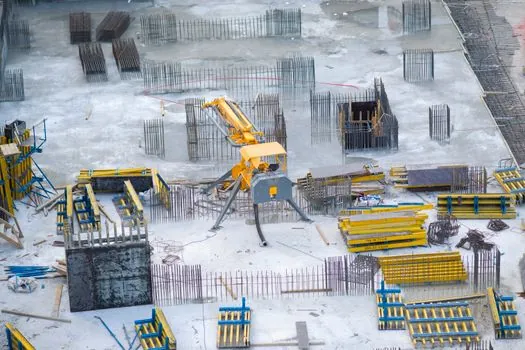
Portable electric rebar cutters like the GQ50 bar cutting machine listed by IDEAL run on 380 V three-phase industrial power and are widely deployed at fixed-site Chinese construction yards, where the manufacturer also builds straightening-and-cutting lines, stirrup benders, and road cutters [S2].
On a demolition site the constraint is rarely the machine spec, it is the available power: 380 V three-phase is common on tower-crane feeds and shore-power tie-ins but absent on brownfield urban teardowns. Specify the electric head when the project has a dedicated site transformer; specify a 5.5 kW-class portable genset or a battery-hydraulic pack for isolated slabs and interior strip-outs.
Spare parts, blade sets, and the consumables budget
Blade life is the single largest variable cost on a demolition rebar cutter, and the US-made aftermarket for B&C, BNC, BN Products, Eagle, Edwards, and EZE Bend machines is mature: catalogued part numbers include BNC19 (USD 1.75 to USD 75.00), BNC25 (USD 1.85 to USD 85.00), DC-16W (USD 1.65 to USD 65.00), DC-32WH (USD 1.95 to USD 129.00), and EDW15 for the Edwards No. 15 (USD 8.95 to USD 140.00) [S3].
Lock the procurement contract to a model that has a stocked blade supply chain before the machine is delivered. TAEYEON B&C machines sold through CNB Machinery ship with full spare-parts inventory held in the distributor's Philippine warehouse, and the rebuild path (online triage, on-site repair, warehouse pull-out) is documented as a three-tier service ladder rather than a return-to-factory cycle [S1].
Comparison: cutter types against demolition decision criteria
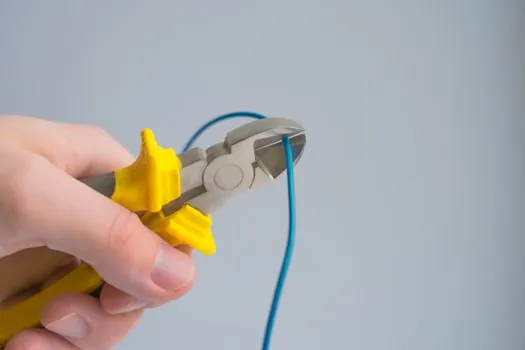
Matching the head architecture to the four decision criteria that matter on a teardown: capacity range, cut quality, cycle rate on contaminated bar, and field serviceability, gives a clear ranking. [S1]
For 10 to 20 mm bar on interior strip-out, the BN Products DC-16W mechanical jaw is the lowest-cost option at USD 1.65 to USD 65.00 per blade set and runs on standard single-phase power. For 20 to 32 mm bar on bridge or pier demolition, a B&C TYC-NHD25 or BN Products DC-32WH hydraulic shear gives the cleanest cut and the longest blade life. For 32 to 42 mm bar on heavy structural demolition such as pier caps and pile caps, only the 42 mm-class heads like the TYB-HD42D are credible, and they should be paired with a 380 V three-phase feed or a dedicated diesel-hydraulic power pack [S1][S2][S3].
Failure modes, limits, and the misapplication traps
The three ways a rebar cutter gets destroyed on demolition are: cutting pre-stressing strand (which requires a dedicated strand cutter, not a rebar head); running the hydraulic cycle on a bar that is still under load from a partially cut member; and using a mechanical-jaw head on bar above its de-rated capacity, which cracks the jaw pivot [S1][S3].
Hard exclusions for demolition-rated rebar cutters: do not specify a fabrication-shop head for sub-sea or chemically contaminated work without confirming seal compatibility, do not run a single-phase machine off a phase-converter wired to a tower-crane feed, and do not accept a blade set without verifying the mounting hardware is included (the catalog distinguishes BNC19 and BNC25 sets as "Mounting Hardware Included" while the Eagle EAG6F and EAG6M ship "Mounting Hardware NOT Included") [S3]. A related reference for adjacent tool selection is the rebar cutter selection guide for interior finishing, which covers the lighter-duty end of the same product family.
Standards, sourcing, and what to verify on the data sheet
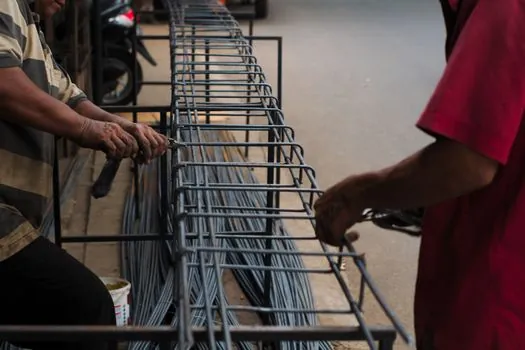
No single ISO or EN standard governs portable rebar cutter safety in demolition service, so verification has to happen at the order-spec level: confirm blade material (typically Cr12MoV or equivalent tool steel), hydraulic pressure rating (commonly 60 to 70 MPa for 32 mm-class heads), and a documented IP rating for the control box if the work is outdoors [S1][S2][S3].
Two trackable signals to watch over the next two quarters: 1) TAEYEON B&C's distributor network in Southeast Asia has been adding in-country spare-parts warehouses since 2022, which compresses blade lead time from weeks to days, a metric worth requesting in any 2026 RFQ [S1]; 2) the IDEAL Chinese OEM lineup now bundles rebar cutters with straightening-and-cutting lines, stirrup benders, and power trowels, so a demolition contractor tendering a large slab-and-foundation package may be able to negotiate a single-shipment volume discount across the rebar-processing chain [S2]. For demolition rigs pairing cutting heads with boom-mounted carriers, also see the demolition hammer selection reference and the aerial work platform duty-class guide which together define the carrier-side envelopes the cutter head has to fit inside.
Background reading: Crawler crane selection for quarrying: 2026 spec gates.