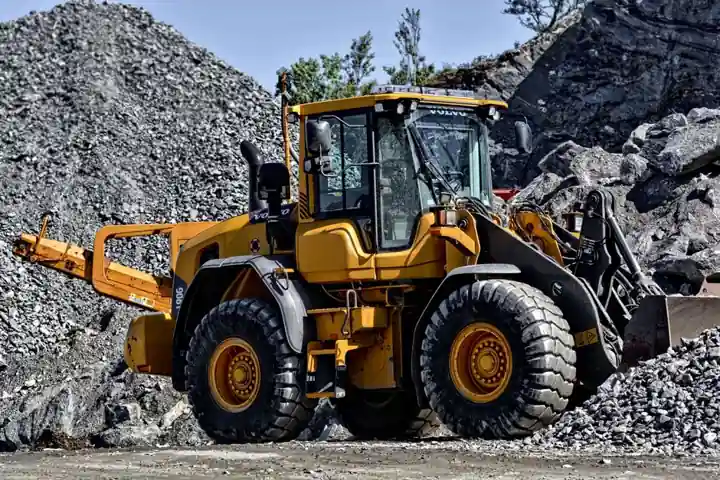
Quarry operators sizing a crawler crane in 2026 are pushed toward tracked lattice-boom machines in the 80 to 300 t class, because tracked undercarriages spread load over a 4 to 6 m ground contact length and keep ground bearing pressure in the 80-150 kPa window typical of soft, ripped quarry floors [S5]. The same fleet data shows ISO 9001 undercarriage suppliers in Yantai, Shandong routinely stocking track shoes, bottom rollers, top rollers, idlers, and sprockets in 40Mn2 and 35SiMn steels with 7-14 day ex-works lead times [S5].
The narrow list of OEMs that show up on quarry tender sheets is consistent across the 2022-2026 window: Manitowoc, Liebherr, Terex, Link-Belt, Sany, and Kobelco [S1][S2][S4][S5]. Terex describes its tracked-lifting range as engineered for "heavy-duty hoisting, precise load handling, and stable operation on demanding job sites" and lists construction, infrastructure, energy, industrial and extractive work as primary duty cycles [S4]. A crawler crane is the right base architecture for quarry duty because no outrigger pad prep is required on a moving pit floor.
Why tracked beats wheeled on a pit floor
Tracked undercarriage pressure on ripped limestone or sand-floor benches sits in the 80-150 kPa band once the machine is rigged, well below the 200-250 kPa that wheeled mobile crane outrigger pads demand and which loose quarry subgrade often cannot deliver [S5]. The five wear parts that govern quarry undercarriage life are track shoe, track roller (bottom roller), top roller, front idler, and sprocket; VM's product page lists 40Mn2 as the dominant top-roller steel and 35SiMn for sprockets, with bolt-type and spline-type sprocket variants both available [S5].
Quarry dust ingestion is the dominant wear mode, which is why the same ISO 9001 supplier quotes 7-14 day shipment on stocked undercarriage parts rather than build-to-order, a sign that operators routinely carry spares [S5]. For comparison, a mobile crane on outriggers needs cribbing plates and a level pad; a gantry crane needs rail; the crawler simply walks to the next blast pattern.
Lattice boom vs telescopic boom in the pit
Lattice boom dominates quarry and mining lifts above 100 t because pinned sections let the rigger match boom length to radius without transporting an over-length load, and the open steel section survives dust and impact better than a multi-stage telescopic box [S2]. The 2023 Manitowoc MLC300 VPC-MAX wide-boom insert kit and the 3.5 m VPC650 boom attachment, both added to ALL Family of Companies' fleet in January 2023, show the OEM pattern of building a single 330 t class chassis that reconfigures across wind, oil-and-gas, and quarry duty [S2].
Telescopic crawlers earn their place in the 60-100 t class where the machine must self-erect, reposition inside a working bench, and pick drill-casing or a hydraulic breaker without a helper crane. Sany, Link-Belt TCC, and the smaller Terex HC-110 (the latter surfaced in the CEG used-equipment listing for 2026) sit in this slot, with the HC-110 described as a tracked lifting machine for heavy-duty hoisting, precise load handling, and stable operation on demanding job sites including aggregate and extractive work [S4].
Sizing the crane to the bench

The right capacity bucket for a hard-rock quarry is 1.5x to 2x the heaviest single pick, which in practice is the rock-screen mainframe, the primary crusher cheek plate, or a mill liner lift [S1][S2]. Fleet transactions in the public record cluster around 250-330 t: ALL Crane's 2023 order of four Liebherr LR 1250.1 (275 t) and four LR 1300.1 SX (331 t) units, and Manitowoc MLC650 boom kits for 330 t class VPC-MAX chassis [S2]. For a smaller aggregate pit serving a crane scale weighbridge and a single jaw crusher, 80-150 t lattice or telescopic crawlers are more common.
Pick-and-carry moves on a tracked crane are limited to the chart's travel-axle rating, which on most quarry models is 60-80% of the stationary rating, so long-distance repositioning between benches is normally done with the boom stowed rather than loaded.
Configuration options, lined up
For a quarry fleet planner the four realistic configurations to compare on 2-4 decision axes are: (a) lattice crawler 80-150 t, (b) lattice crawler 200-330 t, (c) telescopic crawler 60-100 t, and (d) tower crane on a static pedestal for a fixed crushing plant. On capital cost, (c) and (a) win; on max single-pick capacity, (b) wins; on set-up time per move, (c) wins; on pit-floor mobility, (a), (b), and (c) tie ahead of (d) which needs rail or a poured foundation. Used-equipment availability, as shown by Terex HC-110 listings on CEG in 2026, tilts (a) and (c) toward lower entry cost for a new pit [S4].
Manoeuvrability inside a confined bench, repeated by the contractors in the Mammoet Sheybarah Island overwater-villa lifts (February 2023) and the Atlantic trestle pipeline (February 2023), is the structural reason crawler cranes are preferred over stacker crane style gantries when the work-face moves [S2].
Standards, safety gates, and what the spec sheet must show
A quarry-spec crawler crane in 2026 must carry an OEM load chart that is valid for the configured boom, jib, and counterweight combination, plus a documented ground-bearing check for the worst bench. Undercarriage documentation should reference ISO 9001 manufacture (the certification VM lists for its track-shoe, roller, idler, and sprocket lines) so that wear-part replacement does not void the crane's stability case [S5]. The standard lift-plan flow is OEM chart, ground-bear calculation, rigging gear rated to the pick, and a pre-lift toolbox talk; the absence of any of these is the most common audit finding on aggregate sites.
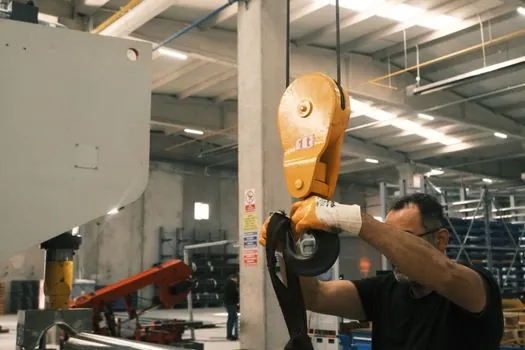
Rigging gear (shackles, slings, lifting beams) is the higher-risk component on a quarry pick because it is replaced site-by-site rather than OEM-controlled, and ratings must be cross-checked to a recognised standard. A crane scale verification before the first production lift, and a recalibration interval on the OEM certificate, are the cheapest insurance against an over-radius pick.
Where crawler cranes lose to alternatives
A crawler crane is the wrong tool when the work is repetitive, fixed-position, and high-cycle, for example a stockpile feed or a barge loader: in that case a fixed gantry crane or a purpose-built stacker crane cuts cycle time. It is also the wrong tool when the pit floor is waterlogged soft clay and ground bearing falls below 50 kPa, because even a tracked machine will rut and refused picks follow; in that condition a mobile crane on a temporary matting road is the safer call. Finally, for tower work on a headframe or a static crushing station over 40 m hook height, a tower crane on a pedestal is the economic answer. [S1]
Trackable signals worth watching into late 2026: new ISO 9001 undercarriage kits for 200-330 t class machines entering the aftermarket, OEM announcements of variable-position counterweight kits, and quarry fleet orders logged at Manitowoc, Liebherr, and Terex. A second node is the used-equipment price spread between Tier-1 OEM lattice crawlers and Chinese OEM units, which directly sets the buy-vs-hire decision on the next pit expansion [S1][S4][S5].
Background reading: Industrial Rubber Selection for Oil and Gas: Elastomer, Hardness, and Sour-Service Gates.