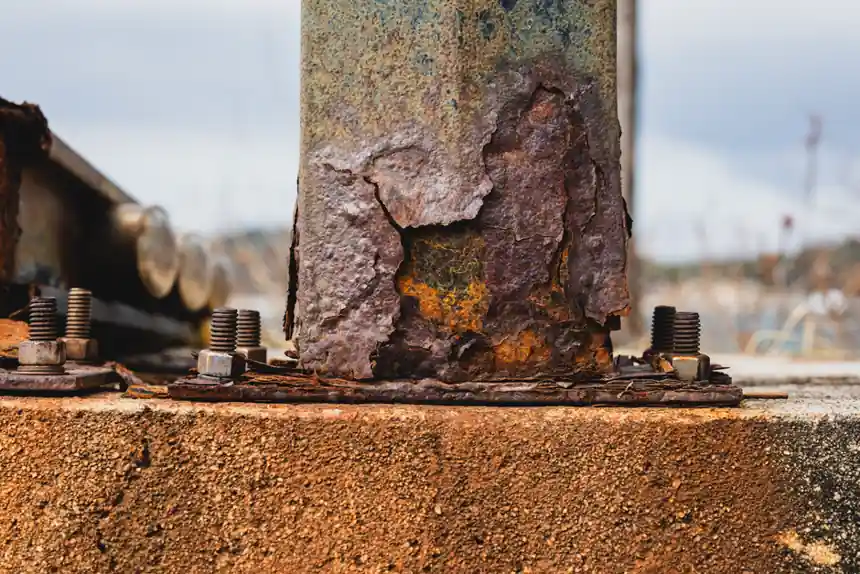
Dynamic balancing machines deployed outdoors face a corrosion load that indoor shop-floor units do not: salt-laden marine air, chemical-plant wash-down, humidity cycling, and UV-driven polymer degradation. Selection therefore starts with enclosure integrity, not balance grade.
The most common field duty is rotors from 1 kg to 3,000 kg, run on belt-drive or universal-joint horizontal machines targeting ISO 1940-1 G2.5 balance quality for general industrial work and G1.0 for turbo-class shafts; the corrosion package, not the kinematics, decides whether a given installation survives five years in an open yard.
What "outdoor-rated" actually means in a balancing machine
An outdoor-rated dynamic balancing machine is, at minimum, an IP65-protected console, IP54-protected bed, and a marine-grade or galvanised structural frame. The horizontal universal-joint drive models widely supplied for fans, motors, pumps and turbo-compressors are typically built around a ribbed cast-iron or welded-steel bed, on which the corrosion burden falls hardest [S1][S5].
Three corrosion vectors dominate. First, salt-chloride pitting of the bed, pillow blocks, and drive-head castings, common within 1 km of coastline. Second, acid-condensate attack on the operator console, especially in fertiliser, steel-mill and wastewater sites where SO2 or NH3 plumes drift into the open yard. Third, galvanic corrosion at the stainless-fastener / carbon-steel-frame joint, accelerated by wet-dry cycling rather than by steady rain [S2].
Field-service suppliers describe a typical on-site job as a single or small-batch rotor, weighed in the installed condition, where the machine must travel to the asset rather than the asset travelling to a shop; the rig has to be set up on wet grass, oily concrete or a sloped pad, which makes frame stiffness and foot-levelling as much a corrosion story as a vibration story [S3].
Selection criteria mapped to a buyer's spec sheet
For outdoor service, a buyer's spec sheet should rank four criteria above rotor mass and balance grade, in this order: enclosure rating, frame finish, electronics protection, and then the mechanical envelope. [S1]
Enclosure rating: console at IP65 minimum, ideally IP66 if the unit is hosed down; bed-mounted sensor junction boxes at IP67. The measuring unit and cable glands are the usual failure point, not the kinematics, on outdoor units [S1].
Frame finish: hot-dip galvanised to ISO 1461 (typical coating 70–85 µm for 1.5–3.0 mm steel sections, 85–100 µm above 6 mm), or 304/316 stainless on critical castings. Powder-coat over zinc-rich primer is acceptable in low-chloride environments but is the first layer to fail in coastal service [S5].
Storage spec should reach +70 °C for sun-loaded cabinets. The JP-580-class measuring unit, supplied in soft-bearing and hard-bearing machines, is a typical example of electronics that must be field-sealed, not just panel-sealed [S5].
Mechanical envelope: a horizontal universal-joint or belt-drive machine covering 1 kg to 3 t will handle the bulk of field rotors in fans, motors, pumps, and small turbo shafts; above 3 t the buyer should look at a dedicated heavy-duty hard-bearing bed, below 1 kg at a portable or micro balancer with the same corrosion package [S1].
Comparing the realistic options against four decision criteria
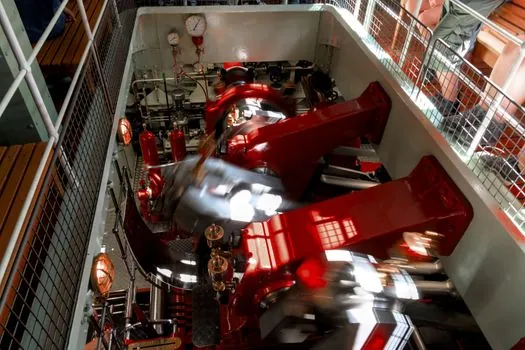
Three architectures compete for the outdoor yard: horizontal universal-joint hard-bearing, horizontal belt-drive, and portable/portable-on-site. The table below lines them up against the four criteria that decide an outdoor spec.
Horizontal universal-joint hard-bearing (e.g. JP-series, NCH 0.3–3 t class): best balance accuracy in the group, repeatable setup for production rotors, moderate corrosion sensitivity at the drive-head coupling. Best for: motor and pump OEMs running 5–50 rotors per day in semi-sheltered yards [S1][S5].
Horizontal belt-drive soft-bearing: lower cost, wider speed range, easier field calibration, but the drive belt and pulleys are exposed wear parts in dusty outdoor air. Best for: fan and blower repair shops, agricultural machinery, medium-throughput service [S5].
Portable / on-site balancer (e.g. PortAlyzer-class instrument plus clip-on sensors): the rotor stays installed, no crane needed, and the only outdoor exposure is the sensor head and a laptop in a sealed case. Best for: large turbo shafts, installed-condition balancing where dismantling is uneconomic [S3][S4].
On the four criteria: portability and minimum asset dismantling are clearly won by the portable class. Maximum balance accuracy and throughput are won by the horizontal hard-bearing bed. Corrosion tolerance is roughly even if all three are bought to the same IP/finish spec; it is the packaging, not the architecture, that decides survival outdoors [S1][S4][S5].
Who a corrosion-hardened balancing machine is for, and who it is not for
This spec profile is for buyers running an open-yard or canopy-only service centre, a coastal or chemical-plant-adjacent maintenance bay, or a field-service crew that drives a van to the asset. It is also for OEM end-of-line test cells that sit next to plating lines, pickling baths, or marine loading arms where chloride and acid drift are constant [S2][S3].
It is not for buyers who can keep the machine indoors, who only balance sub-100 g armatures in a clean lab, or who need a cleanroom-compatible machine with no exposed rotating parts. A shop-floor micro balancer such as the NB-307 family is the right tool for that job, not a corrosion-hardened field rig [S1].
It is also not the right pick for buyers whose priority is sub-0.5 g·mm/kg residual unbalance on turbo-class shafts: the balance-grade ceiling, not the corrosion package, is the limiting factor there, and the answer is a high-speed hard-bearing unit in a temperature-controlled room, not a galvanised field rig [S4].
Standards, sourcing, and what to put in the RFQ

The governing standard for residual unbalance on rotating shafts is ISO 1940-1, with G2.5 as the typical general-industrial target and G1.0 / G0.4 reserved for turbo-class rotors; the RFQ should state the grade, the rotor mass range, and the service environment in that order. Enclosure rating should reference IEC 60529 (IP code) explicitly, with IP65 console, IP54 bed, and IP67 junction boxes as the minimum outdoor baseline [S1].
Frame finish should call out ISO 1461 for hot-dip galvanising or a named stainless grade (typically 304 for inland, 316 for marine). Surface preparation under any paint system should follow ISO 8501-1 to Sa 2.5; this is the single biggest determinant of coating life in coastal service.
For the wider instrument side of an outdoor yard, a buyer will typically also be specifying process thermometers and manometers for outdoor tank farms on the same corrosion basis, and the same IP / finish logic carries across to hazardous-area thermocouple points when the balancer sits inside a classified zone. Enclosure-build guidance for ancillary instrumentation is covered in decade resistance box selection for enclosure builds, which uses the same IP/finish pair as the balancer console.
For reference, the architecture of the machine itself is detailed in the dynamic balancing machine encyclopedia entry; related machine-tool context, including how a balancer sits in a wider shop floor, is covered in the cutting machine entry and the core machine entry, which together describe the stationary-bed machine category a horizontal balancer belongs to.
Failure modes and field feedback to expect
The three failure modes that show up first on outdoor units, in order, are: console keypad failure from UV and moisture ingress, drive-head bearing corrosion on universal-joint machines left uncovered, and sensor-cable gland loosening from thermal cycling. A 24-month service interval on the drive-head, an annual re-greasing of pillow blocks with marine-grade grease, and a five-year re-coat of the bed are realistic maintenance assumptions [S2][S3].
Buyers who skip the conformal-coat line item typically see PCB failures inside 18 months in coastal service; buyers who spec 316 stainless on the bed but pair it with zinc-plated fasteners see galvanic attack at the fastener within 24 months. The pattern is consistent across field-service reports: corrosion is a system problem, not a material problem [S3].
Closing signals and next node
Two trackable signals for follow-up. First, watch for vendor datasheets that list the IEC 60529 IP code and ISO 1461 coating thickness side by side, which is the clearest indicator that the supplier has actually engineered for outdoor service rather than relabelling a shop-floor unit. Second, track whether field-service suppliers continue to publish on-site balancing as a primary offering, which would confirm that portable instrumentation is not displacing yard-installed hard-bearing machines but running alongside them [S2][S4].