
Selecting a decade resistance box for an electrical enclosure build is governed by five interlocking criteria: total resistance range and decade count, accuracy class, per-step power dissipation, switch contact technology, and the enclosure's ingress or hazardous-area rating. The box itself is the calibration resistor: a manually switched assembly of precision resistors arranged in decades (1 ohm steps, 10 ohm steps, 100 ohm steps and so on), used to inject known values into instrument loops during commissioning, loop checks, and periodic re-calibration [S1].
For 2026-era panel builds, the typical spec envelope is a 4- to 7-dial box covering 1 ohm to 10 megohm (or 100 megohm on high-resistance models), 0.1% to 1% accuracy, 0.5 W to 1 W per-step dissipation, and a silver- or gold-plated rotary switch rated for at least 100,000 operations. That envelope is sized to verify the working range of 4-20 mA loops, RTD simulators, and the input ladders of a Pt100 / RTD read chain without dragging in a second instrument.
Resistance Range, Decade Count, and Dial Resolution
Decade count drives the usable range: a 6-dial box with 1 ohm, 10 ohm, 100 ohm, 1 kohm, 10 kohm, and 100 kohm decades spans 1 ohm to 1,111,110 ohm in 1 ohm steps, which covers the bulk of analog loop and insulation resistance tester checks. Add a seventh 1 megohm decade to push the upper limit to roughly 11.1 megohm for higher-impedance instrumentation [S1].
Resolution dictates whether you can dial a 0.1 ohm shift on a 4-wire RTD leg or only a 1 ohm jump. For RTD simulation at the 100 ohm Pt100 nominal, a 0.1 ohm dial (1 ohm decade with a 10-turn trim or a dedicated 0.1 ohm decade) is the practical floor; below that, the RTD platinum curve cannot be exercised at the 0.1 K to 0.3 K tolerance most process plants demand. Engineers who try to use a 4-dial 1 ohm to 10 kohm box for Pt100 work usually end up buying a second box within eighteen months.
Accuracy Class, Residual Resistance, and Temperature Coefficient
Residual resistance, the resistance of the internal wiring, switch contacts, and binding posts when all dials are set to zero, typically lands at 0.01 ohm to 0.05 ohm on a 4-terminal box; that offset matters when you simulate a low-resistance sensor or a shunt. [S1]
Temperature coefficient of resistance (TCR) for the internal wire-wound or metal-film resistors sits in the 5 ppm/K to 50 ppm/K band; for calibration-bench use inside an air-conditioned panel, 50 ppm/K contributes roughly 0.25% drift across a 50 K swing, which is enough to swamp a 0.1% accuracy spec if the box is not thermally stabilised. The defensive move is to mount the decade box on the inner door of the low voltage electrical cabinet with a foam gasket and document the ambient at the time of use [S4].
Per-Step Power Dissipation and Switch Contact Rating
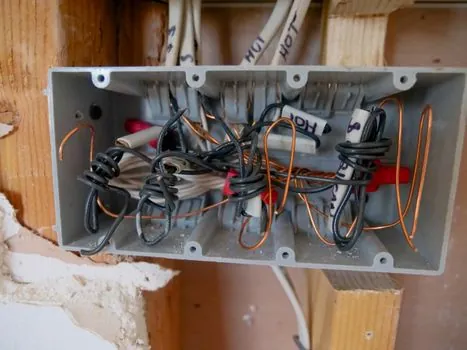
Per-step power rating is the most ignored spec and the most common cause of in-box fires. A typical wire-wound decade resistor is rated at 0.5 W to 1 W per step, but the rating drops when several dials share one current path; a 1 W step dissipating 1 W sits at 45 K to 60 K rise, which is fine in still air but lethal if the box is sealed against a hot enclosure wall. [S2]
Switch contact technology separates the cheap from the usable: silver-plated brass rotary wipers handle 1 A to 2 A at 30 V and cost little, but they tarnish and develop contact resistance drift after a few thousand cycles. Gold- or rhodium-plated contacts in a wiping design stay under 0.001 ohm contact resistance across 100,000 operations and are mandatory if the box is used for low-voltage (< 100 mV) RTD simulation. The next failure mode after contacts is the binding-post-to-internal-wire joint; binding posts with 4 mm banana jacks and a secondary M4 stud for ring lugs are the standard pattern for electrical measurement panels [S1][S4].
Enclosure Rating: IP, NEMA, and Hazardous-Area Fit
For a bench-instrument enclosure in a control room, IP54 (dust-protected, splash-proof) is usually adequate; for a field-mount cabinet on a process skid or near a process-plant enclosure line, IP66 (dust-tight, protected against powerful water jets) is the minimum, and NEMA 4X adds corrosion resistance for offshore or chemical-service builds [S2]. The hazardous-area segment is projected to reach USD 26.60 billion by 2034 at a 6.70% CAGR, which tracks directly to the demand for certified instrument enclosures around the decade box.
If the decade box lives in a Zone 1 or Zone 2 (IEC 60079-10-1) classified area, the enclosure itself must carry the matching ATEX or IECEx certification and the box's switches and binding posts must not become an ignition source. In practice, most calibration teams avoid that entirely by housing the decade box in a certified purge-and-pressurisation cabinet or simply removing the box from the classified area and running a long test lead back to the loop. The wrong move is to drop an uncertified bench box into a Z1 cabinet: the rotary switch is a documented ignition source under [S2].
Mechanical Mounting, Wiring Layout, and Maintenance Access
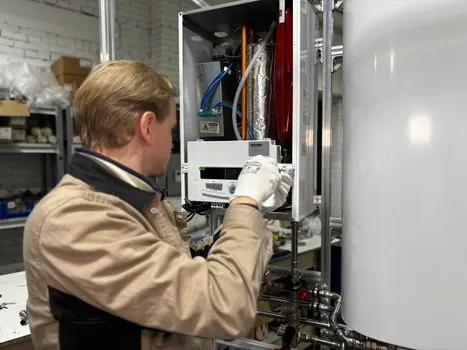
Mechanical integration decides whether the box gets used or ignored. A panel-mount decade box with a 144 mm by 144 mm cutout and a depth under 200 mm fits a standard 19-inch sub-panel cutout with a bezel adapter; the binding posts should be on the front face, not the rear, so the technician can land the test leads without opening the cabinet door. Cable entry from below through PG or metric glands preserves the IP rating; top entry invites water to track down the leads into the posts [S5].
Internal wiring of a decade box to a loop or to a calibration test point should follow twisted-pair, shielded cable with the shield grounded at one end only, to keep common-mode noise out of low-level RTD simulation. A 4-wire (Kelvin) connection is mandatory for sub-ohm simulation; a 2-wire connection adds the lead resistance to every step and turns a 0.1 ohm decade into a 0.3 ohm step. Maintenance-wise, plan for a 5-year recalibration cycle on the 0.1% to 1% box and a 2-year cycle on any 0.05% or better unit, with the calibration certificate kept next to the box inside a clear sleeve on the inner door.
Comparison of Main Decade Box Options Against Decision Criteria
Four realistic options cover most enclosure-build needs, and the choice falls on duty rather than brand. A 4-dial bench box with 1 ohm to 10 kohm range and 1% accuracy suits loop checks on a control-room desk and is the lowest cost entry. A 6-dial 1 ohm to 1 megohm, 0.1% calibration unit covers RTD and thermocouple simulator work and is the workhorse for an instrumentation shop. A 7-dial 1 ohm to 10 megohm, 0.05% lab-grade box with gold contacts belongs in a metrology lab, not on a plant floor. A 6-dial 1 ohm to 1 megohm, 1%, IP66-rated, ATEX-certified field unit is the only one that belongs in a process-skid enclosure in a classified area; everything else must be moved out of the hazardous area before energising [S2][S8].
On cost, expect a 4-dial bench unit near a low three-figure USD price, a 6-dial 0.1% calibration unit in the low four figures, a lab-grade 0.05% unit at the top of four figures, and an ATEX-certified IP66 field unit at roughly two to three times the cost of its non-ATEX twin. On lead time, the bench and calibration units are typically off-the-shelf; the ATEX field unit is built-to-order with 6 to 12 week lead times. The cheap trap is buying a non-ATEX box for a classified site to save the certification premium: the inspector will reject it, and the rework cost is several times the saved budget.
Who the Mainstream Option Is For, and Who Should Avoid It

The 6-dial 0.1% calibration box in a 19-inch panel-mount housing is the mainstream pick for most process-plant loop commissioning teams and most decade resistance box buyers building electrical panels. It hits the accuracy target, fits standard enclosures, and has a spares ecosystem. [S4]
It is the wrong pick when (a) the work is sub-ohm shunt calibration, where a 4-wire Kelvin box with a dedicated 0.001 ohm decade is needed; (b) the work is high-resistance insulation testing above 10 megohm, where a dedicated insulation resistance tester is needed; or (c) the box is destined for a Zone 1 / Class I Div 1 area, where an ATEX-certified unit, remote operation, or a purge cabinet is mandatory. Trying to use a bench box in any of those three duties is a known path to either a failed audit, an inaccurate reading, or a hot enclosure [S2][S8].
Trackable signals for the next quarter: the publication of new ATEX 2014/34/EU guidance on calibration equipment in Zone 1 areas, and the rollout of the next revision of the IEC 61010-031 safety standard for measurement probe assemblies, which governs the test leads that land on the decade box's binding posts. Either of those will force a spec refresh on new enclosure builds between late 2026 and mid-2027.
See also our earlier report, POM material selection for oil and gas: when acetal fails and what to use instead.