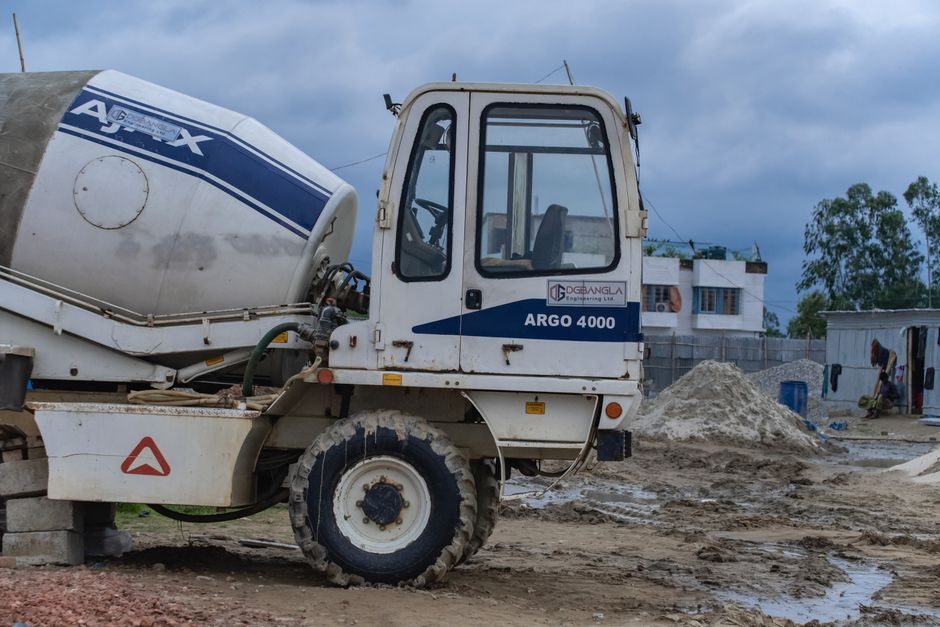
Ready-mix concrete is the default batching route for new K-12 school construction, with suppliers batching to British/European strength classes C20/C30/C40+ and delivering by truck-mixer or volumetric vehicle on a timed rota [S2].
The economic case rests on three engineered attributes: factory-batched consistency, third-party-tested concrete admixture dosing, and on-time delivery that protects placement windows around teaching-term handovers [S1][S2].
Strength-Class Mapping for School Elements
Most ready-mix suppliers in the UK and US match the strength class to the structural element, with C20 specified for non-structural blinding and footings under low loading, C30 for internal floor slabs, driveways and aprons, and C40 and above for structural columns, beams and load-bearing shear walls [S2]. A single-element school build typically pulls at least three classes from the same plant order, so mix design verification is repeated per grade rather than per pour.
For US K-12 work, the equivalent compressive-strength targets are commonly specified in psi (3,000 / 4,000 / 5,000 psi) referencing ready-mix concrete ACI/ASTM mix codes, but the decision logic — light grade for non-structural, mid grade for slabs, high grade for structural frames — is identical to the European C20/C30/C40 pattern [S1][S3].
Plant Capacity, Batch Consistency, and QC Documentation
Ready-mix plants serving school projects run calibrated weigh-batchers and admixture dosing pumps; the supplier signs off each load with a delivery ticket carrying mix reference, batch time, and target strength, and plant laboratories cube-test samples at 7 and 28 days against the concrete batching plant QC records [S2].
For schools, the practical implication is that every pour arrives with a traceable paper trail — useful both for building-control sign-off and for the 50-to-60-year design life audits that local authorities apply to educational estates [S1]. Standard cement types in the US/UK supply chain include Type I/II OPC and CEM II blends; supplementary cementitious materials (fly ash, slag, silica fume) are dosed as standard concrete admixture components to manage heat of hydration in mass school foundation pours [S1][S2].
Site Access, Pump Selection, and Delivery Window
School sites are typically landlocked and surrounded by occupied classrooms, so truck-mixer access is constrained; suppliers offer boom pumps for height/distance pours and line pumps for tight, horizontal runs into basements or internal courtyards [S2]. Boom pump reach commonly runs 24-42 m, with line pumps limited to roughly 80-120 m of pipeline horizontally — numbers that should be cross-checked with the school's own site logistics plan rather than assumed.
Volumetric on-site mixing is the third logistics route and is preferred on multi-day school programmes where placement volumes vary: the mobile mixer carries dry constituents and water/dosing tanks, batching fresh concrete on demand so there is no risk of the load going off before placement [S2]. For a single-phase summer-holiday build, truck-mixer delivery is normally cheaper; for phased or term-time pours, volumetric removes the over-order risk.
Reinforcement Detailing and Crack Control
School floor slabs and playgrounds are typically reinforced with steel mesh or rebar at 150-200 mm centres, and the concrete fiber option (polypropylene or steel fibres at 0.5-1.5 kg/m³) is increasingly specified as a secondary crack-control measure for ground-bearing slabs and pavements [S2]. Macro-synthetic fibres at 4-6 kg/m³ can replace light mesh in some non-structural slabs, but structural suspended slabs in school halls still require conventional bar reinforcement to satisfy design codes.
Joint spacing for school ground-bearing slabs typically follows a 24-30× slab-thickness rule (e.g. 150 mm thick slab → 3.6-4.5 m bay), with saw-cut contraction joints placed within 24 hours of placement. Suppliers will usually quote a finishing crew alongside the delivery, since slab tolerance (typically FM2 / FM3 floor flatness under the Concrete Society TR34 classification) is as much a placing-and-finishing skill as a mix-design problem [S2].
Curing, Weather Windows, and Programme Risk

Curing compounds are sprayed on freshly placed school slabs to retain moisture and meet the 28-day design strength, with the concrete curing compound choice driven by whether the slab will receive a subsequent screed or floor finish [S2]. In UK/US summer pours, ambient temperatures above 25-30 °C force suppliers to add ice to the mix water or dose retarders; below 5 °C, the mix is heated and accelerators used, with pour windows shrinking to late morning.
Mechanical concrete vibrator consolidation is standard for school columns, beams and slab edges — poker vibrators at 11,000-12,000 vpm for columns/walls, beam vibrators for slabs — and the supplier's QC plan usually states the minimum immersion time per lift (typically 5-15 seconds) to avoid honeycombing without over-vibrating the paste [S2]. Hand-vibrated pours are not accepted on school structural work.
Comparison: Ready-Mix Delivery Routes for School Projects
Across the three principal ready-mix delivery routes, the trade-off for schools sits on three axes: lead time, waste risk, and minimum order quantity. Truck-mixed (wet-batch) supply offers the fastest lead time and the lowest minimum order (1 m³), but carries a 90-minute working window before the load begins to slump. Volumetric (mobile) mixing has effectively no working-window constraint but needs 1-2 hours of on-site setup [S2]. Site-batched hand-mix remains the worst option for schools — variable strength, no QC trail, slow output.
Standards and Specifications to Reference

UK school concrete work typically references BS 8500 (concrete — complementary British Standard to BS EN 206), with strength classes C20/25, C25/30, C28/35, C30/37, C32/40, C35/45, C40/50 covering the school-element range. US school work references ACI 318 (Building Code) for structural concrete and ASTM C94 (Specification for Ready-Mixed Concrete) for the supply standard [S1][S2]. Exposure classes (XC1-XC4, XD1-XD3, XF1-XF4 under BS EN 206) drive the maximum w/c ratio and minimum cement content, and must be selected against the school's local environment — coastal sites need chloride resistance, freeze-thaw zones need air entrainment.
For districts standardising their specifications, the National Ready Mixed Concrete Association (NRMCA) in the US and The Concrete Society in the UK publish checklist specifications that can be adopted verbatim by school procurement teams, and Kansas-based suppliers such as Kansas Sand & Concrete explicitly cite ASTM, ACI and NRMCA as governing bodies on their technical pages [S1]. Engineers should pin a single mix-design reference per element type to avoid over-specifying — over-specifying C40+ when C30 would do is a common school-project cost leak.
Who Ready-Mix Suits — And Who It Doesn't
Ready-mix is the right call for any poured element of a new school build — foundations, ground-bearing slabs, structural frames, external aprons and pavements — where a plant-certified mix, third-party cube tests, and timed delivery are required to satisfy building control and the warranty insurer [S1][S2][S3]. It is also the right call for summer-holiday refurbs where concrete must be placed and finished within a fixed 4-6 week window.
It is the wrong call for small one-off repairs (under ~1 m³), where a pre-bagged mix-and-water solution is faster and cheaper, and for very remote sites where the nearest plant is more than 60-90 minutes' drive, since the working window will be exhausted before placement. In those cases, volumetric on-site mixing is the fallback [S2]. Schools with strict same-day-noise curfews (residential neighbours) should also flag the pour window to the supplier up front so pump positioning and truck routing are planned to avoid early-morning complaints.
For hospital work adjacent to schools on a shared campus, the spec bar moves higher — see Specifying Ready-Mix Concrete for Hospital Construction: Mix, Logistics, and QC for the stricter infection-control and vibration limits that apply. Excavation logistics for the school sub-structure typically run alongside the concrete programme; the Excavator Selection for Road Construction: Class, Undercarriage, and Boom Match reference gives the class sizing rules for the bulk dig.
Track next: confirm whether the local building control requires a designated BS 8500 / ACI 318 mix-design reference per element, and lock the supplier's QC plan (cube frequency, slump target, delivery ticket format) into the contract documents before the first pour. Watch the volumetric-vs-truck-mix split on the order — if more than 40% of the programme volume routes through volumetric trucks, the supplier may be running two plants and lead times will extend by 1-2 days.