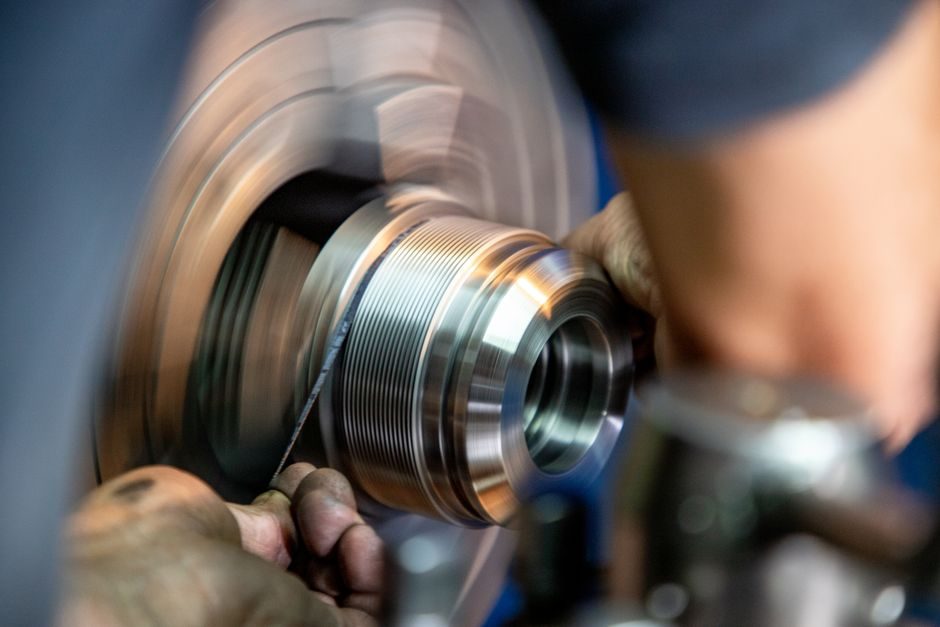
A spherical plain bearing is a matched-inner-and-outer-ring joint whose convex sliding contact carries radial load, axial load, or both, while accepting angular misalignment that would destroy a rolling-element bearing; the 2026 buy decision is dominated by three engineering choices — sliding-surface material, load direction (radial vs. thrust), and whether the part is maintenance-required or maintenance-free [S5][S6].
Spherical plain bearings are distinct from rolling-element bearings: contact is sliding, not line or point contact, so capacity is governed by PV (pressure × velocity) limit and by the tribological pair, not by fatigue life of a raceway [S3][S6]. This is why a procurement engineer who treats a spherical plain bearing like a deep-groove ball bearing — and buys on dynamic load rating Cr alone — will end up with a part that seizes within weeks in a hydraulic cylinder or a king-pin application.
Sliding-Surface Options: Steel/Steel, Steel/PTFE, Steel/PTFE Fabric, Brass
The first gate in a 2026 spherical plain bearing datasheet is the sliding-surface tribopair, and the four practical choices are steel-on-steel with MoS2 treatment, steel-on-PTFE composite, steel-on-PTFE fabric, and steel-on-brass/bronze — each with a sharply different operating envelope [S1][S3][S5][S6]. Steel-on-steel with molybdenum disulphide (MoS2) surface treatment, as supplied in the FLURO GE..AX series, uses 100Cr6 / AISI 52100 bearing steel for both inner and outer rings, hardened, ground, phosphated and MoS2-coated, and is regreasable for high axial load at moderate speed [S3]. The same tribopair shows up in the ACCURATE BUSHING GE series molybdenum-coated offering, which is the workhorse choice for low-speed, high-load pivots in construction and agricultural equipment [S1].
Steel-on-PTFE composite, available as the radial spherical plain bearing to ISO 12240-1 designation GE..-DO-2TS with steel-reinforced PTFE lip seals on both sides, is the standard maintenance-free part for alternating dynamic loads, hydraulic cylinders, and applications where relubrication is impractical [S6]. PTFE-fabric (woven PTFE liner) and PTFE/glass/MoS2-filled PTFE liners extend the PV ceiling and the temperature window; FLURO's High-Performance FLUROglide line and its NIRO stainless range address the food/pharma and marine segments where corrosion and washdown rule out carbon steel [S5]. Brass-backed and bronze-backed spherical plain bearings remain a cost-driven choice for low-duty pivots, but they are not a like-for-like substitute for PTFE at high PV.
Load Direction: Radial, Angular Contact, and Thrust Geometries
The second gate is load direction, and ISO 12240-1 is the geometry standard the buyer must read before quoting a part number, because a radial spherical plain bearing and a thrust spherical plain bearing are not interchangeable even when the bore is the same [S5][S6]. Radial spherical plain bearings carry load perpendicular to the shaft axis and accept angular misalignment, typically ±5° to ±15° depending on series; the GE..-DO-2TS radial type with steel-reinforced PTFE seals is the default series for hydraulic cylinder rod eyes and articulating joint heads [S6]. Thrust (axial) spherical plain bearings, by contrast, carry load along the shaft axis and are used in applications such as swing-post pivots, hydraulic cylinder clevis mounts where axial force dominates, and king-pin thrust take-up; the FLURO GE..AX and the RBC MB series (swivel / metal / thrust) sit in this thrust category [S2][S3].
Angular-contact spherical plain bearings are the third geometry, designed to carry combined radial + axial load at a defined contact angle; this is the type to specify when a rod end sees both a pull-out force and a side load, for example on a hydraulic cylinder with a moment-induced side load. Across all three geometries, bore size, outer width, and ball diameter must be checked against ISO 12240-1 series letters (E, G, W, C, K) that codify the radial/internal-clearance and width envelope — a spec gate that is often missed in low-cost sourcing and shows up as a stack-up error at assembly [S5][S6].
Material, Hardness and Liner Stack: What the Heat-Treat Line Has to Show
Material specification is the third gate and the easiest place for an unbranded supplier to economize; the buyer should pin both ring steel grade and surface treatment, not just "spherical plain bearing" [S3][S4]. For steel-on-steel MoS2-treated parts, the procurement line should call out 100Cr6 / AISI 52100, hardened to roughly 58–62 HRC, ground and phosphated, then MoS2-coated; FLURO's GE..AX datasheet is the reference wording for this [S3]. For steel-on-PTFE maintenance-free parts, the inner ring is typically hardened chrome or stainless steel, the outer ring is hardened steel or stainless depending on environment, and the sliding layer is a PTFE or PTFE-fabric liner bonded to the outer ring groove; MISUMI/INA's GE..-DO-2TS radial type is the catalogue anchor for that construction [S5][S6].
Stainless options (FLURO NIRO, equivalent 1.4301 / AISI 304 or 1.4401 / 316) are mandatory for washdown, marine, and chemical exposures where standard carbon steel would pit and destroy the liner in months [S5]. Surface finish on the raceway, typically Ra ≤ 0.2 µm for the PTFE-liner path and Ra ≤ 0.8 µm for steel-on-steel, is a non-negotiable number in the datasheet if the supplier is serious; Made-in-China sourcing listings rarely quote Ra and that is the first red flag to filter on [S4]. The buy should also pin the PTFE compound: virgin PTFE for low-load, glass-filled PTFE for higher PV, MoS2-filled PTFE for higher temperature, and PTFE fabric for the highest PV ceiling within the PTFE family [S5][S6].
Maintenance Class: Required vs. Maintenance-Free vs. Sealed-for-Life
Maintenance regime is the fourth gate and dictates relubrication interval, grease type, and seal arrangement — three things that the procurement PO has to call out explicitly, because a "spherical plain bearing" without a maintenance class is an ambiguous part [S3][S5][S6]. Maintenance-required (regreasable) steel-on-steel bearings, like the FLURO GE..AX and the ACCURATE BUSHING GE series, accept grease through an axial or radial lubrication feature; typical greases are lithium-based EP2 with MoS2 for slow pivots, and the relubrication interval is set by the PV integral and the contamination load, not by a calendar date [S1][S3].
Maintenance-free PTFE-liner spherical plain bearings, in radial ISO 12240-1 GE..-DO-2TS form, are designed to run dry for the design life with no relubrication; the steel-reinforced PTFE lip seals on both sides keep contamination out, which is why this is the default choice for hydraulic cylinder rod eyes, food-processing pivots, and inaccessible joints [S6]. Sealed-for-life steel/steel bearings exist as a middle path — they ship greased and sealed, with a finite relubrication-free life that the supplier must publish, not hand-wave. A practical 2026 buy rule: if the joint is reachable and the load is high, specify maintenance-required steel/steel with MoS2; if the joint is sealed inside a cylinder or behind a shield, specify maintenance-free PTFE with dual seals; if neither fits, the application is probably wrong for a standard catalogue spherical plain bearing [S5][S6].
Load Rating, PV Limit, and Misalignment Angle: The Three Numbers That Actually Decide the Part

The fifth gate is the engineering numbers the datasheet must publish, and there are three that decide the part: static load rating C0 (or axial static load Ca for thrust types), dynamic load rating C (where it applies), and misalignment angle α, with PV limit as a derived check [S5][S6]. For a radial steel-on-PTFE bearing, the working pressure P is typically capped below roughly 50 N/mm² static and well below that in motion, sliding velocity V is capped in the low-m/s range, and PV (pressure × velocity) is capped by the liner: virgin PTFE ~1.5 N/mm²·m/s, glass-filled PTFE higher, PTFE fabric highest in the PTFE family [S5][S6]. Misalignment angle α is the angular swing the bearing accepts without binding; typical values are 5°–9° for radial series and can reach 30°+ for specialized rod-end series, and the buyer should never assume the catalogue number — read the ISO 12240-1 sheet for the actual figure.
For steel-on-steel MoS2-treated parts, the static load ceiling is much higher than the PTFE family but the sliding velocity ceiling is much lower, so steel/steel is the right pick for slow, heavily loaded king pins and bucket pivots, and steel/PTFE is the right pick for faster hydraulic motion with lower per-unit load [S1][S3][S6]. Temperature window is the sixth number: standard PTFE liners cap at roughly +200 °C continuous, with peaks higher; PTFE fabric extends that, while steel/steel with the right grease handles cold and high-temperature service; FLURO's High-Performance FLUROglide line is built specifically for elevated-temperature and high-PV service [S5]. If a buyer's load/speed/temperature triplet is not on the published PV curve, the bearing is the wrong bearing.
Standards, Sourcing Channels, and the 2026 Price/Cost Levers
Standards discipline is the seventh gate: the dimension envelope should be ISO 12240-1 (radial spherical plain bearings), the thrust series sits under related ISO dimensional sheets, and military / aerospace programmes may call out AS81935 (formerly MIL-B-81935) for rod-end spherical plain bearings, which is a different document tree from ISO and should be checked before the RFQ is sent [S5][S6]. Sourcing channels split into three tiers in 2026: brand-direct from FLURO, RBC, Accurate Bushing, Schaeffler/INA, SKF, NSK, Timken, Aurora, GGB, and Igus; industrial MRO distributors (MISUMI, Grainger, McMaster-Carr in North America; RS Components, norelem, and the FLURO direct shop in Europe); and the Made-in-China direct-from-factory channel for non-safety, non-aerospace general industrial use, where MOQ is typically 1 piece on the listing page and pricing is negotiable [S4][S5][S6].
Price/cost levers in the 2026 buy are, in descending order of impact: sliding-surface material (PTFE fabric > PTFE composite > steel-MoS2 > brass), brand vs. unbranded (FLURO, RBC, INA, SKF sit 3–10× over Made-in-China equivalents on like-for-like bore size), stainless vs. carbon steel (typical 2–4× multiplier), sealed vs. open, and lot size (MOQ 1 is the Made-in-China default, while brand-direct usually requires a pack/box quantity) [S1][S2][S4][S5][S6]. For like-for-like comparison the buyer should always normalize on ISO 12240-1 dimensional series and on published C0 and α, not on photo; for related rolling-element context the encyclopedia entry on ball bearing is a useful contrast, and the broader spherical plain bearing reference is the index page to bookmark. Lead time in 2026 is typically 2–6 weeks for brand-direct catalogue parts and 3–8 weeks for Made-in-China factory orders on non-stock bores, with stainless and PTFE-fabric constructions on the longer end [S4][S5].
Application Fit: Who a Spherical Plain Bearing Is For, and Who It Is Not For

A spherical plain bearing is the right part for any joint that needs angular misalignment plus combined load, and the wrong part for any high-speed, high-precision location job — which is what a rolling-element bearing or a plain journal bearing is for [S5][S6]. Specifically, it is the right part for hydraulic cylinder rod eyes and clevises, king-pin and steering linkages, construction and agricultural equipment pivots, off-highway suspension joints, rolling-mill roll-necks at moderate speed, and slow-speed articulating arms in material handling; it is also the right part where shock load and vibration would fatigue a rolling-element raceway in a few thousand hours [S1][S3][S5].
It is the wrong part for high-speed rotating shafts (use ball bearing or ceramic-bearing hybrid for high-speed machine-tool spindles), for long-life continuous-rotation under constant radial load with no misalignment (use a linear-guide carriage or a rolling-element slewing ring), and for precision positioning under reversing load (use a crossed-roller-guide where stiffness matters more than misalignment). It is also the wrong part if the buyer needs a linear-bearing style stroke in a single axis — spherical plain bearings do not provide constrained linear motion. Decision rule: misalignment + combined load + slow-to-moderate speed = spherical plain bearing; precision location + high speed + long fatigue life = rolling-element bearing [S5][S6].
Specification Checklist and Sourcing Watch-Outs for the 2026 PO
A clean 2026 spherical plain bearing PO should carry, at minimum, the following six lines: ISO 12240-1 series and dimensional code (e.g. GE 30 DO-2TS for a 30 mm bore radial maintenance-free part), sliding-surface material and treatment (e.g. steel-on-steel, 100Cr6, MoS2-treated; or steel-on-PTFE composite, glass-filled), load direction (radial, thrust, or angular contact), static load rating C0 or Ca with the supplier's calculation basis, misalignment angle α, and the maintenance class (required, maintenance-free, or sealed-for-life with relubrication interval) [S3][S5][S6]. Without those six lines, the quote-back is going to be apples-to-oranges.
Sourcing watch-outs specific to the 2026 market: unbranded Made-in-China listings often quote a "GE" prefix but ship a non-ISO 12240-1 envelope, so the buyer's first-sample inspection must measure bore, outer diameter, width, and ball diameter against the ISO sheet before accepting volume [S4][S6]. Brand-direct distributors like FLURO, RBC, and Schaeffler/INA publish ISO 12240-1 dimensional sheets and full PV curves — that documentation is the price premium's value, not the etched name [S2][S3][S5][S6]. For applications adjacent to a spherical plain bearing — pillow block housings, slewing rings, rod-end ball joints, and spring-washer preload stacks — the related 2026 buying guides cover the spec gates that flank this part: pillow block bearing selection covers the housing, self-aligning bearing sourcing covers the rolling-element alternative, and ball bearing selection is the rotation-side reference.