
A356-T6 squeeze cast at 50-150 MPa applied pressure delivers a tensile-strength range of 290-310 MPa with 8-12% elongation, versus roughly 220-260 MPa and 3-7% elongation for permanent-mold gravity cast A356-T6 in published foundry data [S2][S4].
Porosity is the lever: gravity die-cast A356 routinely shows 2-5% microporosity, while squeeze casting pushes porosity below 1%, and that single delta drives most of the fatigue-life gap between the two processes [S2][S5]. For a fatigue-loaded structural component, the squeeze-cast route is the higher-strength option; gravity casting is the lower-cost, faster-cycle option when peak fatigue performance is not on the spec [S2].
Process fundamentals: where the strength delta comes from
Squeeze casting applies 50-150 MPa of mechanical pressure through a hydraulic punch during solidification of molten metal inside a closed, preheated metal die, suppressing shrinkage and gas porosity at source [S2][S3]. Direct squeeze casting pours metal into the cavity and pressurizes immediately; indirect squeeze casting uses a gating system to inject metal before punch pressure is applied; liquid-metal forging is the high-pressure variant that chases near-wrought density [S3]. The mechanism behind the strength gain is twofold: refined dendrites and reduced dendritic arm spacing from faster cooling under pressure, plus mechanical break-up of the dendrites that started growing before full pressure ramp-up, both of which shrink defect size and population [S5].
Gravity die casting relies on gravitational fill of a permanent mold, with no active pressure during solidification, leaving 2-5% porosity as the baseline and capping tensile strength in the 220-260 MPa window for A356-T6 [S2][S4]. Squeeze casting's sub-1% porosity is not a marketing line; it is a direct consequence of die-cavity pressurization maintained until the alloy is fully solid, which physically collapses shrinkage voids [S3]. This is also why squeeze-cast A356 can absorb a T6 heat treatment to higher peak strength than gravity-cast A356, the denser starting structure tolerates the solution-and-aging cycle without blistering at trapped-gas sites [S4][S7].
Mechanical property comparison: A356-T6 squeeze vs gravity
Foundry-published and peer-reviewed numbers for A356-T6 align consistently across the two process routes. A side-by-side, using the data points that are explicitly grounded in the research: [S2]
Property, Squeeze Cast A356-T6 (typical), Gravity Cast A356-T6 (typical): Tensile strength, 290-310 MPa [S2][S4], 220-260 MPa [S2][S4]; Elongation, 8-12% [S2][S4], 3-7% [S2][S4]; Porosity, below 1% at 50-150 MPa applied pressure [S2], 2-5% [S2]; Yield strength, often 200 MPa and above in T6 [S2], typically 150-180 MPa in T6 [S2]; Process pressure, 50-150 MPa hydraulic [S2][S3], atmospheric (gravity only) [S3]; Heat treatment compatibility, full T6 with no blistering at higher strength [S7], full T6 but at lower ceiling [S7].
The reported 47% tensile-strength gain and 33% hardness gain for a high-pressure squeeze-cast Al-Si variant versus its gravity die-cast counterpart is consistent with the A356 envelope above, and it is worth treating as a process-direction number rather than an alloy-specific one [S5]. For comparison, semisolid squeeze cast Al-Si-Cu-Ni (a different alloy system) has been reported at 310 MPa UTS, 169 MPa YS, and 3.8% elongation in the as-cast condition, which is a useful reminder that alloying can push UTS into the 300 MPa zone without T6 [S1].
Why porosity drives fatigue life in A356
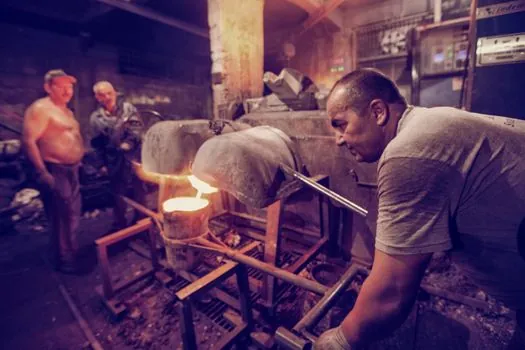
Fatigue cracks in cast aluminum initiate almost exclusively at pores and oxide inclusions, so a 2-5% porosity population versus a sub-1% porosity population produces an order-of-magnitude difference in cycles to failure at a given stress amplitude, not just a 20-30% difference. The 10% coefficient-of-friction reduction and 15% wear-loss reduction measured on a high-pressure squeeze-cast Al-Si alloy versus the gravity die-cast version track the same root cause: fewer and smaller internal defects act as crack-nucleation sites under cyclic load [S5].
Squeeze casting's pressure window, 50-150 MPa, is also the operating range where dendritic refinement is most aggressive, with applied pressure physically breaking dendrites that begin to grow before full pressurization, and with enhanced cooling rate under pressure shrinking the secondary arm spacing [S5][S2]. For fatigue-critical A356 parts, the practical takeaway is to specify both T6 temper and squeeze process in the print, since T6 alone on a porous gravity casting will not close the fatigue gap to a denser squeeze casting in the same temper. Foundry-side guidance for converting existing gravity-cast A356 parts to squeeze-cast A356 is to expect higher post-T6 strength and a more stable strength distribution across a production lot, precisely because the dense starting structure eliminates the porosity-driven variance that plagues gravity castings [S7].
Cost, cycle time, and tooling trade-offs
Gravity casting's equipment cost runs 3-5 times lower than squeeze casting's, with faster cycle times and lower die wear, which is the reason gravity permanent-mold casting still owns the 500-50,000 parts/year structural segment for A356 [S2][S4]. Squeeze casting requires tighter parameter control (pouring temperature, pressure ramp, dwell time) and more robust die materials to absorb the 50-150 MPa load, both of which push tooling cost up and push minimum economic lot size higher [S2][S3].
For an automotive chassis node or suspension arm where fatigue life, not piece price, drives warranty cost, the higher tooling spend of squeeze casting pays back in service; for a non-safety structural cover or housing where static strength is sufficient, gravity casting remains the default [S2]. Squeeze casting also has a near-natural fit for aluminum-magnesium alloys and other Al-Si systems that need high strength and structural integrity, which is why the process has been the default in automotive and aerospace structural nodes since the 1970s [S3]. The cost-versus-strength envelope is summarized in the table below for direct A356-T6 comparison: Criterion, Squeeze Cast A356-T6, Gravity Cast A356-T6: Tensile strength, 290-310 MPa [S2][S4], 220-260 MPa [S2][S4]; Porosity, below 1% [S2], 2-5% [S2]; Equipment cost multiplier, 3-5x baseline [S2], baseline (1x) [S2]; Typical cycle time, longer (press cycle) [S2], shorter [S2]; Best fit, fatigue-critical structural nodes [S2][S3], medium-volume static structural [S2][S4].
Selection criteria: when to pick which process
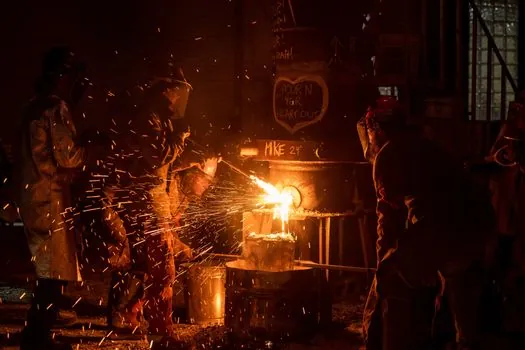
Pick squeeze casting for A356 when the part sees cyclic load, when fatigue life is on the print, when the casting must survive T6 at peak strength without blistering, or when wall-section uniformity under pressure is required for a safety-critical node [S2][S7]. The high-pressure squeeze route is also the right pick when wear resistance matters, since coefficient of friction drops measurably and wear loss drops measurably versus gravity die-cast equivalents at the same alloy [S5].
Pick gravity casting for A356 when the part is a static-loaded structural cover, housing, or bracket; when production volume is in the 500-50,000 parts/year window; when the budget cannot absorb 3-5x tooling cost; or when the application tolerates 2-5% porosity without fatigue-life penalty [S2][S4]. For mixed-spec parts where some regions are fatigue-critical and others are static, the high-pressure variant of squeeze casting with refined dendrites is often the better answer than splitting the part across two processes [S5].
Standards, sourcing, and verification references
A356 is identified as the workhorse alloy for structural gravity castings, and the T6 temper is referenced as the standard solution-and-aging treatment in the foundry data above [S6][S7]. Permanent-mold gravity casting is the A356 baseline process for structural castings, and squeeze casting is the pressure-assisted variant for higher strength and lower porosity at higher equipment cost [S2][S6]. For a related spec-driven selection on the equipment side, the squeeze casting process is detailed in the squeeze casting machine reference, and the baseline gravity process on the gravity die casting machine page, both of which list the operating-pressure and cycle-time windows that drive the cost trade-off above.
For an alloy-process overview that is broader than this A356 comparison, the cast iron reference covers the high-pressure casting decisions in ferrous systems where similar porosity-driven fatigue logic applies. A peer-reviewed datapoint worth pinning: semisolid squeeze-cast Al-Si-Cu-Ni in the as-cast condition reaches 310 MPa UTS, 169 MPa YS, and 3.8% elongation, a useful upper bound when reasoning about what an Al-Si squeeze casting can deliver before T6 [S1].
Trackable signals for the next decision node: (1) request a T6 tensile and elongation test bar from any squeeze-cast A356 supplier and confirm the 290-310 MPa / 8-12% window before locking the print, and (2) ask for an ASTM E647 fatigue-test data sheet or an equivalent S-N curve at the design stress amplitude, since static tensile numbers alone do not capture the porosity-driven fatigue delta that drives the whole process choice [S2][S5].
Related analysis: EMFR vs strain gauge load cell: weigh-off on capacity, speed, accuracy, duty.