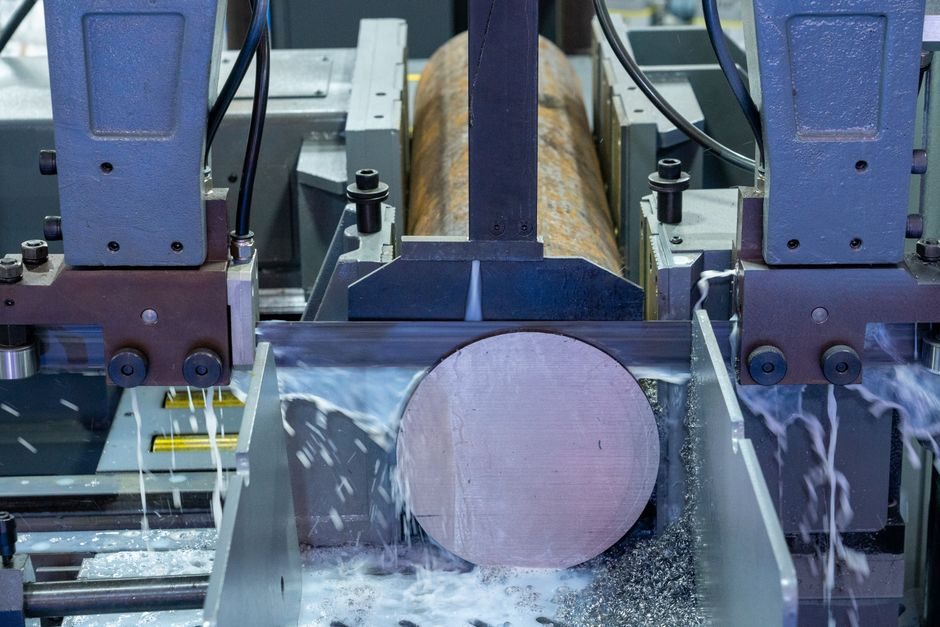
A new squeeze casting machine in the 300-1600 ton clamp-force range lists between roughly USD 25,000 and USD 350,000 FOB in 2026, with the wide spread driven by platen size, intensifier pressure, vertical versus horizontal frame geometry, and whether the press ships with a PLC/HMI control cabinet or a bare hydraulic skid [S1][S4].
Squeeze casting — sometimes called liquid-metal forging — sits between gravity die casting and closed-die forging: molten metal fills a closed die, then a punch applies sustained pressure (typically 50-150 MPa) during solidification, producing near-net-shape parts with mechanical properties approaching wrought stock [S2]. Capital cost is therefore closer to a hydraulic press than to a high-speed cold chamber die casting machine, and operating economics are dominated by cycle time, die life and alloy yield.
Price Bands by Clamp Tonnage and Frame Geometry
Entry-level 300-ton vertical squeeze casting presses for brass inserts and small aluminum housings are advertised in the USD 25,000-55,000 range on Asian B2B catalogs, while mid-range 630-800 ton units with servo-controlled intensification and dual-circuit hydraulics cluster at USD 80,000-150,000 [S1][S4]. Above 1000 tons, a new vertical hydraulic squeeze casting rig with full PLC control, 1250×1250 mm platen and 200 mm stroke typically lists USD 200,000-350,000; custom 1600-ton four-post designs with ejector cushions and closed-loop pressure profiling exceed USD 350,000 before tooling [S4]. Horizontal squeeze casting lines for automotive knuckles and control arms carry a 20-40% premium over equivalent-tonnage vertical presses because of the shot-sleeve, tie-bar layout and billet-handling automation. Process economics depend on the densification gain during solidification: applied pressure shortens the freezing time and collapses gas porosity, allowing tensile and elongation values within roughly 5-10% of the parent wrought alloy [S5].
Specification Stack That Drives the Invoice
Four line items move the quote more than any others. First, clamp tonnage — squeeze casting presses are spec'd 20-40% below equivalent cold chamber die casting ratings because the metal is already largely solidified when peak force is reached, so a 1000-ton squeeze press often replaces a 1500-ton conventional die caster [S1]. Second, platen dimensions and tie-bar spacing — these gate the projected casting area and dominate the steel-content cost of the bed. Third, intensifier pressure and stroke profile: high-tonnage units use a pre-fill chamber plus hydraulic intensifier to reach the 50-150 MPa range without oversizing the main cylinder. Fourth, the control architecture: a relay-logic panel adds a few thousand USD; a Siemens S7-1500 / Mitsubishi MELSEC iQ-R PLC with 10-inch HMI, pressure-time profiling, and traceable shot logging adds USD 12,000-25,000, and is increasingly the default in new builds [S3][S4]. Heating — die pre-heat to 200-300 °C, oil-circulation or electric cartridge banks — is sold as a USD 5,000-15,000 option that most brass and aluminum squeeze casters will not skip.
Standards and Metallurgical Baseline

ASTM B969-2009 is the governing specification for aluminum-alloy castings produced by squeeze casting, thixocasting and rheocast semi-solid casting, and it locks tensile, yield and elongation minimums on alloys A356, A357, A201, 6061 and others commonly run on these presses [S6]. For brass and copper-alloy squeeze castings there is no single ASTM equivalent; buyers typically reference ASTM B584 (copper-alloy sand castings) or B763 (copper-alloy die castings) as a metallurgical baseline, then impose tighter mechanicals via print. Buyers weighing squeeze casting against die casting versus forging should note that squeeze cast A356-T6 typically reaches 230-280 MPa UTS with 5-10% elongation, well above HPDC A380 (160-180 MPa, 1-3% elongation) and approaching forged 6061-T6 (260-310 MPa, 8-12%) [S2][S6]. That property gap is the single most important economic justification for the higher press price.
Operating Cost Levers: Cycle Time, Die Life, Yield
Squeeze casting cycles run 60-180 seconds depending on part mass, alloy thermal mass and die-cooling strategy — slower than a cold chamber die casting machine cycle (30-90 s) but with near-zero porosity scrap and no secondary impregnation [S2]. Raw-material yield runs 90-95% versus 70-85% for HPDC because runner and biscuit are minimized and remelt returns are clean [S3]. Die life on H13 tool steel at 200-300 °C die temperature typically reaches 30,000-80,000 shots before refurbishment, which is the largest variable cost: a full squeeze die set for an automotive knuckle runs USD 25,000-80,000 depending on cavity count and slide complexity. Buyers cross-shopping against vacuum die casting machine lines should expect 10-20% lower cycle time on vacuum-assisted HPDC but higher porosity scrap, so the cost comparison lands on part-mix rather than press price.
Who Should Buy, and Who Should Not
Squeeze casting is the right process for structural aluminum and brass components where fatigue, pressure-tightness or heat-treat response justify the premium: suspension arms, steering knuckles, brake calipers, hydraulic valve bodies, gas-meter housings, and high-integrity electrical enclosures [S2][S3]. It is the wrong process for thin-wall cosmetic parts (use HPDC), for high-volume zinc hardware (use zinc die casting), and for very large castings above the available platen — there, gravity die casting or sand casting win on tooling cost. Shops that need to run both ferrous and non-ferrous alloys are also a poor fit, because squeeze casting tooling, die heating and intensification circuits are alloy-specific; a second alloy typically requires a second press or a major retrofit.
Selection Gate and Total-Cost Worksheet
Three gates filter the shortlist. Gate 1: required clamp tonnage = projected casting area (cm²) × alloy-specific intensification pressure (MPa) ÷ 10, with a 20% safety margin. Gate 2: platen and tie-bar clearance vs. the largest die envelope plus robotic pickup envelope. Gate 3: control system must log shot-end pressure and stroke for SPC on each cycle, otherwise scrap rates climb 2-4% within six months [S1][S4]. Build the total-cost worksheet as: press price (FOB) + die set + die pre-heat + auxiliary melting/holding furnace + installation (10-15% of press price) + commissioning + 10% contingency. For a representative 800-ton vertical squeeze casting cell in 2026, that lands at roughly USD 220,000-380,000 all-in before the first production shot. Tooling-heavy programs — for example, tin bronze plumbing bodies or aluminum suspension arms — should amortize machine and die over 50,000-100,000 shots to keep per-part cost competitive with HPDC plus impregnation.
Buyers who lock tonnage, platen, control and ASTM B969 conformance in the RFQ before negotiating price typically save 10-20% versus open-spec inquiries.