
Squeeze casting applies sustained pressure of 50–150 MPa throughout solidification, collapsing shrinkage and gas porosity to near zero, which lifts tensile and fatigue strength well above conventional HPDC levels [S5][S9].
The trade-off is concrete: HPDC fills in milliseconds at 10–175 MPa injection pressure, enabling thin walls below 2 mm and cycle times suited to high-volume cosmetic parts, while squeeze casting requires sections thicker than roughly 5 mm and longer cycle times [S5]. For automotive structural and hydraulic components, the porosity gap decides the spec; for enclosures and heat sinks, HPDC remains the default.
Process Mechanics: Why the Fill Profile Changes the Porosity Map
Squeeze casting, often called liquid metal forging, pours molten metal into an open die and closes a hydraulic press, so pressure is held over the cavity as the metal contracts; HPDC instead injects at high velocity through a shot sleeve and releases pressure as the cavity fills, which traps gas [S1][S5]. The fill-velocity difference, not nominal pressure, is the dominant variable separating the two processes: HPDC uses turbulent injection that entrains air, while squeeze casting uses slow, controlled, laminar flow that keeps the cavity gas-free [S1][S5].
Direct squeeze casting fills from the bottom of a closed die, giving better heat transfer and stable solidification, while indirect squeeze casting uses a thicker gate and a slower shot than HPDC, but still keeps the metal under press load until solidification completes [S1]. For a deeper reference on the process family, see the die casting overview and the squeeze casting machine page, which cover the equipment envelope and clamping force range.
Porosity Levels and Density in Cast Aluminum
Squeeze-cast parts exhibit almost no shrinkage porosity, with limited inclusions and gaseous porosity, and a fine-grain crystal structure that gives superior mechanical behavior compared with conventional castings [S9]. HPDC, by contrast, has historically struggled with porosity and internal defects caused by gas entrapment during the high-speed injection phase, a problem that becomes severe in thicker sections and in any casting that will see pressure-tightness or fatigue loading [S3][S7].
The density advantage has a practical spec consequence: high-pressure die castings are normally NOT T6-heat-treatable, because the trapped gas expands and blisters the surface, while squeeze-cast parts tolerate T6 without blistering and reach higher post-treatment strength [S5]. The mechanical gap is real for cast aluminum, magnesium, and copper alloys, the three metals most commonly squeeze-cast today, and the same alloy can move from a marginal HPDC part to a T6-qualified structural part simply by switching the process route [S1][S4].
Mechanical Strength: Tensile, Yield, Fatigue, and Elongation

The combination of forging-grade pressure and casting-grade geometry produces components with better finishing and mechanical properties than either parent process; the high pressure and tight seal suppress shrinkage, and the cooling under load produces a denser grain network [S1]. Quantitatively, squeeze castings show higher tensile strength, higher yield strength, higher elongation, and lower porosity than HPDC of the same alloy, and they extend fatigue life because the absence of internal voids removes the crack-initiation sites that limit HPDC under cyclic load [S4][S6].
Comparing across criteria, the squeeze-cast route scores higher on every strength and density axis, while HPDC scores higher on cycle time, tooling cost amortisation, and minimum wall thickness; the only mechanical metric on which HPDC is competitive is surface finish at very thin wall sections, where neither process has a porosity advantage because the section is too thin to entrap large voids [S5][S6]. The result is a clean decision line: if the part is loaded in fatigue, holds pressure, or needs T6, squeeze casting wins; if the part is a cosmetic, non-loaded, thin-wall housing, HPDC wins. For related bearing-load context where porosity-driven crack initiation also matters, see the analysis of shaft key materials under high torque.
Process Selection: Cost, Cycle Time, and Geometry Envelope
HPDC remains the default for high-volume thin-walled parts such as housings, connectors, and heat sinks where tight cosmetic tolerances and cycle time dominate the cost model [S5]. Squeeze casting carries higher equipment cost and longer cycle time, but its near-net-shape output cuts post-casting machining, and most scrap or runner material can be remelted, which keeps material utilisation high on long automotive and aerospace runs [S1][S4].
The wall-thickness rule is hard: HPDC routinely runs below 2 mm, while squeeze casting is generally specified above 5 mm because the slower fill and thicker gate cannot reliably feed thin sections before solidification [S5]. For thin-wall aluminum housings under 2 mm, the HPDC route typically yields a more cost-effective part, even accepting the porosity penalty, while structural knuckles, suspension arms, brake calipers, and hydraulic valve bodies sit firmly in the squeeze-cast window [S5][S3].
Standards, Materials, and Heat-Treatment Compatibility
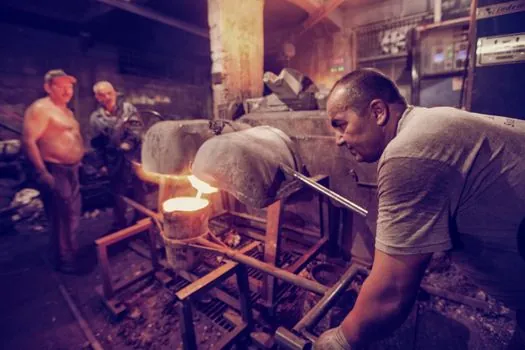
For aluminum structural castings, the T6 blistering limit of HPDC is the single most-cited reason to switch process: the trapped gas in HPDC expands during solution treatment, so conventional HPDC is not specified where AMS 2771 or equivalent T6 temper is required, whereas squeeze-cast parts can be T6-treated in the same furnace cycle [S5]. Aerospace and defense applications, which require exceptional tensile strength, fatigue resistance, and dimensional accuracy, are therefore a structural market for squeeze casting and a deliberate exception for HPDC [S3].
On materials, squeeze casting accepts the same ferrous and nonferrous alloy range that gravity die casting uses, including aluminum, magnesium, copper, and selected steels, which gives it broader alloy coverage than many other casting routes [S1][S4]. For foundries deciding between gravity die casting and pressure-fed routes, the die casting die and aluminum die casting machine reference pages outline the tooling envelope and clamping-force bands that bound each process choice.
Failure Modes and Common Spec Mistakes
The most common spec error is selecting HPDC for a part that will see pressure cycling or T6, then discovering porosity-driven leakage and surface blistering in the qualification stage; this shows up most often in hydraulic manifolds, brake calipers, and EV motor housings, where the design intent is structural but the cost model pushed the part into HPDC [S3][S5]. The reverse mistake, specifying squeeze casting for a thin-wall cosmetic housing, drives cycle time and unit cost up without a strength return, because the porosity advantage is irrelevant in a non-loaded cover [S5].
Another recurring failure is assuming that vacuum-assisted die casting closes the gap to squeeze casting on density; vacuum HPDC reduces gas porosity but does not eliminate shrinkage porosity during solidification, so it improves pressure-tightness but does not reach the T6-blister-free envelope that squeeze castings deliver [S6]. For heat-treatment-bound structural parts, squeeze casting or a semi-solid forming variant remains the only reliable route among the two processes compared here [S3].
Decision Matrix and When to Choose Each
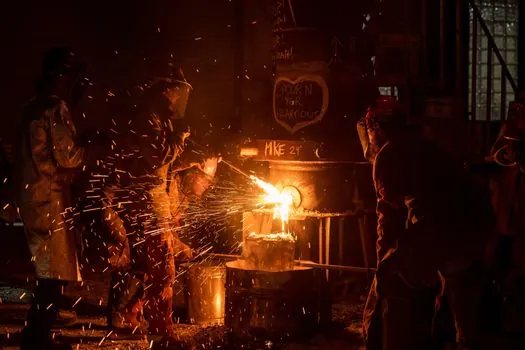
Across the four decision criteria that matter on a casting RFQ, the squeeze casting route leads on internal soundness, mechanical strength, and heat-treat compatibility, while HPDC leads on cycle time, tooling cost, and minimum wall thickness; the tie-breaker is always the loading condition of the part [S5][S6]. A useful spec-side rule: if the part must pass a pressure-tightness test, reach a T6 temper, or carry cyclic fatigue load, route it to squeeze casting; if it is a thin-wall, high-volume, non-loaded housing, keep it on HPDC [S3][S5].
Trackable signals for 2026 sourcing: vacuum-assisted HPDC cell counts continue to grow in EV battery-housing lines, but squeeze casting capacity remains constrained for safety-critical knuckles and structural nodes, so lead times on squeeze-cast tooling above 800 t clamping force are the first bottleneck to watch; cycle-time benchmarking data published by automotive foundries in 2026 will be the next comparison point, alongside the next revision of the major OEM internal casting standards.