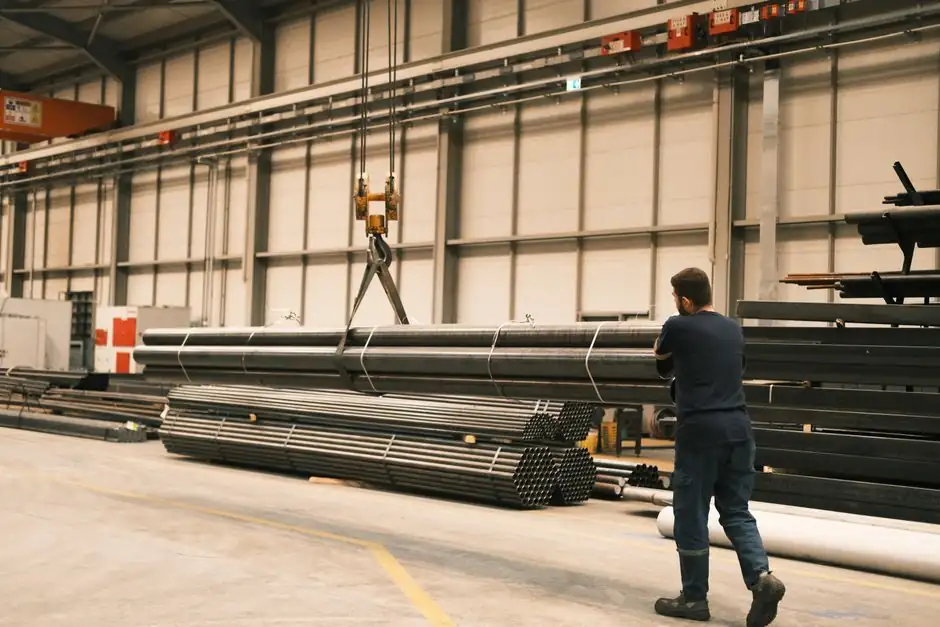
Steel masts dominate fixed-pallet stacker cranes up to 148 ft tall and 1.65 t per load, while aluminum masts cut mast-section mass by 50 to 70 percent at equivalent rating, with the practical crossover falling near the 22,000 lb capacity class [S4][S5].
Specifying mast material for an AS/RS stacker crane means weighing deflection behavior, corrosion exposure, and the structural demands of a vertical column that runs the full warehouse height, not just generic construction machinery economics.
Where Steel Wins on the Mast
Steel delivers higher stiffness and a tighter strength ceiling: portable steel gantries span 500 lb to 150,000+ lb rated capacity, well past the practical ceiling for portable aluminum at 22,000 lb [S4].
For a mast specifically, that stiffness matters because the column carries combined bending from the lifting carriage, torsional input from travel acceleration, and lateral loads during fork extraction. Single-mast pallet stackers from Interlake Mecalux, model MT-1 through MT-5, reach 59 to 148 ft installation height with up to 1.65 t single-deep and 1.1 t double-deep permitted load, traversing at 722 ft/min with 2 ft/s² acceleration and 104 °F ambient, or down to -22 °F in cold storage [S5]. Those numbers are realistic with a steel mast; matching them in aluminum would push the section modulus (and the moving mass at the top of the column) sharply higher.
Failure mode also differs: an overloaded steel beam stays visually stiff, then snaps in catastrophic failure, while an overloaded aluminum beam deflects progressively, hits yield, and shows permanent set as a visual overload indicator before any drop event [S3]. In a manned warehouse, that benign-failure signature is a real safety argument, but it presupposes the mast has been designed with enough reserve that the operator actually sees the bend in time.
Where Aluminum Earns the Mast Slot
At comparable load rating and size, an aluminum gantry weighs 2.5 to 3 times less than its steel counterpart, a mass ratio that translates almost directly to a stacker crane mast when the same aluminum alloy profile section is substituted [S3].
That mass reduction does three things on a stacker crane: it lowers the moving mass the bottom-rail and upper guide-rail drives have to accelerate (improving energy per cycle), it cuts the peak vertical load the foundation slab sees, and it lets the upper guide rail be lighter because the lateral mass coupled to it is lower. Corrosion is the other big lever: anodized aluminum alloys showed little surface change over 30+ years of salt-spray testing in British Aluminum lab work cited by REID, and BS EN ISO 12944-2 Category 5/6 sites will strip 80 to 200 µm/year off low-carbon steel without coating maintenance [S3]. A cold-storage AS/RS running at -22 °F with intermittent condensation, or a coastal distribution center, is the textbook case for an anodized aluminum mast or a steel mast with a documented coating program.
Patent EP2161237A2 from the stacker-crane IP record makes the same point structurally: in stacker-crane geometries where some members see lower load, designers specify lighter aluminum sections with smaller cross-section to cut total mass, accepting lower per-member strength for a lower overall system weight [S9].
Decision Matrix: Steel Mast vs Aluminum Mast

The four criteria that actually move a mast material decision: rated payload, installation height, environment, and whether the crane is fixed or relocatable. [S1]
On rated payload, steel takes anything above 22,000 lb; aluminum covers the 1,100 to 22,000 lb portable band with model series up to a 22,000 lb flagship [S4]. On installation height, the Interlake MT-1 to MT-5 steel-mast family reaches 148 ft at 1.1 to 1.65 t; aluminum masts in this height range are uncommon because the section would balloon, and moving that mass up a 100 ft+ column at 217 ft/min lift speed becomes the limiting design constraint [S5]. On environment, anodized aluminum or coated steel in salt-spray, chemical-exposure, or sub-freezing warehouses with condensation is the safer bet, since BS EN ISO 12944-2 Category 5/6 corrosion rates erode 80 to 200 µm/year off unprotected low-carbon steel [S3]. On mobility, aluminum wins for relocatable stacker-crane masts because a 50 to 70 percent mass cut eliminates the crane-truck erection step that fixed steel masts always require [S4].
Deflection, Standards, and What the Codes Actually Say
Aluminum beams deflect more visibly under the same load than steel beams, and the operator sees the bend before any permanent set, a soft-failure signature with no load drop; steel beams stay level longer, then fail suddenly, a hard-failure signature with a dropped load [S3].
On the standards side, both materials fall under ASME B30.17 (overhead and gantry cranes) and OSHA general-duty rules in the US, with CSA B167 and CSA S157 added for Canadian aluminum structures and CSA W47.2 covering aluminum welding certification; steel welding follows CSA W47.1 or the equivalent US code [S4]. The deflection limits and fatigue checks inside those standards are written so the material-specific behaviour is built into the design factor, not bolted on, which is why a steel-to-aluminum section swap is not a like-for-like calculation.
Real Warehouse Scenarios
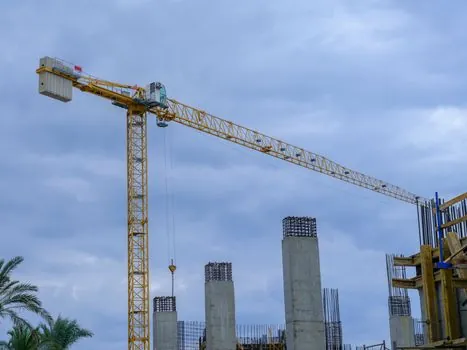
A 100 ft+ fixed pallet AS/RS at 1.65 t per load, running 24/7 in an ambient or cold-storage distribution center, is still a steel-mast job: the MT-3 to MT-5 envelope is the published reference, with 722 ft/min travel and 2 ft/s² acceleration as the design point [S5].
A relocatable miniload AS/RS or a light-duty pallet crane under 22,000 lb in a coastal or chemical-exposure site is the aluminum-mast case, where 50 to 70 percent mass reduction, anodized corrosion performance over 30+ years of salt-spray data, and elimination of the crane-truck erection step all line up on the same side of the ledger [S3][S4]. For a deeper look at the structural choice between single-mast and twin-mast configurations that sits on top of this material decision, see this single-mast vs twin-mast VLM extractor spec-driven selection walkthrough, and for the alloy-pricing angle that swings a steel-versus-aluminum decision on large AS/RS programs, the alloy surcharge mechanics reshaping mold base steel buying note tracks the same steel-mill index logic.
What This Means for the Next Spec
Two trackable signals to watch on the next AS/RS bid: whether the OEM publishes a deflection curve at 1.5x and 2x rated load for the mast material offered (aluminum suppliers increasingly do, steel suppliers rarely do), and whether the bid documents a BS EN ISO 12944-2 corrosivity category with a corresponding coating or anodizing spec for the mast section, since this is the most commonly omitted line item in fixed-steel AS/RS awards. [S3]