
Split tubular housings are formed by rolling two half-shells and bolting them together along flanged seams, a construction that exposes the screw, flighting, and bearings for cleaning and inspection without cutting the casing, per KWS Manufacturing [S1][S4].
Solid (non-split) tubular housings are rolled from a single cylindrical sheet and continuously seam-welded, and KWS specifies them for inclined runs over 15 degrees, weather-tight service, and any application that must hold internal pressure inside the screw conveyor [S4].
Housing Geometry, Fabrication, and CEMA Baseline
Both styles share a common CEMA baseline: S. Howes ships its standard split tube and solid tube models with 7-gauge trough plate and 1/4 inch flighting, exceeding CEMA component standards for medium-duty service [S3][S5]. Solid tube shells are produced by rolling plate and continuously welding the seam, or by cutting standard spouting or pipe to length, which is the lowest-cost path when no field access is needed [S4]. Split housings are rolled as two half-shells with formed flanges on each cut edge, then bolted into a rigid assembly; this adds flange hardware, gasket material, and a second fit-up step, but it also eliminates the welded longitudinal seam that would otherwise have to be cut and re-welded every time the internals are opened [S1][S4].
KWS ships troughs and tubular housings in carbon steel, abrasion-resistant steel, hot-dipped galvanized, and stainless steel, and can roll any commercially available metal, so the split versus solid decision is independent of the alloy choice [S4]. For context on the broader conveyor family, see the screw conveyor reference page for naming, components, and CEMA torque classes.
Cleanout Access, Washdown, and Sanitary Service
Quick-access hinged covers are the headline benefit of split tube designs, reducing cleanout and maintenance time compared with solid tube construction where the casing stays closed [S1]. S. Howes pairs the hinged cover with a bottom cleanout for washdown drain, gasketless housing for full washdown, FDA and USDA approvable material options, and finishes up to #4 or higher for sanitary lines [S3]. S. Howes' published sample list for split tube units includes powdered milk, ground meat, batter, flour, pigments, cosmetics, and food-grade chemicals, all of which are changeover-heavy or allergen-sensitive [S3].
Solid tube housings are still preferred where the goal is pure containment: the continuously welded circular shell inherently isolates powder, odor, and dust from the room, and KWS documents their use for weather-tight service and for holding internal pressure inside the conveyor [S4]. Tubular drag-style conveying on S. Howes equipment is described as significantly more robust than flexible tube conveyors, with a tight auger-to-trough clearance that eliminates the U-trough dead space and supports single-product, long-life service [S5].
Sealing, Filling Rate, and Inclined Performance
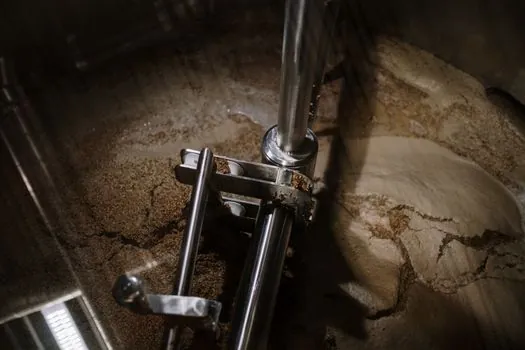
U-trough conveyors allow a higher material filling rate and a higher unit-length capacity, but their many joints and removable cover plates limit sealing, so dust leakage is a known risk in dusty service, per Jierda Environmental's comparison [S2]. Solid tubular housings sacrifice some of that filling rate to gain complete enclosure, dropping the fill factor slightly at the same screw diameter and speed to keep material from compressing against the pipe wall [S2]. The structural payoff is real: the circular section has higher rigidity and strength than a U-trough, so solid tube housings are KWS's default for inclined runs over 15 degrees, where fall-back of bulk material would otherwise stall a U-trough [S4].
Split housings sit between the two: the bolted flanges are potential leak paths, so they are normally specified where the access benefit outweighs the small loss in hermeticity, and where the run stays horizontal or only mildly inclined, so fall-back is not a controlling limit. For high-angle layouts and dust-tight or pressurised service, the welded solid tube remains the conservative call [S2][S4].
Comparison Matrix: Split Tube vs Solid Tube Housing
The four criteria that drive almost every selection meeting are summarized below, using only data drawn from the research [S1][S2][S3][S4][S5]:
1. Access for cleanout: split tube adds hinged covers and bottom cleanout for tool-free washdown; solid tube requires cutting or unbolting end sections to reach the screw, per KWS [S1][S4].
2. Sealing and dust containment: solid tube continuously welded shell wins; split tube flanges are bolt joints, gasket-dependent, and better suited to indoor or mildly dusty service, per Jierda [S2].
3. Inclined conveying capability: solid tube is the KWS-specified choice above 15 degrees of incline because of rigidity and fall-back reduction; split tube is normally limited to horizontal or low-incline layouts where access matters more than angle [S4].
4. Cost and fabrication time: solid tube is cheaper to fabricate because it is a single rolled and seam-welded cylinder; split tube adds a second roll, two flange formings, bolt holes, and gasket hardware, but it eliminates the field cost of cutting and re-welding for every cleanout, per KWS [S1][S4].
5. Material and finish options: identical on both styles, carbon steel, AR steel, hot-dip galvanized, or stainless steel, with sanitary finishes up to #4 available on split tube models from S. Howes [S3][S4].
Matching Housing Style to Material Behaviour and Use Case
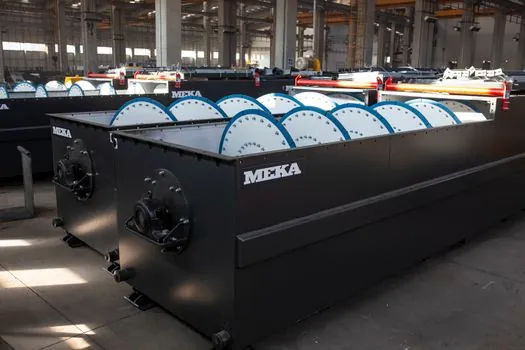
For sticky, viscous, or allergen-prone bulk solids that need frequent washdown and product changeover, S. Howes recommends the split tube, listing powdered milk, ground meat, batter, flour, pigments, and cosmetics as standard split tube applications [S3]. For single-product, long-life service with rare changeovers, including dry chemicals, resins, regrind, plastics, pellets, grain, salt, carbon, and rare earth minerals, S. Howes positions the welded solid tube as the economical and robust choice [S5].
For inclined runs over 15 degrees, weather-exposed outdoor service, or any conveyor that must hold internal positive or negative pressure, KWS specifies solid tube and supplies ASME coded tubular housings for pressure-vessel service [S4]. Drive selection matters alongside housing choice, and the shaft-mount versus end-mount screw conveyor drive decision walks through the torque, speed, and guarding trade-offs that interact with housing access. Belt and chain alternatives are covered separately for plants that need to move the same bulk solids without an enclosed auger, see belt conveyor and chain conveyor for layout and maintenance comparison baselines.
Standards, Codes, and Specification Discipline
CEMA component standards govern the dimensional and load baselines for both housing styles, with S. Howes' standard models explicitly exceeding CEMA for 7-gauge troughs and 1/4 inch flighting [S3][S5]. KWS offers ASME coded tubular housings for any application where the casing becomes a pressure vessel, which is a separate code path from the conveyor mechanical standard and must be called out on the datasheet [S4]. Sanitary split tube units from S. Howes can be configured with FDA and USDA approvable contact surfaces, continuous or ground-smooth welds, and finishes up to #4, all of which are option list items, not baseline [S3].
Specify housing material separately from housing style: carbon steel for general bulk solids, abrasion-resistant steel for high-wear minerals, hot-dip galvanized for outdoor corrosion, and stainless steel for food, pharmaceutical, or washdown service, per KWS [S4]. Do not pair a split housing with an internal pressure or vacuum requirement, the bolted flange joints are not designed as pressure-retaining seals, and that case belongs on a continuously welded solid tube with ASME code stamp [S4].
Decision Rule and Watch-Items for the Next RFQ

Pick split tube housing when the dominant constraint is cleanout time, allergen or contamination control, and frequent product changeover, and the run is horizontal or below 15 degrees of incline. Pick solid tube housing when the dominant constraint is dust containment, weather exposure, internal pressure, or inclined conveying above 15 degrees, and access can be sacrificed for sealing and rigidity [S1][S2][S4].
Two signals to track on the next RFQ: confirm whether the OEM is offering ASME coded shells for any pressurised run, and confirm whether the split tube quote includes FDA or USDA approvable welds and a #4 finish if the line is food or pharma, since both are option-list items rather than baseline features [S3][S4].