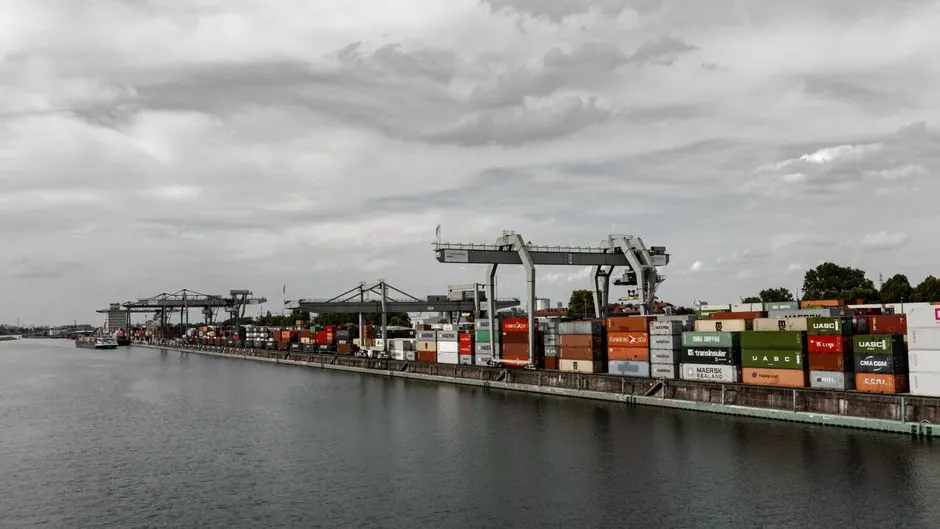
Apparel distribution centers running in single-deep FIFO mode typically deploy a stacker crane with a 1,000-1,650 kg unit load on a rail-guided mast, paired with selective pallet racking to keep pick faces open for SKU-velocity items [S3][S9].
The global stacker crane market is forecast to reach USD 16.03 billion by 2035, growing at 6.85% CAGR (2025-2035), with the e-commerce and retail-fulfillment verticals driving the bulk of the apparel-channel demand per the Market Research Future report dated 2026-08 [S10]. For a 10,000-30,000 SKU apparel operation, the crane choice, aisle width, and storage-depth strategy usually set the throughput ceiling for the next decade.
Crane Topology vs. Apparel SKU Profile
Single-mast unit-load cranes handle pallet loads up to 1.65 t and dominate mid-rise apparel DCs, while double-mast variants add rigidity for >30 m lifting heights and are common where cartons are stacked 8-10 high [S3][S9].
For mini-load cartons in a hanging-garment back-up, a single-mast mini-load crane running a telescopic fork typically serves SKUs under 50 kg in totes or shallow trays; pharmaceutical and electronics lines share this topology because of narrow-aisle geometry, but apparel can stretch to 200-300 kg per tray when pre-packed merchandise returns are processed [S3]. The Swisslog Vectura platform, which has accumulated nearly 4,000 installed units globally since its 1979 automated release, is the benchmark reference for unit-load pallet stacker cranes in high-bay warehouses [S1].
Aisle Width, Storage Depth, and Throughput Math
For seasonal apparel overflow, a double-deep crane paired with selective-plus satellite shuttles can lift site capacity by 40-60% versus a single-deep layout on the same footprint, but FIFO breaks down: any apparel line that needs first-in rotation (new-season style drops, dated perishables like cosmetics bundles) should stay single-deep [S3]. Where every pick face must remain addressable, a unit-load AS/RS built on a trilateral head (Matco's reference build) is a current standard, exchanging a few milliseconds per cycle for the ability to handle non-standard pallet footprints common in retail apparel [S2].
Load Capacity, Lift Height, and Drive Selection
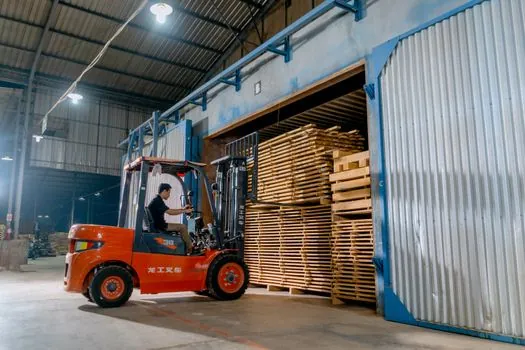
Standard pallet stacker cranes cap at 1,000-1,650 kg per unit load with lift speeds of 1-2 m/s horizontal and 0.5-1.0 m/s vertical; SEW-Eurodrive's MAXOLUTION package routes the same drive electronics family across small-parts and pallet warehouses, which simplifies spare-parts holding for mixed apparel DCs [S6][S9].
Where the apparel mix shifts to long, awkward items (curtain rods, display mannequins in crates, rolled textile racks), ICAM's MAXI STC long-materials stacker crane handles load units from 10 to 23 ft in length with dual simultaneous extraction and 400+ storage positions, a topology worth considering for the home-textile side of a fashion DC [S8]. High-bay Spacesaver industrial stacker systems (Pro Stak, MAX-RAK) target the same vertical-density envelope, typically 8-12 m, for back-of-house retail storage rooms that feed store replenishment [S5].
Apparel-Specific Decision Matrix
Choose single-mast unit-load (1-1.65 t) for: standard GOH (garments on hangers) cartons and totes, single-deep FIFO, ceiling 8-15 m. Choose double-mast unit-load (>1.65 t) for: palletized bulk buys, ceiling 15-30 m, double-deep LIFO. Choose mini-load single-mast (<50 kg) for: hanging-garment reserve picking, e-commerce each-pick, deep-lane storage. Choose long-materials (10-23 ft) for: rolled fabric, fixture, and home-textile overflow lines [S2][S3][S8][S9].
For a typical 15,000-SKU apparel DC with 70% carton reserve and 30% hanging reserve, a 2-crane single-deep unit-load aisle (1.65 t, 12 m lift) plus a 1-crane mini-load aisle is a defensible baseline; doubling to 4 unit-load cranes plus 2 mini-loads scales to roughly 60,000-80,000 SKU without changing topology, only crane count and rack length [S2][S3]. Hanging-garment handling itself is best served by a separate overhead conveyor or garment-on-hanger (GOH) rail system, so the stacker crane fleet should be specified for carton and reserve-pick duty, not for direct GOH extraction [S3].
Limitations, Failure Modes, and Integration Risk
Stacker cranes do not handle non-standard footprints gracefully; mixed-SKU apparel with odd carton sizes will need trilateral heads or satellite shuttles, both of which add 10-20% to capital cost and demand tighter racking tolerances, typically ±5 mm on rail alignment [S2][S3].
Cycle-time figures assume the WMS is integrated with the crane's S7/Profinet or equivalent PLC layer; standalone stacker cranes without a WMS handshake tend to underperform manual reach-truck fleets by 20-30% in mixed-velocity apparel environments, which is the core critique raised by AutoStore's 2023 review of the format and a useful sanity check before capex sign-off [S4][S7]. A pallet stacker on the inbound dock, by contrast, is a complementary tool for staging pallets before they enter the crane aisle, not a substitute, since the crane owns the storage slot and the pallet stacker owns the floor-level buffer [S2][S3].
Standards, Safety, and Sourcing Anchors
Relevant safety anchors include EN 528 (rail-dependent storage and retrieval equipment, safety), EN ISO 13849-1 (safety-related parts of control systems, PL performance levels), and FEM 9.341 (crane duty classification); these govern the rail geometry, emergency-stop architecture, and drive-sizing calculations any specifier should demand from the OEM before contract. [S5]
Vendors to shortlist for a 2026 build: Swisslog (Vectura, [S1]), Interlake Mecalux (pallet cranes, [S9]), Matco Material Handling (trilateral, [S2]), ICAM (long-materials MAXI STC, [S8]), SEW-Eurodrive (MAXOLUTION drives, [S6]), and Spacesaver (Pro Stak/MAX-RAK, [S5]). For carton and packaging automation downstream of the crane aisle, the specifier's path typically continues into a carton erecting machine line, where throughput targets must match the crane's net pick rate, not its gross travel rate.
Trackable signals for the next 6-12 months: published quarterly unit-shipment data from the Material Handling Institute (MHI) for the AS/RS product category, and any 2026-Q4 vendor announcements on Vectura-class energy-recovery options that will reset the cents-per-pallet-stored benchmark set by Swisslog's 50-year-old platform [S1][S10]. Specifiers should also confirm with each OEM whether the proposed drive package is rated for the local mains voltage, harmonic distortion, and ambient temperature of the apparel DC, and whether a power distribution upgrade sits inside the crane's capex envelope or outside it.