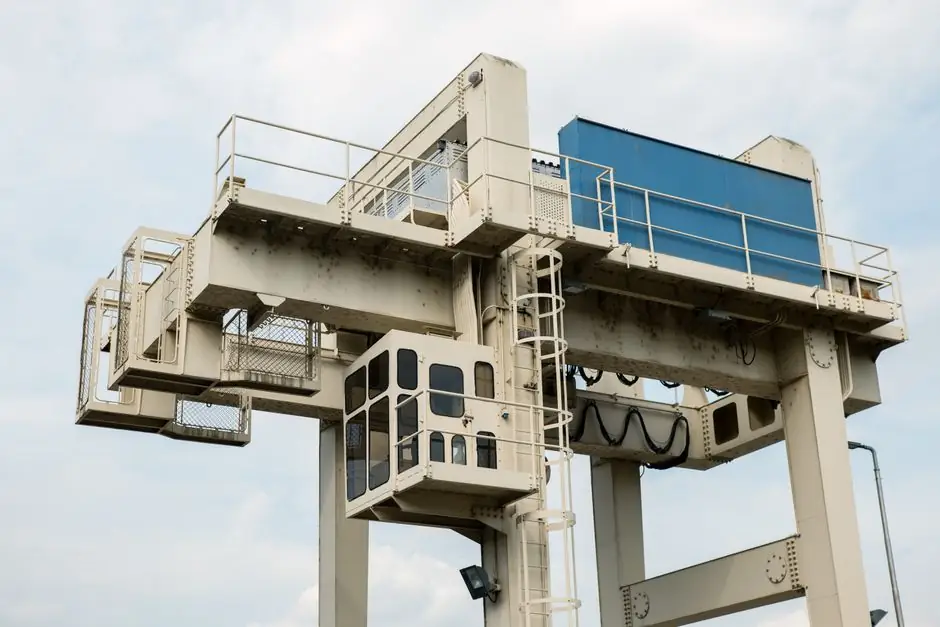
A modern single-mast stacker crane can travel horizontally at up to 160 m/min unloaded and hoist vertically at 66 m/min unloaded, dropping to 54 m/min when carrying a 1,000 kg class pallet, with both axes motion-blended under the warehouse control system rather than sequenced [S1].
Those two numbers are the headline spec, but the engineering reality is that combined travel-plus-lift in one vector, not either axis in isolation, is what defines a crane's effective cycle time, and that combined motion is the reason pallet AS/RS still wins on vertical density while shuttle systems win on raw moves-per-hour [S3][S5].
What simultaneous travel and hoist actually means
A stacker crane executes three independent motion axes along one aisle: longitudinal travel along the floor rail, vertical lift on the mast, and transverse fork extension into the rack. When the WCS issues a storage or retrieval command, the travel and lift axes run in parallel so the load follows a diagonal trajectory to the target X-Y cell, rather than traversing the full aisle length and then the full height in sequence [S1]. This composite move is the standard operating mode in every high-bay pallet AS/RS; it is not an optional feature, it is the only way to keep S/R cycle time in the 30-60 second band that justifies a 30+ m tall building.
The trade-off is kinematic. Peak travel and peak lift cannot both be sustained at the same time when the load is heavy, because the hoist motor on a single-mast crane sized for a 1,000-1,650 kg pallet has to derate as the carriage moves. Mecalux publishes the derate explicitly: 66 m/min hoist empty versus 54 m/min hoist loaded on the same crane [S1]. Travel does not derate the same way on a single-mast, because the horizontal motor is sized for the empty crane mass plus load and the rail friction term dominates, so the 160 m/min number is a no-load envelope that the loaded crane still approaches within a few percent.
Headline speed ranges from the actual product datasheets
The numbers that show up on OEM datasheets are not identical across vendors, and the gap is real engineering choice, not marketing noise. The table below lines up the documented envelopes from four published sources, all of them in the public domain, all of them stated as maximum values rather than typical operating setpoints: [S2]
<strong>Single-mast pallet stacker crane speed envelopes (manufacturer-stated maxima)</strong><br>Source 1: Mecalux, pallet stacker crane product page, 160 m/min travel, 66 m/min hoist empty / 54 m/min hoist loaded [S1].<br>Source 2: Interlake Mecalux MT-series, single-mast pallet, 722 ft/min travel, 217 ft/min lift (approx. 220 m/min and 66 m/min), 2 ft/s² (0.6 m/s²) acceleration on both axes [S2].<br>Source 3: Inform International comparison piece, up to 240 m/min travel on heavy-pallet stacker cranes in high-bay AS/RS [S3].<br>Source 4: Lodige air-cargo stacker crane, 150 m/min travel, 30 m/min lift, 1,500 mm telescopic fork extension [S7].<br>The Interlake figure converted is roughly 220 m/min, which is materially higher than the 160 m/min on Mecalux's current pallet page; the 240 m/min figure from Inform is again higher and the Lodige cargo unit trades lift speed (30 m/min) for compact mast design suited to air-cargo ULD handling. The 30 m/min lift on a 150 m/min travel crane is a structural choice, not a performance gap: the cargo crane has a heavier telescopic fork and a shorter lift envelope.
Acceleration, not just top speed, sets the cycle
Top speed only matters for the time the crane spends at cruise; the rest of the cycle is acceleration and deceleration. The Interlake MT-series datasheet quotes 2 ft/s² (0.6 m/s²) on both travel and lift axes [S2], and that number is broadly representative of single-mast pallet cranes in this class. At 0.6 m/s² a crane needs roughly 4.4 seconds to reach 160 m/min and another 4.4 seconds to stop, so for any single-axis move under about 13 m the crane never reaches its catalog speed at all, which is the usual case in a real warehouse where the average cell-to-cell distance is 5-8 m horizontally and 3-6 m vertically.
This is why combined-cycle S/R rates in production rarely exceed the 30-60+ dual-command cycles per hour per aisle range that AS/RS designers use as a first-pass sizing assumption. Shuttle systems publish 200-1,000+ movements per hour per aisle [S5], but the comparison is not apples to apples: a shuttle move is a single-axis horizontal transfer inside one level, while a stacker crane cycle is a full X-Y plus fork-extend move that may cover 20+ m of combined path. Vendors and integrators quote both numbers against their own baselines, so the right way to read them is moves-per-hour per aisle at a stated aisle length and load weight, not in isolation.
Single-mast vs twin-mast: why the speed gap exists
Single-mast and twin-mast stacker cranes split the speed-versus-load trade differently, and the split is structural. A single-mast crane uses one vertical column with the carriage riding on it, which keeps mass low and lets the travel and lift motors be sized for faster acceleration, so it wins on cycle time for light unit loads (1.1-1.65 t per Interlake's MT-series spec) [S2]. A twin-mast crane uses two columns with the carriage bridging them, which adds rigidity and lets the hoist carry heavier or taller loads, at the cost of top-end speed and acceleration. Interlake's MT-1 through MT-5 single-mast models are explicitly optimized for installations up to 148 ft (45 m) tall with pallet weights in the 1.1-1.65 t band, which is the same 45 m height ceiling that Mecalux publishes for its current stacker crane line [S1][S2].
Mast count interacts with the speed question in another way: in a very tall aisle, the lift axis dominates cycle time because the vertical distance is large and the hoist motor is the bottleneck. That is why mini-load (box) AS/RS, which uses a lighter single-mast crane for totes, can publish substantially higher cycle rates than pallet AS/RS, and also why a single-mast pallet crane will routinely out-cycle a twin-mast unit of the same height class on light loads.
Operating envelope: temperature, aisle width, load
The published speed numbers only hold inside the operating envelope, and the envelope is narrower than the marketing implies. Standard stacker cranes are rated for ambient operation down to -22 °F (-30 °C) for cold-store work [S1][S2]; below that, grease viscosity, steel contraction on the mast, and condensation on the rail all push the integrator to derate acceleration. Aisle width is the other hard limit: Mecalux publishes a 1.5 m minimum aisle, and at that width the crane's sway margins under emergency stop shrink enough that the integrator usually caps travel acceleration below the 0.6 m/s² catalog value, which in turn drops the effective cycle rate.
Load is the third derate. The 66/54 m/min hoist split on Mecalux's published spec is a load derate, not a choice [S1]. Going from empty to a 1,000 kg class pallet drops hoist speed by about 18%. Going to a 1,500 kg pallet, the upper end of the MT-series single-deep permitted load, drops it further on most OEM curves, though vendors do not always publish the second derate step. The result is that a 30 m tall aisle running 1,500 kg loads at full storage depth will deliver a real-world cycle rate that is 20-30% slower than the same crane running 800 kg loads to near-by cells, and that gap is purely kinematics, not controls.
How this connects to a wider materials-handling decision
The reason this speed question matters in 2026 is that the choice between a stacker-crane aisle and a shuttle-based aisle is no longer a pure-density-versus-throughput trade. Inform International's 4-way shuttle comparison frames it as flexibility versus vertical dominance, with the stacker crane winning on heavy-pallet high-bay work and the shuttle system winning on modular, scalable throughput [S3]. GoASRS's 2026 buyer guide reaches the same conclusion from the other side: shuttle ASRS is the better fit when the operation needs high throughput and fast order response, crane ASRS is the better fit when it needs very high vertical storage density and stable pallet movement [S5].
For a working engineer, the practical reading is that the 160 m/min and 66 m/min numbers on a datasheet describe the upper bound of what the kinematics can deliver in an empty, warm, full-speed aisle, and the realistic cycle rate for a 30-40 m tall pallet AS/RS running 1,000-1,500 kg loads lands in the 30-60+ dual-command cycles per hour per aisle band, with shuttle ASRS at 200-1,000+ single-axis moves per hour per aisle on the same site [S5]. A useful next node is to ask the integrator for the cycle-time-versus-aisle-length curve at your actual average cell distance and load, not the catalog top speed, because that curve is what determines whether the AS/RS is sized correctly for the WMS transaction profile.
Spec-level background on the components involved: stacker crane, time relay, and pallet stacker.
Related analysis: Dielectric Sensor Choices for Epoxy Cure Monitoring: Frequency, Geometry, and Integration.